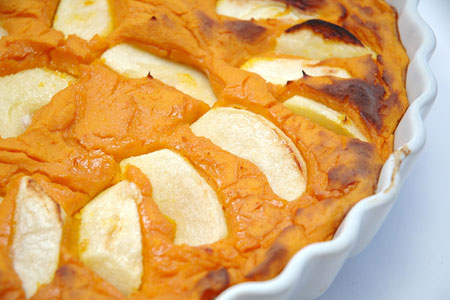
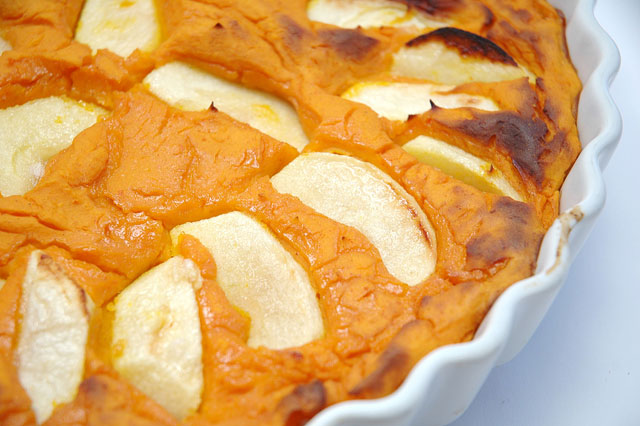
(The 10 year anniversary of JustHungry is at the end of this month. To commemorate this event I’m highlighting some of my favorite posts from the archives. This very healthy squash pudding or crustless pie would make a very good side dish for Thanksgiving dinner. It's vegan, so anyone can enjoy it without worry! It is not that sweet - probably less sweet than many traditional side dishes. I hope you give it a try! Originally on published November 19, 2007, and tweaked a bit since. If you want this to be gluten-free, choose an appropriate type of miso. The miso adds a small but critical bit of umami and richness.)
You know how certain diehard carnivores react to words like 'vegan' 'no dairy' and, gasp, 'tofu in a sweet dish'. There's no reason to tell them that all of these phrases are applicable to this smooth, creamy baked squash pudding, until they've actually eaten and enjoyed. It even is devoid of white sugar, though it is sweetened with maple syrup. The simple combination of creamy squash pudding, flavored and sweetened with real maple syrup with the pure sweetness of the squash shining through, and sweet-sourness of the apples works perfectly together. (The tofu merely adds the creamy texture; you don't taste it at all.) It's rich, but rests very lightly on your stomach - not a bad thing after a heavy main course.
Filed under:
dessert fall sweet tofu vegan squash thanksgiving
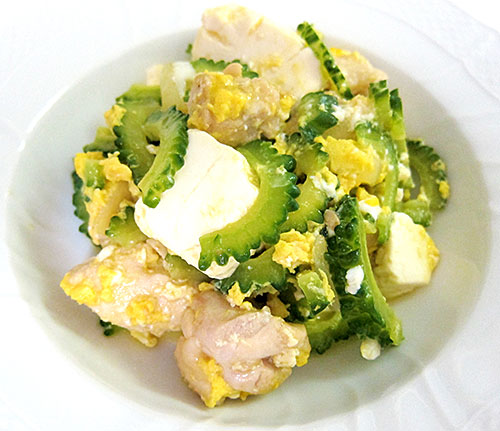
About bitter gourd or bitter melon, called nigauri in Japanese and goya or go-ya- in Okinawan. Plus, a recipe for the most homey of Okinawan dishes, goya chanpuru or champuru.
Filed under:
japanese tofu summer pork okinawa eggs

There are several Japanese recipes that I take so much for granted that I'm sure I've uploaded to this site already...but I haven't. Shira-ae or shiraae, a classic tofu paste that was born from the Zen Buddhist vegetarian cuisine called shojin ryouri, is one such recipe.
It's often described as a 'dressing', but that doesn't adequately describe its thick, rich texture. It's usually mixed with various shredded vegetables, but there's nothing stopping you from mixing it with poached and shredded chicken, or ham, or toasted pine nuts, or anything you like. The rich taste comes from ground sesame seeds and a touch of miso. The key to the texture is to drain the tofu very well.
Filed under:
japanese tofu vegan washoku shojin
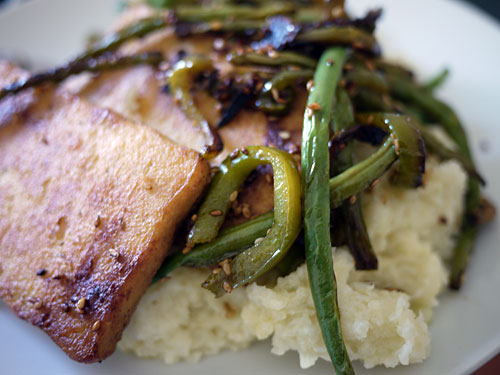
A low-carb, vegan lunch experiment.
Filed under:
vegetarian tofu vegan low-carb diabetes
Submitted by maki on 30 April, 2010 - 09:16
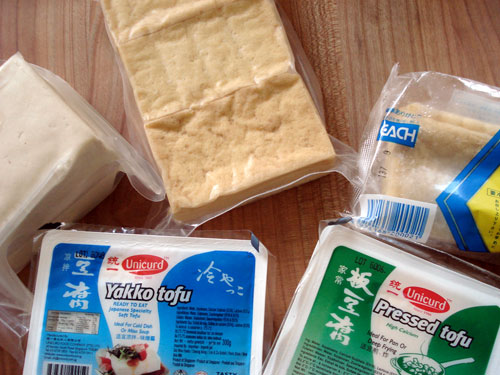
(Periodically I like to dust off an article from the vast Just Hungry archives, give it a little facelift, and present it on the front page again. I wrote this guide to tofu back in September 2008. I think it will answer most, if not all, your questions about Japanese-style tofu and related products. Enjoy!
There are several tofu recipes both here in Just Hungry as well as on Just Bento, and I've even shown you how to make your own tofu from scratch. However, up until now I have never really tried to explain the differences between types of tofu, when to use them and how to store them. Well now is the time to fix that.
Type:
feature Filed under:
japanese ingredients vegetarian tofu vegan
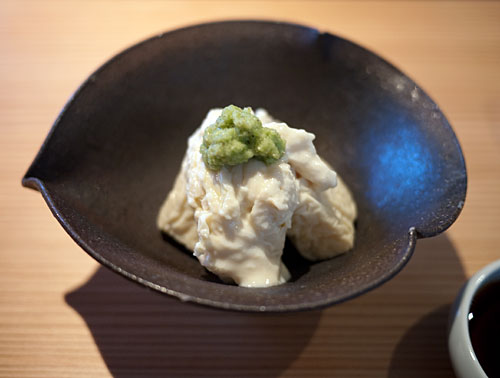
When you go to Kyoto, you must have at least one tofu meal. It's just the way it is. Fresh tofu in Japan is far better than it is anywhere else, and the tofu in Kyoto is generally held to be the best in the country. This is generally attributed to the skill, refined court and/or temple-influenced culture and the quality of the local water. Whatever the reason, to most Japanese people Kyoto means tofu, and vice versa. A visit to a fine Kyoto tofu restaurant is very likely to convert even the most die-hard carnivore into a tofu fan.
During my week in Kyoto, I was able to pursue one family business's vision of what tofu should be from beginning to end. Kamo Tofu Kinki, a company that's been in business since 1834, makes tofu and related products in two tiny workshops located in the Gion Kiya-cho area of Kyoto. Later on, I visited Sosoan, the tofu restaurant owned and operated by Kinki for a multi-course tofu feast.
Filed under:
food travel restaurants tofu shopping japan kyoto cool stuff from japan
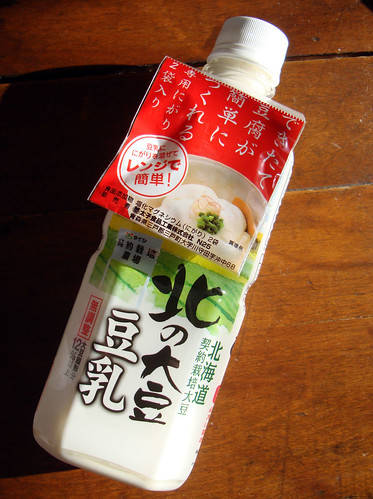
During my stay in Japan, I thought I'd feature some cool stuff (or things that you all may find cool) that I've seen. Here is a bottle of soy milk or tounyuu (豆乳) that I got at a shop in the local Tokyuu line train station (or in other words, it's not like a special brand or anything).
Filed under:
food travel japanese tofu shopping japan
Submitted by maki on 29 January, 2009 - 16:04
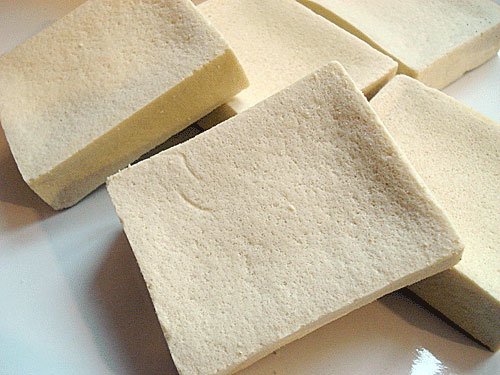
I've talked a little about kohya dofu or kouya dofu (高野豆腐)in the past, but I thought I'd describe it in detail so that I can refer back to it when I use this very versatile Japanese pantry staple in recipes.
Kouya dofu is freeze dried tofu. It's a long lasting pantry staple of most Japanese households.
Type:
feature Filed under:
japanese ingredients vegetarian tofu vegan
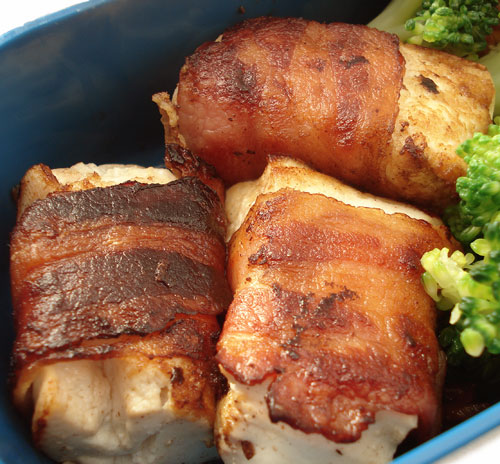
Bacon. Tofu. Two proteins on the opposite ends of the food social scale. One is revered, serenaded, hailed as the food of the Gods. The other is reviled, sneered at, as being bland, boring, even disgusting.
When I saw this conflict depicted as bendable figurines (via Serious Eats) I had to do something to end this conflict.
The only reason why tofu is put down is because of its mishandling by well meaning but unskilled cooks who focused only on its healthy benefits. There are plenty of Westerners who hate tofu, but you'd be hard put to find many Asians who do. That is becase in eastern Asian cuisines, tofu is infused with other flavors, as it should be.
So, back to the bacon and tofu. This is actually not an uncommon dish in Japanese households. It's called either just bacon tofu (or tofu bacon) or even bacon tofu steak. The salty bacon-ness of the bacon infuses the bland tofu, and the two marry together to become a tasty morsel that's good hot or cold. It's salty-crispy on the outside, soft on the inside. (Yes, it's good for bento, and it will feature in one shortly.)
Filed under:
japanese tofu bacon
A question I get asked a lot is where to find the stainless steel tofu mold/press shown in action in my tofu making article. While I don't have a ready online source for something like that yet, I have seen plastic molds, which should be just as handy.
For example here's one sold as part of a tofu press kit on eBay. You can also search on "tofu kit" on eBay for other results.
Filed under:
tofu shopping
Pages

 Welcome to Just Hungry, where we serve authentic Japanese recipes and more! I'm