basics

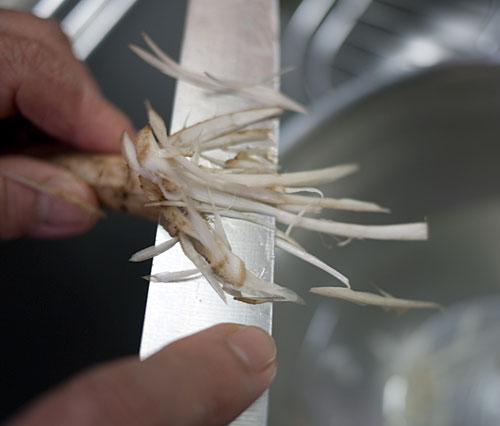
How to cook taro root or satoimo

satoimo1.jpg

How to prepare that hairy looking beast, the taro root or satoimo. continue reading...

filed under

Cooking whole dried soybeans

soybeans1.jpg

Until fairly recently I had a blind spot when it came to the humble soybean. I regularly consume soy products like soy milk, tofu and okara, not to mention fermented soybean products like natto and tempeh. And green soybeans or edamame are always a great snack.

But for some reason, I didn’t really get into eating the whole dried (and cooked) soybean. It’s not that they are that much harder to cook than other dried beans either.

In any case, I’ve rectified that situation and now I cook up a batch of soybeans quite regularly and store them in the freezer. Plain boiled soybeans are amazingly delicious, and just packed with nutrition. The cooking liquid is so rich that it can be used as a very nutritious stock or dashi for making soups and such.

There are a couple of points to watch out for when cooking whole soybeans, which are noted below in copious detail. continue reading...

filed under

How to cook lotus root (renkon)

renkonnegiitame.jpg

Lotus root (renkon in Japanese) is actually the rhizome of the lotus plant. It’s a popular vegetable throughout southern and eastern Asia, but it’s still not that well known in the west. Lotus root is full of fiber and various vitamins and other nutrients. In Asia it’s believed to have various medicinal qualities, but in macro-nutrient terms it’s best to think of it as a starchy vegetable, like potato. Visually of course, it’s very appealing with all those little holes. Here I’ll explain how it’s prepared and eaten in Japan. continue reading...

filed under

Basics: Cold soba noodles with dipping sauce

soba1.sidebar.jpg

Most of Japan gets very hot and humid in the summer. To combat the heat, a number of dishes meant to be eaten cold have been developed. One of the main cold summer dishes is cold noodles.

Soba noodles, made of soba (buckwheat), are available all year round but are really popular when the heat turns unbearable. As with other cold noodles, they are prepared in a way that may seem strange if you’re used to pasta and other Western-style noodles. Unlike pasta, most Japanese noodles, including soba, are rinsed rather vigorously in cold running water. This not only cools them down but gets rid of excess starch, which adversely affects the flavor of the noodles. Many recipes written in English omit this critical rinsing step: you don’t just plunge it in cold water, as many directions incorrectly state, but you actively wash the noodles. Once you’ve done this once, you will definitely notice the difference. I’ve given detailed instructions for this procedure below.

Dipped into a properly made sauce or soba tsuyu, with plenty of spicy condiments or yakumi, there’s nothing more refreshing to eat on a hot summer evening. continue reading...

filed under

Vegetarian / Vegan dashi (Japanese stock)

mizudashi.jpg

As I’ve stated many times here over the years, the basis of most Japanese savory foods is a good dashi, or stock. Dashi is not just used for soups, it’s used for stewing, in sauces, batters, and many, many other things.

The regular way to make dashi was one of my first entries on Just Hungry. It uses kombu seaweed and dried bonito flakes (katsuobushi). Some people use niboshi, small dried fish, in addition to or instead of bonito flakes.

Katsuobushi and niboshi are both fish-based, so not vegetarian. So how do you make a good vegetarian, even vegan, dashi? continue reading...

filed under

Basics: Kaeshi, soba and udon noodle soup or sauce base

kaeshi.jpg

When the weather gets warmer, we eat a lot of cold Japanese noodles: soba (buckwheat noodles), hiyamugi (thin wheat noodles), so-men (even thinner wheat noodles), Sanuki udon (thick wheat noodles- Sanuki is the name of a region famous for udon) and harusame (bean or ‘glass’ noodles). For most cold noodle dishes a salty sweet soy sauce based soup or dipping sauce called mentsuyu is used. You can buy pre-made mentsuyu concentrate, but to me most of them taste too sweet or are overwhelmed by a too-strong MSG or similar artificial tasting umami flavor. Making mentsuyu at home from scratch is not so difficult, and the difference in taste is quite worth the little extra effort.

The base of mentsuyu is a mixture of soy sauce, sugar and mirin called kaeshi (or hon-gaeshi: hon means “real” or “authentic”). It can also be used as a flavoring base for many other things. You just need good quality dark soy sauce, white sugar, and good quality mirin. It keeps for months in the refrigerator, or even in the freezer (where it will stay liquid) so I like to make as big a batch as I can afford to price-wise and fridge-space-wise.

This is similar to the Japanese essence mix, but doesn’t include the kombu seaweed or bonito. If you are a vegetarian you can use kaeshi safe in the knowledge that it’s totally vegan, and combine it with a vegetarian stock. Kaeshi also lasts a lot longer since the basic ingredients are indefinite keepers.

I’ll be talking about cold noodles and such in upcoming posts, so if you’d like to follow along, you may want to make some kaeshi to be ready.

This is a very traditional basic recipe. continue reading...

filed under

Poached and marinated pork (Nibuta)

nibuta1_300.jpg

With summer just around the corner, I like to think of food that can be made well ahead and tastes great served cold, or at least cool, to keep me out of a hot kitchen. The vegetable part of this is usually taken care of with seasonal vegetable salads and the like. If the protein part means meat, I like to have pre-cooked pieces tucked away in the freezer.

One of my favorite cold meats is poached and marinated pork, or nibuta. (Ni means to cook in liquid, and buta is pig.) It’s very easy to make, stores beautifully in the refrigerator for about a week or much longer in the freezer, and of course, tastes great - savory, slightly sweet, and very juicy. It can be sliced very thinly or julienned for one-dish meal salads or in sandwiches, or chopped up and added to stir-fries, wraps, and so on. It’s a great addition to a bento box. It can be cubed or coarsely ground and used instead of char siu (roast pork) in steamed buns or bao. The possibilities are only limited by your imagination.

There’s one unusual ‘secret ingredient’ in the poaching liquid, umeboshi or pickled plum. You can omit this if you like, but adding just one umeboshi seems to de-fat the meat a bit more than just poaching, plus making it taste a bit cleaner and fresher in an interesting way. continue reading...

filed under

Basics: Tamagoyaki or Atsuyaki Tamago, Japanese sweet omelette

tamagoyaki2.sidebar.jpg

Tamagoyaki is such a integral part of Japanese food that I am rather kicking myself for not having posted a recipe for it before here. The name tamagoyaki means “fried egg”, and the alternate name, atsuyaki tamago, means “thick fried egg”. (Some books or restaurants erroneously called it just tamago, which just means “egg”.) A slightly sweet, moist square-shaped egg concoction, tamagoyaki is a bento box staple, as well as being a popular sushi neta (topping). It’s also great as a side dish for any meal.

You don’t really need a special tamagoyaki pan for making this. A regular small non-stick frying pan will do. The one advantage of having a small tamagoyaki pan like this one is that the size is good for making small, thick tamagoyaki without using extra eggs. Conversely, a big square tamagoyaki/atsuyaki tamago pan is used for making those thick tamagoyaki served at better sushi restaurants. (Cheap sushi places use manufactured tamagoyaki, which is an abomination.) However, I’m assuming most people are likely to own a small frying pan, so that’s what I’ve used for the photos here. The one I have is an ordinary (pretty cheap) Tefal model that I got at a sale somewhere.

Once you get the hang of making the multilayers of egg, it’s very easy to do. A 2-egg tamagoyaki takes less than 5 minutes to cook, and a 4-egg one just a bit more. 4 eggs is the maximum that’s practical to cook in a 20cm / 8 inch standard frying pan.

I prefer my tamagoyaki to not be too sweet so there isn’t much sugar in this - I’ve seen recipes that add up to 3 tablespoons for 4 eggs. You can add more or less to your taste. continue reading...

filed under

Soy sauce based dipping sauces used in Japanese dishes

A lot of Japanese dishes are quite subtly flavored to start with, and are eaten dipped in a simple soy sauce based dipping sauce. You’re probably familiar already with the wasabi + soy sauce combination used for most kinds of sashimi and sushi, but there are a few others. Which sauce goes with which dish really seems to depend as much on tradition as anything, though certain combinations just fit better than others. The ratio of flavoring to soy sauce is a matter of personal taste in most cases.

Whenever using a dipping sauce, try not to dunk whatever you are eating into it. The common sushi eating mistake made is to dunk the rice side into soy sauce - this not only makes the rice grains go all over the place, often down your front, but absorbs way too much soy sauce. Turn the sushi over and dip the fish just a bit instead. (I tend to think that this rice-dunking is why a lot of the finer sushi restaurants nowadays serve their sushi pre-seasoned, needing no dipping.)

Here are the most commonly used dipping sauce combinations: continue reading...

filed under

roux step 1

roux step 1
filed under

Related sites

(I am on MySpace, Facebook, LinkedIn and things but I never use them....)

Food Destinations

food destinations button

Food Destinations is on hiatus, but it may return. More about Food Destinations...

Causes we support

wfp banner img
freerice234_60_Banner2.jpg

Hello!

Just Hungry is a site about Japanese food and home cooking, healthy eating, the expat food life, and more. [log in] or [register]

About this site

maki Just Hungry is a site about food. There are lots of recipes and much more. You may want to take the grand tour, read about Just Hungry, or contact the site owner, Makiko Itoh. To dive in real deep, try the site map.

Sharing!

  • tech-fav-1.gif
This article is from justhungry.com.