
Botamochi for spring, Ohagi for fall: Sweet Japanese rice and bean cakes
[From the archives: Today (September 23rd) is the first day of the fall o-higan (お彼岸), when ohagi or botamochi are offered to ones ancestors, as well as oneself! My mother and my grandmother always made these at home around this time of year - I love their not-too-sweet stickiness. O-higan ends on the 26th, so if you like wagashi, why not give these a try? Originally published March 2007.]
 The seven days centered around the bi-annual days of the vernal equinox is a Buddhist festival period known as higan (or o-higan for the honorific term) in Japan. The fall (autumn) higan is aki no higan, and the spring higan is haru no higan. Since the day of the spring equinox is March 21, we're about to enter the haru no ohigan period.
During haru no higan, a sweet confection called botamochi is eaten. The mochi part means sticky, pounded rice, and the bota part comes from botan, or the tree peony. Botamochi is supposed to ressemble a tree peony flower.
During the autumn equinox (aki no higan or simply (o)higan)) period, a very similar confection called ohagi is eaten. This is supposed to look like a hagi or bush clover flower (Latin: Lespedeza thunbergii). Botamochi and o-hagi look the same to me, even though a hagi flower looks nothing like a tree peony flower, but the good old ancestors were probably a lot more imaginative than I am.
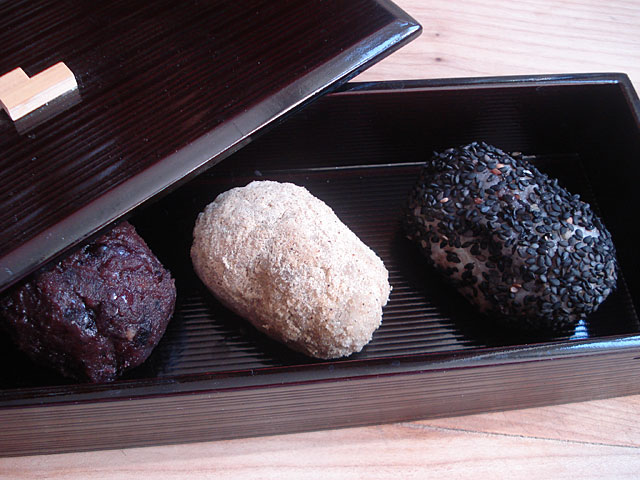
Botamochi and o-hagi are made of sticky rice and sweet tsubuan, 'chunky-style' sweet azuki bean paste. They are a bit fiddly to make but not difficult, especially if you use one of my favorite cooking helpers, plastic cling film. Since these are best eaten freshly made, it's well worth the effort to make them at home if you like bean-based Japanese sweets. You can adjust the amount of sugar in the tsubuan to your taste. Here I have made three variations: coated with black sesame seeds; coated with kinako (toasted soy bean powder); and the most traditional form with the rice cake wrapped in a layer of the tsubuan.
Botamochi or Ohagi: Sweet Japanese rice and bean cakes
 This makes quite a lot of botamochi/ohagi about 2 inches / 5 cm or so long. If this is too much, halve the ingredients. They also freeze very well - see Notes below.
By 'cup' here I mean the measuring cup that comes with a rice cooker, which has a capacity of 180ml. As long as you keep the same proportions you can use larger (e.g. American size, which is about 220ml) cups too.
For the mochi part:
- 1 cup regular white uruchimai or Japanese / japonica rice (the kind used for sushi and so on)
- 2 cups white mochimai or sweet rice (see Looking at Rice if you're confused about which rice is which. You cannot substitute any other kinds of rice for this.)
- About 2 cups of water (or the amount indicated for your rice cooker)
The tsuban:
- 1 batch of tsubuan
The kurogoma or black sesame coating:
- 3-4 Tbs. black sesame seeds
- 1 Tbs. superfine white sugar
- pinch of salt
The kinako coating:
- 2-3 Tbs. kinako (available at Japanese groceries and some healthfood stores)
- 1 Tbs. superfine white sugar
pinch of salt
Extra water for forming the dumplings
Equipment needed:
- rice cooker (you can cook the rice in a pot, but a rice cooker is much easier)
- plastic wrap / cling film (however you call it in your neck of the woods)
The day before, wash the rice well, and wash and sort the azuki beans. Soak the azuki beans and the rice (separately) in enough water to cover, overnight or at least 8 hours. Drain well.
Make the tsubuan following these directions.
Cook the rice in a rice cooker in the normal way, with the indicated amount of water for 3 cups of regular rice.
In the meantime, toast the sesame seeds in a small frying pan until the seeds begin to pop. Remove from the pan into another bowl and mix well with the sugar and salt.
Mix together the kinako and the sugar and salt in another bowl.
While the rice is still warm not not burning hot anymore, put it in a large ziplock plastic bag. Close the zip, pushing out as much air as possible. Pound the rice and squeeze it and knead it until it's sort of half-crushed (it's mostly paste but you can still see some rice grains in there). This state is called hantsuki, or half-beaten, mochi. Let cool a bit in the bag.
Divide the mochi into 24 or so equal pieces.
To make the kinako-coated dumpling: flatten a piece of mochi on a sheet of plastic wrap, trying to make the edges a bit thinner than the middle, with moistened fingers. Put a teaspoonful or so of tsubuan in the middle. Carefully gather up the mochi around the filling (just like you'd do with onigiri) to form a sort of oval-shaped ball, completely enclosing the tsubuan filling. (This oval shape is called tawara-gata, or rice bale shape.) Roll the dumpling well in the kinako-mix. You may need to roll it 2 or 3 times since the kinako tends to sink in to the rice.
Make the sesame coated dumplings in the same way. To make the sesame stick better you may need to lightly moisten the surface of the dumpling.
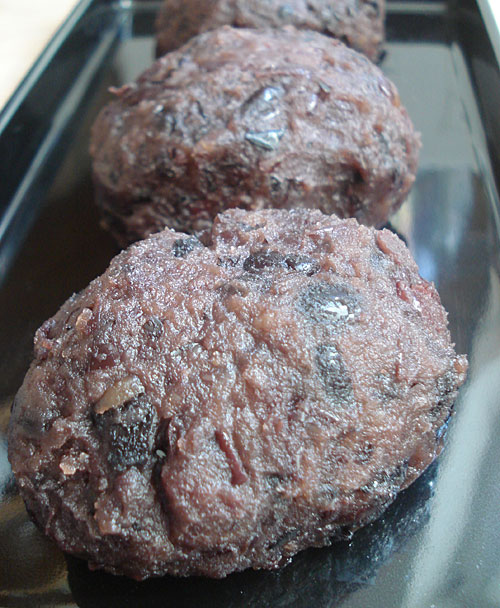
To make the tsubuan-coated dumplings, make a small oval-shaped ball with the mochi. Spread some tsubuan on a piece of plastic wrap, and gather up the plastic to make a ball. If the dumpling looks funny you can adjust it a bit after unwrapping it from the plastic wrap.
Serve with green tea, preferably while gazing at some beautiful spring (or fall) scenery.
Notes
In the photo at the top, I've presented the botamochi in a lacqured black wooden box. In the second picture the dumplings are on a black ceramic plate. Black seems to suit these better than white.
The traditional way of making this half-beaten mochi is to grind it in a suribachi, but the pounding on the plastic bag method is much easier, requires no cleanup and lets out your aggressions. (Web developers: imagine it's a difficult client's face and punch away.)
These do not keep well in the refrigerator since the rice hardens up, so keep in a cool place until it's time to eat them. They can be frozen successfully though: just wrap them individually in plastic wrap, and defrost at room temperature or nuke in the microwave for about a minute per dumpling (depending on the wattage of your microwave).
I find that adding a bit more salt to the tsubuan for this makes the dumplings tastier.
Submitted by maki on 2008-09-23 11:31.
If you enjoyed this article, please consider becoming my patron via Patreon. ^_^
 Welcome to Just Hungry, where we serve authentic Japanese recipes and more! I'm







Comments
Rei
16 March, 2007 - 21:10
Permalink
Traditional favorites
Hi Maki!
Ohagi is my mom's favorite from when she was little! Thank you for the recipe. I'm want to make her some next week as a special treat that will bring back fond memories.
maki
17 March, 2007 - 03:03
Permalink
comfort food
Botamochi / ohagi are real comfort food for my mother too. I like them a lot but I guess they are the comfort food of the previous generation. I hope your mom will like them!
kate
18 April, 2007 - 13:00
Permalink
Ingredients avaliable in Australia
Hi there,
I have only just found this website and I think your blog is fantastic!
I would love to cook this, and many of the other recipes here, but I am not sure about the ingredient avaliablility in Australia.
Would you happen to know if I could find, for example the sweet rice, etc in Australia or where I could import it from?
Thanks for your inspiration!
Kate
maki
18 April, 2007 - 18:43
Permalink
Japanese groceries in Australia
Kate I've never been to Australia unfortunately, but this list may be a place to start:
Japanese grocers in Australia
Mark Barone
26 August, 2007 - 15:52
Permalink
Where can I buy any japanese cakes with azuki in them?
I am looking for any japanese cakes with azuki beans (ie. daifuku, an donuts, anpan, yokan etc.) I am based in Brisbane, Australia and would like to know if I can't buy them here, can I order them from Japan directly?
maki
27 August, 2007 - 02:40
Permalink
The best place to ask would
The best place to ask would be your local Japanese grocery store, if there is one. Since all the items you mention are freshly made items (except for yokan) they can't be shipped long distances (unless they are frozen).
Butler
20 May, 2008 - 15:40
Permalink
Delicious Looking Botanmochi
Hi,
What a interesting and informative website you have got.
Your Botanmochi/hagi looks delicious.
By the way, would you know how to make Shiodaifuku?
I really missed eating them.Yummmm...
Keep up the good work.
Chien
22 June, 2008 - 12:25
Permalink
mochimai
Hi, found your site whilst looking for what recipes to use up my bag of kinako powder. Am now contemplating to make Botamochi :)
However Japanese ingredients are not readily available at where I live. Do you know if I can substitute mochimai for glutinous rice (the type used for Thai rice dessert)?
Thanks to advice.
maki
22 June, 2008 - 17:11
Permalink
I’m not too familiar with
I'm not too familiar with Thai rice dessert, but the rice has to be short and round and an opaque white like the one shown in the article here, and when cooked/steamed it should be very sticky. (Chinese groceries also sell sticky or glutinous rice.)
Chien
23 June, 2008 - 11:57
Permalink
Hi there, looking at the
Hi there, looking at the photo and description of mochi-mai, I 'd say glutinous rice (糯米) would be a good substitute if not it. Rice used for Thai desserts is type that Chinese groceries carry. Thanks :)
Rikke
26 July, 2011 - 22:00
Permalink
Re: mochimai
I just tried making osekihan with the thai dessert (sweet sticky) rice, and it worked pretty well. They're a little more "dry" (or maybe I just didn't steam them enough?), but I would make it again for sure. They're also longer and thinner, and the taste may be different (but it's been almost a year since I had real, made-by-Japanese-hands, osekihan, so my memory may be a little dull), but again, it's good for sure! Plan on trying botamochi and ohagiin the future as well ;)
They require a good amount of soaking, so I just let them sit in the coloured azuki water for some hours, and they got the nice, pink colour :)
timbudtwo
29 September, 2008 - 06:17
Permalink
Mochi Mochi Mochi Mochi
Not to deviate from the subject, but I have been interested in making straight mochi without mochiko. I have read about an usu and the mallet used to pound the rice, but I have not seen information of what they are made of. Obviously some kind of hardwood, but is there a preference? Is there a particular way they are made?
As well, have you had experience making mochi in a breadmaker? I have had no success.
And thank you for a wonderful website!
Regards,
Tim
maki
29 September, 2008 - 13:34
Permalink
The usu and mallet are both
The usu and mallet are both made out of wood. They are like a giant mortar and pestle. The usu (the 'bucket' part) is originally made out of a hollowed out wood trunk I think, or stone. I don't know what kind of wood is used but I think it is hinoki (Japanese cedar). Pounding mochi is a two-person job - one strong person pounds with the mallet, while another rapidly turns the rice ball over, avoiding getting their hands crushed! Here's a video on YouTube showing how it's done. My aunt and uncle used to do it every New Year's...they weren't that fast but they were still a great team! Commercially though, mochi is made in a machine that does resemble a bread baking machine, but with a stronger motor. (My mother used to have one of these, and we did make mochi with it when we lived in the US, just for New Year's). I've never tried making mochi in a bread baker since I don't own one. I have tried making it in a food processor, and that sort of works - if you just do small amounts of rice at a time though, and your processor better have a good strong motor!
BarbJ
5 December, 2008 - 03:53
Permalink
more mochi
My kids just adore mochi, so I looked to see if we could make it at home. I love your site and recipes. I also wanted to share with you this nice page about mochi. It's so cute and the lady seems as nice as you! ^_^
These both look like great projects to do with kids.
http://archives.starbulletin.com/2002/08/07/features/story1.html
cathrinetta
26 August, 2009 - 20:49
Permalink
Re: Botamochi for spring, Ohagi for fall: Sweet Japanese ...
Is there a recipe to make mochi using glutonious rice flour. I bought some at my local asian supermarket but can not find a recipe I trust. Also I would like to make mochi AND mochiko. I have a can of anko past that I bought.
Origionally I bought the anko to make steamed red bean paste buns but I have not been able to find a good recipe to make the steamed bun dough either =(
sica
2 September, 2009 - 05:06
Permalink
Re: Botamochi for spring, Ohagi for fall: Sweet Japanese ...
hi there:)..i want to clarify something..is it botamochi is one of the type of wagashi?
maki
2 September, 2009 - 21:44
Permalink
Re: Botamochi for spring, Ohagi for fall: Sweet Japanese ...
Yes it is.
Emma
27 April, 2010 - 08:47
Permalink
Re: Botamochi for spring, Ohagi for fall: Sweet Japanese ...
I am living in Japan at the moment, and I made these to take to hanami with some Japanese friends. They were sooo impressed - as not many people actually hand make these anymore. My tsubuan was not very sweet at all, but it seemed to be rather popular!!
Thank you so much for the recipe - it may be easier to buy these, but it was lots of fun to make, and definitely worth the effort!
Jackie
14 August, 2011 - 08:43
Permalink
omg this sounds sooo fun!!!
omg this sounds sooo fun!!! D=
why did i not discover this sooner??
how long do you think it'll take in a rice cooker?
you rule!!! ^^
SLanter
2 December, 2011 - 10:47
Permalink
Re: Botamochi for spring, Ohagi for fall: Sweet Japanese ...
What nobody tells you is that you will have to hire an industrial sand blaster to clean your kitchen following this recipe...