
Looking at rice
(I've updated this very popular post with some info about germ rice (haiga-mai) and sprouted brown rice (hatsuga genmai). In case you missed it the first time around, here it is again in your RSS reader and on the front page.)
Rice is a big part of my food life. While I do like other kinds of carbohydrates, especially good bread and pasta, rice is definitely my favorite.
There are so many different kinds of rice though. Even if one leaves out the rather more exotic kinds like red rice from the Camargue, American wild rice (which is not actually a rice but a kind of grain) or black rice (kokumai), I usually have on hand several different kinds of rice, each with a different use. Here are the ones I have in the pantry right now that I use in everyday cooking.
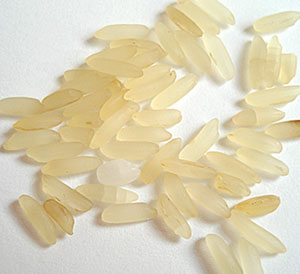 This is the long grain, parboiled rice, the kind that is most commonly used in European and American cooking. The grains don't stick together, for that separate, 'fluffy' texture that American/UK cookbooks find desirable. To me this is the most boring kind of rice with little character of its own. Nevertheless it is the least expensive kind of rice usually, and has its uses. I use this for rice dishes that have a lot of added flavor, like pilafs or fried rice. It can not be used as a substitute for japonica rice in most traditional Japanese dishes, since it is it not sticky enough.
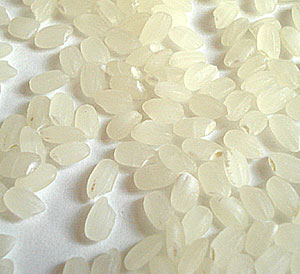 This is Japanese-style rice, or uruchi-mai - the kind of rice I talk about the most on this site. It is also sold as medium grain rice, or sushi rice. It's the rice to use for almost any kind of Japanese dish, including the all-important sushi and onigiri. The rice grains cling together without being mushy when properly cooked. This rice must be polish-washed to bring out its best flavor, as I have previously described. The best kinds of this rice have a translucent quality and have clean, rounded grains. As you can see, the grains are rounder compared to long-grain rice.
A variation of white uruchimai is haigamai (germ rice, 胚芽米). It's hulled and polished white rice with the germ left intact. This is a bit more nutritious than regular white rice. This is getting more available at Asian/Japanese groceries.See this excellent tutorial on Instructables for how to sprout brown rice.
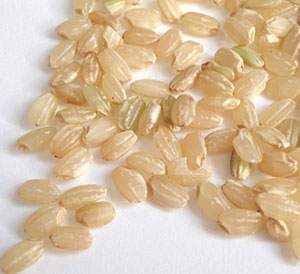 This is gen-mai, the brown version of uruchi-mai. It requires more water and a longer cooking time than the polished version. If you are in the market for a new rice cooker you may want to look for one that can cook brown rice. I've been eating more of this instead of the polished rice recently. Since the bran that is on brown rice contains oils that can turn rancid, it should be as fresh as possible. (Update: how to cook brown rice in a pot on the stovetop.)
One way to process brown rice, which is supposed to make it much more nutritious, is to let it germinate or sprout. This turns it into hatsuga genmai (literally, "sprouted brown rice", 発芽玄米, also known as GBR in health-food/vegan circles). To sprout rice on your own, soak it in lukewarm water for 24 hours, and keep it in a warm place (I keep mine on top of the hot water tank). At the end of the 24 hours, you may see the end of the grains are splitting a bit, and evena tiny little white root peeking out - that means it's sprouted. If it hasn't sprouted yet, rinse the grains and cover again with lukewarm water. If it still hasn't sprouted by the end of another 24 hours, it probably never will, so you can just cook it before the grains start fermenting actively. Since the grains have been soaked for so long you can cook it as you would white rice (in a rice cooker for example). It is softer and supposed to be easier to digest than regular brown rice.
You can also purchase sprouted rice - look in health food stores.
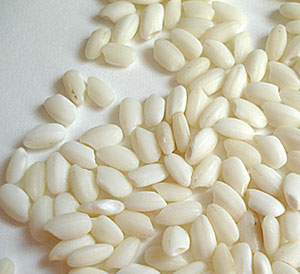 This is mochi-mai, or mochi rice, otherwise called sweet rice, short-grain rice, or sticky rice. The grains are not really that much shorter than the "medium-grain" uruchi-mai above but as you can see, the grains look quite different. The are opaque and white rather than transculent. This is beaten and kneaded to make glutinous mochi cakes, used to make osekihan (red rice with beans), or used for some sweets.
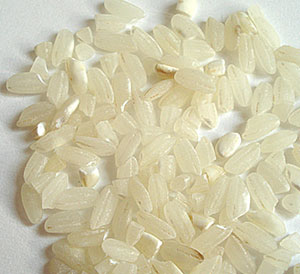 This is vialone rice from Italy. I use this or arborio rice for making risotto. It actually looks quite similar to uruchi-mai or japonica rice. These medium grain Italian rices can, a pinch, be used instead of Japanese rice. This is useful to know if you live in an area where vialone, arborio and other Italian rice varieties are cheaper than Japanese rice (which is certainly the case in Switzerland...we are a lot closer to Italy than to Japan after all). The reverse holds true too - if you have more or easier access to Japanese rice than arborio, vialone or carnaroli, you can use that, unrinsed, for risotto. When used for Italian dishes rice is not rinsed, since the powder that clings to the grains is the substance that makes risotto creamy.
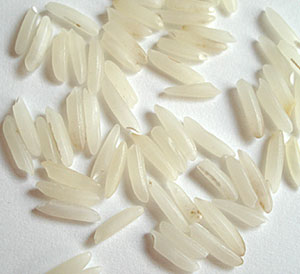 The final kind of rice that is a staple in our house is basmati rice. It has the longest grain of all, and a translucent appearance. It also has a a distinctive sort of spicy aroma, which matches spicy dishes perfectly. I keep this on hand of for Indian and Thai type dishes. I often have Thai 'perfume' or 'jasmine' rice on hand too, which is quite similar in cooking qualities. Neither basmati or jasmine rice can be used successfully in traditional Japanese dishes such as onigiri or sushi, since they are not sticky enough.
See also
Submitted by maki on 2007-01-11 14:41.

 Welcome to Just Hungry, where we serve authentic Japanese recipes and more! I'm






Comments
marceline
11 January, 2007 - 18:17
Permalink
Looking at rice
Does anyone have advice on buying a rice cooker in the UK? I've been thinking of buying one for a while but I only ever see multifunction rice/slow/steam cookers which I'm not convinced about for Japanese rice.
The only Zojirushi cooker seemingly available in the UK is this one. It doesn't look anything like the ones you recommend though so I'm hesitant. Any thoughts?
Donna
18 September, 2008 - 19:24
Permalink
Rice cooker (fuzzy logic) in the UK
We sell Zojirushi Micom fuzzy logic rice cookers in the UK, take a look at our website, it might help you out. We've put lots of info about how the rice cookers work and the ones we sell have white, brown, sushi and porridge settings.
maki
12 January, 2007 - 10:11
Permalink
Looking at rice
marceline, I see from some UK sites that they used to carry the 'fuzzy logic' models but they don't any more..which is a shame. You can try asking at a Japanese food store if there is one near you (the small Japanese shop we have here in Zurich carries some cookers for the expat community, and there's a good chance the ones in the UK do likewise). Or, there are some eBay vendors who sell them though you'd need to find out if the voltage is right, otherwise you'd need to get a transformer...which can be rather expensive on its own. (for what it's worth, we have a transformer, but we run several Japanese and U.S. 110/120V appliances off it.) Good luck!
Kalyn
12 January, 2007 - 16:27
Permalink
Looking at rice
Great post on the different types of rice. Another thing to think of about rice for many people is where it falls on the glycemic index (how fast the food turns to glucose in the blood.) For anyone who's watching this, either for weight control or for a condition like diabetes or insulin resistance, parboiled rice (Uncle Ben's converted rice) or basmati rice are by far the lowest on the glycemic index for white rice, and brown rice is also good.
niceties
17 May, 2007 - 18:32
Permalink
Thanks for this post and the
Thanks for this post and the great close-up photos. It's fascinating to learn about the different kinds of rice! Here in Singapore, we always use Thai jasmine rice as the everyday staple for Southeast Asian cooking, as well as for Chinese food. Basmati rice has a distinctively different fragrance and texture to Thai jasmine. For me, a whiff of hot steaming basmati instantly conjours up memories of tantalising Indian curries :), but would seem rather odd to eat with Chinese and Southeast Asian dishes.
I'm a brown rice junkie :) and love trying different kinds of brown rice that I pick up in various health food stores and supermarkets. Am amazed to find more and more kinds of brown rice available, including long grain and short grain American, Thai jasmine, basmati, Japanese short grain, Japanese sweet rice, 'red rice' (sometimes mixed with white). I've seen many of these in organic and non-organic options too.
My Panasonic rice cooker does white, brown, sushi and even 'nasi lemak', which is Malay-style rice cooked with coconut milk! No cake function though :( - would love any hints on that ^_^.
Staples Office ...
12 June, 2007 - 16:36
Permalink
I like rice in moderate
I like rice in moderate quantities once in a while, we even have a traditional food rice based in our country. People say it's very good but i can't find it's term in English, i don't think it exists. Rice is a healthy food, good for teeth. I had no idea there are so many rice kinds, your blog was very interesting.
Pat
23 January, 2008 - 22:04
Permalink
Haiga mai
I read that there's haigamai rice, which is not as hearty as brown rice but more nutritious than white rice. I'd like to try it but I know my rice cooker is only good for cooking white rice. Do you know if haigamai can be cooked in regular rice cooker since it's not quite the same as brown rice? I cooked brown rice with my rice cooker before and the rice came out fine, but it made a big mess. It is a pain to clean every single time I make brown rice.
I am Thai but I prefer Japanese rice. When I have to use Thai jasmine rice, I'd cook it with a lot of water so it'll be more plump and mushy...ehehehe =)
maki
24 January, 2008 - 04:13
Permalink
haiga mai
haiga mai is white rice with the germ left on the grain. So yes, it can be cooked the same way as white rice.
siehyean
28 January, 2008 - 03:00
Permalink
Jasmine rice
hi! I love your blog... I have a bit of a thing about food as well! ^^ I was just wondering, if i want to make onigiri, would Thai fragrant rice work as a substitute for Japanese sushi rice?
PS: I'm studying in the UK now, and I agree with you - the western idea of "rice" is just boring and barely palatable. It's either mushy and soggy, or else it's undercooked and hard. ><
Thank you for sharing all your recipes! :)
maki
28 January, 2008 - 07:53
Permalink
jasmine rice
Hi siehyean! I don't think jasmine rice would work well for onigiri, because it's not 'sticky' enough for the grains to stick together. The onigiri would fall apart. But I think nowadays it's getting a lot easier to buy 'sushi rice' as it's called in the UK - I've seen it at supermarkets there.
anon.
2 August, 2009 - 19:31
Permalink
Re: jasmine rice
I am using Jasmine rice everytime im preparing food that needs rice, i figured out that if you add alittle bit more water than needed the rice will become sticky, my father doesn't always rinse the rice, and it becomes sticky from that too.
I would love to make onigiri, but i'll have to wait until i start recieving my scholarship(we get money for going to highschool if your parents doesn't earn enough money to school books)
I'll use the first 100-200$ on school books and those stuff, and then ill use it to by my own cooking suplies
maki
29 February, 2012 - 20:47
Permalink
Re: jasmine rice
This is an old comment, but for anyone reading what's described by anon is the utterly *wrong* way to get 'sticky' rice. What s/he describes is mushy overcooked rice. Jasmine rice should be treated in the way that is optimal for it, not forced to become 'sticky'.
A scientist in ...
29 January, 2008 - 13:44
Permalink
Great post! I work on rice
Great post! I work on rice research (on resistance to diseases) so it's really read about your post. What makes rice sticky is the amylose content, the higher the amylose, the less sticky. Basmati and sushi rice are at opposite ends of the spectrum and people from different areas have different preference. Like the Japanese and Korean prefer sticky rice, the better to eat with the chopstick, right?
The pictures look great as well.
Gay
Loretta
29 January, 2008 - 16:03
Permalink
Jumping to brown rice
Brown Japanese rice isn't that easy to get in London and I've felt a bit intimidated by it (silly, huh?).
Your posts have encouraged me to seek it out and I've bought it for the first time.
It comes from the Japan Centre in London, but it seems to be part of the Toku Restaurant's own supply. It's bagged by them and labelled "Brown Rice, Akita-komachi grain, low pesticide, grown in the EU - with the toku logo".
It's twice the price of the white rice I usually use (2.90GB a kilo - 5.80GBP for a 2kg pack) but totally worth it.
Thanks so much for your cooking instructions, I wouldn't have known where to start otherwise. Turns out that an hour is too long for this particular variety. On my second attempt (with Le Creuset pan) I used the lesser amount of water you suggested (1.5 ratio water to 1 of rice) and turned off the heat after 30 minutes. Rice came out very well, but I may need to experiment more. (I noticed a little bit of scum on the cooked surface, so this rice definitely needs a quick rinse first).
Both my husband and I are really enjoying it, so there's no doubt we'll be buying a lot more.
As well as being good for bento, I've found that leftover gen-mai is particularly nice with umeboshi and as a glorious addition to a tomato-lentil soup.
I really appreciate your help in introducing brown rice into our diets, Maki!
Katherine
30 January, 2008 - 13:39
Permalink
What a coincidence!
I bought this brown rice from the Japan Centre's shop just last Thursday, and discovered this blog on Monday, the day of my first bento!
I've cooked the rice twice now, and maybe I'm just lucky, but I did it the same way as I do white rice, just for a longer time. I gave the rice a brief rinse, then put it in to soak for an hour with just under double the volume of water. After the soaking, I brought it slowly up to the boil, then turned the heat down and simmered it gently with the lid on for 35 minutes. At the end there was a little bit of water left, so I turned the heat right up high for thirty seconds.
I rather like that the rice from the Japan Centre is grown in the EU, rather than being shipped halfway around the world, and it's nice that it comes in recycled (and recyclable) packaging. And it's freshly milled on their premises too! How happy am I that they have an online shop for us non-London residents...
Alejandra
29 January, 2008 - 19:09
Permalink
I love these upclose rice
I love these upclose rice photos!
isay
29 January, 2008 - 22:10
Permalink
thanks
thanks for sharing the knowledge regarding rice.
Cyndi
2 February, 2008 - 04:50
Permalink
Haiga
I just bought a bag of Haiga this past weekend in Little Tokyo (Los Angeles) and will be giving it a try tomorrow. I'm going to follow your instructions for freezing rice, so that I'll have a bunch of packets in the freezer for putting in my bentos. I'm also going to give your bacon furihake a try! Thanks for the tutorial on rice. What awful thing have they done to Minute Rice to make it instant rice?
maki
2 February, 2008 - 09:29
Permalink
minute rice...
Not sure what they do to it.... I rarely meet a rice I don't like, but Minute Rice is the exception for sure. It tastes like...boiled lint. Great that you're using haiga-mai, and making bento too! :)
anon.
22 March, 2008 - 22:20
Permalink
I’ve found that the key to
I've found that the key to making brown rice in my rice cooker is to add a little oil. I think it's the same reason oil cuts down on pasta boiling over. I use either extra-virgin olive oil or the lighter flavored kind, depending on whether the strong flavor of EV is appropriate for how I'm going to use the rice. It doesn't take much. I think the least I have used is about two teaspoons for two cups uncooked rice. I think a teaspoon would probably work. Best to mix it with the dry rice before adding the water. Hey, why have I never tried sesame oil for this?
If I don't use oil, then I get light brown rice starch water all over everywhere. It bubbles up out of the steam vent. My old rice cooker had a loose glass lid and that was even messier (and I never tried the oil with it). My current rice cooker is a cheap Aroma that doesn't have fuzzy logic or sharp logic or in fact any kind of logic: it has "cook" and "warm." (For "off" you have to unplug it.)
I don't know if the oil would prevent making onigiri, which I've never tried, but now I'm wanting to! Usually I use long grain brown rice anyway, because at the store where I go (Hy-Vee) it is cheap. The store brand costs the same as the store brand white rice. I think it's $1 for 2 pounds. But they do have a shorter grain brown rice which I may have to try -- I assume short grain brown is stickier than long grain brown, just as with white.
Teyonnah
18 July, 2008 - 16:53
Permalink
Italian rice for Onigiri?
I was just reading over this and I'm so glad I did. I'm trying to make Onigiri for this party I'm going to. I really have no idea where to buy Japanese style rice or sushi rice. But my fried told me about risotto or rather vialone rice and such. And I was wondering if you can use that to replace Japanase style rice to make Onigiri.
I know where to buy Japanase rice (I think), my friend told me Chinatown...but I think that rice would be easier for me.
I was going to use Thai rice...but I read the post you gave to the other person that asked that question.
I live in America (Pennsylvania), if that helps any, but thanks if you can help me much.
maki
26 July, 2008 - 07:50
Permalink
Rice for risotto (arborio,
Rice for risotto (arborio, vialone) is a good substitute for japonica rice. It's my 'budget' option here in Switzerland (since Japanese rice is rather expensive, but vialone is not). Remember to wash it well before using it for Japanese dishes (you wouldn't wash it for risotto).
Adarkara
25 July, 2008 - 15:15
Permalink
reply to Teyonnah
yes you can use Arborio rice for onigiri, I've done it.
MitarashiDango
8 October, 2008 - 06:52
Permalink
Link not working...
I think the link "How to cook brown rice on stovetop" is not working..
maki
8 October, 2008 - 11:12
Permalink
fixed now!
fixed now!
Darren
18 October, 2008 - 18:22
Permalink
Rice...
I have two questions:
1) You said that white Japanese rice is sold as medium grain rice. By this do you mean that ANY medium grain rice is the same thing, even if it does not specifically mention being Japanese rice? The reason I ask this is that I can't always find Japanese rice.
2) I have one of those cheap Aurora rice cookers and no matter what I do, I keep burning the bottom of the rice. Any suggestions? Or should I just by a better rice cooker?
Thanks.
maki
20 October, 2008 - 20:36
Permalink
I’m not sure what you mean
I'm not sure what you mean - do you mean you can't always find Calrose, or Japanese rice in general? Calrose is a brand name (or to be more precise, the given name of a specific kind of rice, sort of like tomato varieties called Big Girl or Brandywine or Roma and so forth). Japonica type rice is a specific kind of rice, but it is grown in many places outside of Japan nowadays (California is the biggest growing area in the U.S., and Arkansas is another growing area. In Europe Spain now grows a lot of Japonica rice). Not all medium grain rice is the same - some Italian rice types as I've detailed (vialone, arborio etc) are also medium grain rices. But any of these can be used in Japanese style dishes since they all have a certain level of stickiness/glutionousness.
About the rice cooker...the heating element of the cooker could be 'off'. Also, check the bottom of the rice cooking bowl and see if it's blackened over with carbon. Gently removing this with a scrubbing sponge or fine sandpaper could help the bowl have better contact with the heating element and prevent burning (but don't rub too hard or you'll wear away the bottom!) Having a brown burnt layer is not too bad, as long as it doesn't give a scorched flavor to the rest of the rice - just take off the brown part. Some people even like that brown part - they fry it or toast it and eat it like a cracker!
Mmbuster
8 February, 2010 - 02:08
Permalink
Re: Rice...
Coat the bottom of your rice cooker with a cooking spray such as "Pam". That will prevent the rice from burning on the bottom.
Darren
20 October, 2008 - 18:04
Permalink
I should have mentioned with
I should have mentioned with regards to Q1, that I meant calrose medium grain rice.
Darren
21 October, 2008 - 13:28
Permalink
OK sorry, I should have
OK sorry, I should have explained that better.
I live in Toronto, and I know that all "Japanese" rice comes from California. However, I have seen marketed: 1) Japanese rice, but also 2) calrose rice sold as Japanese rice, and 3) just plain calrose rice with no mention of being a Japanese type rice, sold by a company called nupack. In this case, calrose seems to be the type of rice, not the brand name.
The 1st kind is much better, but is there a difference in the second 2?
Thanks.
Things to see
11 November, 2008 - 10:44
Permalink
Hey did you know that people
Hey did you know that people can see the future with rice? Just like with beans
Sujan P
31 January, 2009 - 08:30
Permalink
Re: Looking at rice
Thanks for this post and the great close-up photos. About half the world's population eats rice as a staple of it's diet, and two-thirds of the diet of subsistence farmers in India and Bangladesh is made up entirely of rice. If rice crops suffer, it can mean starvation for millions.
Michelle
19 February, 2009 - 23:40
Permalink
Re: Looking at rice
Wow, and all this time, I've been trying to make onigiri using Jasmine rice whenever I run out of Japanese rice (I use Nishiki brand). xD Thanks for letting us know that onigiri and sushi can only be made with Japanese-style rice!
Melinda
10 May, 2009 - 00:18
Permalink
So you do have to soak the rice????
Hi I really like your blog and I'm becoming a big fan of Japanese/Asian cuisine. I have been using this http://www.veryasia.com/bocari.html Botan Calrose rice and on the package it doesn't say anything about soaking. So Im confused, is the soaking process the thing to do to make it taste it's best or can you opt to just cook the rice?
Im new to this area of cooking so any advice would be great ^_^!
maki
10 May, 2009 - 06:44
Permalink
Re: So you do have to soak the rice????
You don't *have* to soak the rice, but it does make it taste a lot better - moist and plump and a bit sticky, which is what Japanese style rice should be. Other types of rice are different of course - e.g. risotto should be creamy, basmati should be sort of separate and nutty, and so on. (And there's that mysterious 'fluffy' texture that seems to be the goal in many American dishes)
Juan carlos
12 May, 2009 - 06:28
Permalink
Re: Looking at rice
wow, thanks a lot for clearing that up!! the pics did the trick. I live in Puerto Rico, and they sell, mostly, one kind of rice, medium rice. Long grain rice is cheaper, and parboiled is expensive *cuz people don't like the long and parboiled* We do rice a little differently, you could try if you want and let me know!
the same amount of rice and water is used. Put water in a pot with salt and oil *I use like a pinch of salt per cup or to taste* * I use like one tb of olive oil per cup* Bring water to a boil, then add rice without cleaning * in medium heat. I recommend, before cooking rice, put it in the refrigerator this keeps bugs away. Cook without the lid of the pot, until water is gone,*when the water is gone, move the rice with a Tb, you can do this only once* then put the lid and cook in low heat.
Juan Carlos
12 May, 2009 - 06:51
Permalink
Thanks a lot!
I don't think my post got through. So I'm writing again.
I'm from PR and Thanks for the info. Here, the most common is medium *japanese kind* grain rice. Long grain rice is more cheap *cuz nobody likes it* and parboiled rice is very hard to find and expensive. In Puerto Rico, we cook rice very differently from Japan. We use the same amount of water AND rice, we bring water to a boil with a litlle salt and a little of oil* in medium heat,I use like two pinches of salt and one tb of olive oil*, then I put the rice in for cook without the lid. When the water is gone I move the rice with a big Tb, then I put the lid in the pot in low heat until the rice is done. This takes about 30 or 40 minutes to make.
We want the rice to be loose, not fluffy, not mushy, nor sticky.
sueita
5 July, 2009 - 05:04
Permalink
Re: Looking at rice
i looked at the mochi-mai, it looks like glutinous rice. can I use glutinous rice as the substitute for japonica rice? for your information, I'm a Malaysian so we practically eats Thai kind of rice. I really think that the rice used for onigiri and sushi are glutinous right? we used that kind of rice for traditional cakes. They were more expensive than the jasmine rice but easy to find here.
JEnna
20 July, 2009 - 01:27
Permalink
Re: Looking at rice
i was wondering, that when u prepare the italian rice to cook, do u still rinse it? sorry if this was already answered.
Eako
22 September, 2009 - 21:16
Permalink
Re: Looking at rice
I live in the UK, and instead of buying Sushi Rice, I buy Pudding rice. I compared the two side-by-side and they look the same both dried and cooked, and taste the same. Instead of using the Rice Pudding recipie, I use the Sushi Rice one. Is this okay?
Also, I found that if I use a pressure cooker, it makes amazingly sticky rice, in five minuets! I love it... but is it any better or worse than buying a rice cooker?
Oh yes, I saw next to the Pudding rice, there was also "Flaked Rice" It's like Rice Flakes, squashed like cornflakes. It's very strange O_o
But thank you for taking the time to read this comment <3
Edda
26 October, 2009 - 14:46
Permalink
Re: Looking at rice
Thanks for this great post! I now know the difference between germ rice and sprouted brown rice. This was so helpful today when I had to describe to my friend what kind of rice to buy.
Rudy
2 December, 2009 - 06:21
Permalink
Re: Looking at rice
Hi Maki.
Great site. Absolutely fantastic. Just wanted to add a post hoping to get your pantry rid of the parboiled rice. :)
And replace it with Koshihikari. Here are the reasons:
1. Koshihikari has some of the highest absorption rates of any rice out there. So it is perfect for pilafs and paellas and those types of dishes as it absorbs much more of the flavors of ingredients it is cooked with.
2. Obviously the above makes it perfect for risottos. It is also medium grain as you know.
3. It can also be the Sushi rice replacing the uruchimai.
One down side is that it is not cheap. Even for me who lives in Los Angeles, CA.
What do you think?
alex
29 December, 2009 - 20:06
Permalink
a cheap alternative
For those of us that live in countries where rice porridge or rice pudding is a common food, a have a good alternative to the expensive real japanese rice.
Here in Denmark, you will find that the cheapest rice is called grødris which translates to porridge rice. It is used for making rice pudding and is normally boiled in milk until it becomes mushy.
However if you study the product declaration you will actually see that the rice is japonica rice, though neither from Japan nor California, but often southern Europe. Surely, the quality is far from that of real Japanese rice, but the texture and stickiness is about the same if you follow the ratios of water and rice of Japanese rice, and you must remember to wash the rice very well (and much more than Japanese rice). The flavour is tolerable, but I cannot recommend it for use in sushi or other dishes where rice flavour is very important. It can however be used for omusubi if you use fillings and maybe some furikake. For curry and the like that it is completely indistinguishable from the real thing.
My wife and I have been using this rice for many years now and got used to it, though nothing beats the rice of home of course.
Now, the real treat is that it is in fact the cheapest rice that you can buy. In Denmark (which is one of the most expensive countries in Europe) it costs about 150 yen for a kg whereas Japanese rice (labelled "sushi rice") will easily cost you about 1000 yen for a kg. I am sure that you will find this rice in many other countries, and definately in Northern Europe.
Thank you Maki for a very nice blog, you are the best!
zibor
4 January, 2010 - 09:51
Permalink
Re: Looking at rice
thank you so much for this post!
how long should it take approximately to cook brown rice that has been soaked for 24 hours?
Madelyne
5 January, 2010 - 03:37
Permalink
Re: Looking at rice
Thanks for the detailed information. I have two questions: Is medium-grain rice and short grain rice the same thing? This really confuses me because I often see them interchanged... and I can't seem to find brown rice in anything but medium grain. Also, does rice keep well in the fridge? Thank you!
maki
5 January, 2010 - 04:59
Permalink
Re: Looking at rice
Medium grain is often called short grain, and vice versa. Confusing I know! The important thing is that long grain really is long and narrow, and not sticky enough for most Japanese foods, while the shorter grain kinds usually are. If you need mochi or 'sweet' (also called short grain sometimes, confusingly!) rice specifically for something, it's usually labeled as 'mochi' or 'sweet' or 'glutinous'. I have never seen brown mochi/sweet/glutinous rice sold in regular stores, though my mother gets it in Japan by mailorder sometimes.
Christian
9 April, 2010 - 11:41
Permalink
Re: a cheap alternative
"Here in Denmark, you will find that the cheapest rice is called grødris which translates to porridge rice. It is used for making rice pudding and is normally boiled in milk until it becomes mushy."
In Germany, and probably in Switzerland too, this kind of rice should be readily available in any supermarket as "Milchreis", rice for being cooked in milk.
maki
20 May, 2010 - 08:21
Permalink
Re: a cheap alternative
I forgot to respond to this, but to me Milchreis is too crumbly to be considered a good substitute for Japonica rice.
Sola
20 May, 2010 - 02:30
Permalink
Re: Looking at rice
I live in florida, I've been dying to make onigiri but i have no idea what kinda rice to get, let alone where i can find it..If anyone can help please send me an e-mail, or write a comment, i'll check back regularily.
kenziecow
25 November, 2010 - 23:28
Permalink
Re: Looking at rice
I always loved "brown rice" because of its flavor! All us Americans ever have is white long grain, which is okay but not nearly as good as short grain!
anonymous hip h...
24 January, 2011 - 01:44
Permalink
Help with cooking
Hey I use Niko Niko calrose rice when making onigiri. No matter what I always end up burning a little rice at the bottom of the pan. I followed your instructions on how to cook the rice but I always run into this problem , someone please help!!!
name of some cl...
28 January, 2011 - 11:27
Permalink
we are Suppier of rice
[Note: I normally delete these comments, but I've left this one here (with details redacted) just to show what I have to deal with...I get one of these at least 1-2 a month around here. People, this is a food blog, I'm not a rice (or dried mushrooms, or organic vegetables from Kenya, or spices, or frying pans, or weird diet pills, etc....retailer. Honest. - maki]
Dear Sir!
[Company name redacted] is one of the leading manufacturer and exporter of agricultural products and foodstuffs in [country redacted]. Currently, the main of our company activities manufacturing and exporting of agricultural commodities as well as food products and agricultural raw materials used for producing fuel , fodder, or essential oil. In addition, our company also exports of freezing seafood and living crab. Our products are appreciated by many importers around the world. We have the ability to supply with big quantities according any customer's requirements, with the criteria: the right price, right quality, right quantity and right time, with high cooperation spirit, honesty, long-term, beneficial for both parties. We are honor to co-operation with you!
We would like to introduce to you our products as bellow:
Our main products:
Rice:
        Long grain white Rice broken 5%, 10%, 15%, 25%

        Jasmine Rice 5% broken, 10% broken

        Round grain white Rice broken 5% (Japonica Rice)

        Southern round rice (Calrose Rice)

        Glutinous Rice broken 10%

        Brown Rice broken 5%, 10%

        Parboiled rice broken 5%

        Rice Flour 12-14% moisture
Flour
Corn Flour, Corn Grits,
Pepper
Black Pepper, White Pepper
Tapioca
Tapioca Chip, Tapioca Starch, Tapioca Flour, Fresh Tapioca,
Coffee, Desiccated Coconut, Cashew W240, W320, Garlic, Ginger, Turmeric Finger, Red Onion, Freezing Seafood, Living Mud Crab
Technology
Gum Rosin, Coal
please feel free to contact me for more in formation
[contact person's name redacted]
[phone number, Skype, email, etc. redacted. Hey, you're web savvy-enough to use Skype, learn to tell the difference between a food blog and an online shop, eh?]
Agnes
1 May, 2013 - 17:43
Permalink
Just Hungry | Japanese food! Authentic, mostly healthy Japanese
Always take Alli exactly as directed on the label
is the most important parts of the country, the talk amidst all movie-goers was Christian Bale's dramatic sex tablets for men in karachi.
Eli
1 March, 2011 - 21:01
Permalink
Re: Looking at rice
Lol, I find it fun that when you say... countries where vialone or arborio are cheaper than Japanese rice, as Switzerland which is near Italy. Italy is much much closer!! :P
Anyway, here in Italy we have much more kind of rices, and the one people say it's more similar to Japanese is Venere. It's actually BLACK and it has a very intense flavour. Sadly is also one of the most expensive and the longest to cook. Although its flavor is similar to Japanese rice the texture is quite different, even when cooked for a very long time it will remain "Al dente". That's a wonderful thing for risotto but not so much for onigiri.
So, I will continue using vialone :)
http://www.bio-bio.biz/images/mid_Dsc01568.jpg
Lori
12 April, 2011 - 05:10
Permalink
Re: Looking at rice
I live in the Caribbean and I have no access to order rice online. All we have here is jasmine rice, white rice and all other long grain rice.
I really want to try this and how can i if all the rice are long grain? Is there anything I can do? Is there anyone who can find a way to make these rice sticky enough without overcooking, smashing or whatnot? T_T
kumiko
19 April, 2011 - 02:40
Permalink
Short grain
Maki-san is it possible to use white or brown short grain rice?
Andrew
25 May, 2011 - 11:43
Permalink
Re: Looking at rice
Hi Maki,
Just made some 玄米活性 yesterday. 3 hours!!! I've never had the patience before.
I'm holding a prize draw to win a free Zojirushi NS-YAC10 rice cooker. If you think your readers would be interested, full details are available on my homepage (http://www.japanesericecookers.net/winning).
Regards,
Andrew Cowan
Kochu
1 June, 2011 - 19:51
Permalink
Looking for rice
Greetings, maki-san!
I would like to ask, and if it's possible for this article to clarify, a question that is very confusing for everyone here.
I also live in the caribean, as some have mentioned, and we only have about 5 types of rice available, or at least that's all I saw in my local grocery store:
long grain rice
medium grain rice
short grain rice
parboiled rice
jasmine rice
The only rice I can be sure of the species is Jasmine, but otherwise, the other rices could be any kind from any country and I wouldn't know. I took a guess with short rice, since everyone here uses long to get that "fluff". Short rice is amazingly sticky, but now I'm not sure if such rice is what japanese would consider uruchi or mochi rice.
It would be pretty helpful if we could be guided by the rice grain's lenght (if that alone is enough to determine if this is the appropiate rice), as the rice packages here say nothing about what rice it is, only it's lenght
Hiragana Mama
9 June, 2011 - 23:31
Permalink
Re: Looking at rice
Thank you so much for this! I've always wondered what the exact differences were among the different types of rice. I always use regular sushi rice for all my Japanese meals, but am looking into eating healthier rice.
Marisa
28 July, 2011 - 17:26
Permalink
Re: Looking at rice
I'm trying to make sushi. I really can't buy the super expensive sushi rice and left what's left go to waste so I purchased some safeway meduim enriched white rice. Would that work? Thanks!
Japanese Rice C...
8 August, 2011 - 13:22
Permalink
Re: Looking at rice
Jasmine rice is my favorite variety of rice - though basmati is a close second. I find the shorter grain varieties just too sticky. Probably a result of my formative rice eating years spent in Thailand..but I just don't understand why anyone likes to eat sticky rice..unless it's true glutinous rice.
lmkiture
7 October, 2011 - 04:14
Permalink
Re: Looking at rice
The facts about the first rice not sticking is very true...unless my mom cooks it, lol, she's not the best when it comes to rice and she often makes what she calls "sticky rice" which isn't how it is usually desired. However I like it when it does stick, easy to use chopsticks!
MRW
14 November, 2011 - 22:50
Permalink
Re: Looking at rice
What is Sukoyaka Genmai rice? Is that the brown rice I can use as Japanese rice?
Thank you for your wonderful blog and generous replies.
maki
26 March, 2012 - 09:52
Permalink
Re: Looking at rice
That sounds like a brand name (the Sukoyaka part). It should be usable as a brown rice. Follow the instructions I linked to for cooking brown rice.
Kitty
27 March, 2012 - 00:53
Permalink
Looking at rice
I may be missing something. But is Baton Calrose rice actually sushi rice or not? I mean I googled it and got some confusing answers that is sushi rice or it isnt sushi rice. Help
Mariesa
29 March, 2012 - 21:38
Permalink
Re: Looking at rice
Dear Maki,
I want to make brown rice onigiris. I want to save them in my refrigerator and serve later.
However, they get dry, hard and they crumble. What is the answer to keeping brown rice onigiri together and fresh?
Thanks for your help,
Mariesa
maki
29 March, 2012 - 21:44
Permalink
Re: Looking at rice
Refrigerating rice is never a good idea. The rice gets dehydrated, hard and crumbly. The best thing to do really is to make your onigiri as close to when you want to serve them as possible, but if that's not possible, try wrapping them individually in plastic wrap and freezing them. See how to freeze rice over on JustBento.
Elisabeth
18 April, 2012 - 02:13
Permalink
Re: Looking at rice
Could anyone tell me what gen-mai would be called in English? I recently got both sweet brown rice and short-grain brown rice: would either of those be it? Any help would be appreciated.
God bless,
Elisabeth
Yuki
25 June, 2012 - 08:47
Permalink
Re: Looking at rice
Do you know where malaysia is? I live there and having a hard time to find japanese rice. Can you help me find it somewhere in malaysia?
Aria
20 July, 2012 - 21:34
Permalink
Re: Looking at rice
I feel like this comment is completely late and random but would Annie Chun's Rice - Sticky White work for making a onigiri? Thanks for typing this, I'm just still a bit confused.
maki
20 July, 2012 - 23:49
Permalink
Re: Looking at rice
I am not familiar with the brand but "sticky rice" is the equivalent of mochi rice, so would be too glutinous and sticky for onigiri.
Aria
21 July, 2012 - 02:03
Permalink
Re: Looking at rice
Okay. Thank you for your help!
Lizard
12 August, 2012 - 04:32
Permalink
Looking at rice
So I go to a local grocery and get a rice that the call Pearl Rice in bulk. is this the same as some of the short grained rices you have mentioned? It looks just like it, Im just unsure...
EunJung
9 March, 2013 - 23:58
Permalink
Re: Looking at rice
I have a tendency to switch between Japanese and Korean rice since they are pretty much the same..
Jean Markale
22 March, 2013 - 23:20
Permalink
Re: Looking at rice
I'm still confused, even after reading this post, the comments, and various websites.
Calrose is a kind of rice, not a brand as you erroneously posted above.
So I'll lay it out here because I don't see a straight answer anywhere:
Can you or can you not use calrose rice in Japanese cooking?
I ask because this is literally the only type of medium-grain rice around here (Michigan)which seems to correspond to the rice variety you speak of. Even in our Asian market. But nowhere on the bags does it say whether it is japonica rice, and no-one online--including here--will come right out and say "yes, you can use calrose rice for making Japanese food" or "no, do not use calrose rice for making Japanese food." The only other posts here asking point-blank questions about calrose rice were never replied to.
So onegai shimasu, for the love of heaven, which is it?
Yes or no?
Domo arigato gozaimasu.
maki
23 March, 2013 - 13:57
Permalink
Re: Looking at rice
Calrose is a medium grain rice that is a hybrid of japonica rice and other types of rice, bred to grow in California. I've tried to clarify the 'brand' thing above - it's not a brand in the way Chevrolet is a brand of Apple is a brand; it's a named variety of rice, in the way you have named varieties of some fruits or vegetables. (E.g. Sweetie oranges.) Anyway, while it's not the best, it's acceptable to use in Japanese dishes. I thought I made that part at least clear but hopefully it is now clear enough.
Jean Markale
3 April, 2013 - 20:55
Permalink
Re: Looking at rice
Thank You!
Thanks to your method and clarification on type of rice, I've cooked beautiful rice without a rice cooker for the first time in my life. I now use the twelve-minutes heat/twenty minutes sitting version. I couldn't believe the difference from my previous attempts to cook rice. I'm never going back.
dee
29 March, 2013 - 22:10
Permalink
Re: Looking at rice
Hi ! I live in France and there are loads of sushi rice brands. Which one would u recommend ?
Your blog is great ! I've tried a lot of ur recipes and always been satisfied with the results ! Thanks
anon.
10 August, 2013 - 03:12
Permalink
Re: Looking at rice
I fixed some rice according to your instructions today (although I inadvertently followed the older instructions because I didn't realize at the time that it was a different post than the one I looked at the other day) I used some Nishiki rice I'd found in bulk and it turned out slightly stickier than I thought it should have, (but I couldn't find the microwave rice you recommend for getting a feel for it so I'm not certain.) From a listing on Amazon it sounds like it should be a suitable rice, although it looks more like your vialone than your Japanese rice. Do you have any thoughts on what might have made it stickier? There were some broken bits of rice in the batch, and I may have left it over the high heat for longer than recommended because I was cooking beans (separately) as well.
Yuki
6 October, 2013 - 15:59
Permalink
Re: Looking at rice
I was just wondering, is it possible to make onigiri and sushi etc. with short grain brown rice/ genmai?
Also, is Japanese rice 'healthy' despite it being white compared to other white rice? Or is it better to go for brown?
Thanks:)
Jaya
10 December, 2013 - 12:24
Permalink
Re: Looking at rice
You can absolutely make onigiri with Basmati... the only rice I like.
After washing your rice, add starch back into the cooking water. I use 1 teaspoon rice flour to each three cups of uncooked rice. Been making onigiri like that just fine. Never, ever fallen apart.
anon.
11 February, 2014 - 14:27
Permalink
Re: Looking at rice
Do you know if they sell whole rice somewhere in tokyo ? I cant eat plain (white) rice...
Lynn
19 November, 2015 - 19:15
Permalink
rice if enriched?
Thank you for so much information on rice. Want to find the half milled type you mention.
Have been trying to find rice that is not enriched and wonder why in US it is dont. Do other countries do this and are the people healthy anyway?
It's the madmade form of folic acid that causes problems for some.
Wonder if rinsing &/or soaking of rice makes it more digestible also.