
Japanese Basics: How to make Japanese-style plain rice and sushi rice
Update: I've updated this post substantially in these two articles, 10 years later: How to cook great Japanese style rice, and How to make sushi rice (shari). Please take a look there - you'll probably find them a lot clearer. I've learned a lot myself in 10 years! ^_^
This is the first how-to and recipe that I posted on Just Hungry. Properly cooked rice is the foundation of a traditional Japanese meal, and you absolutely cannot skimp on the steps detailed here if you are aiming for anything approaching authenticity. I've edited the text to make some things clearer. Back to basics! Originally published in November 2003.
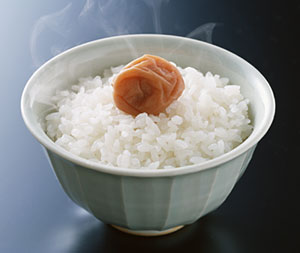
Rice is the staple of Japanese food, and making it just right can be rather difficult if you don't know how. If you think you will be preparing rice regularly, an electric rice cooker will make your life so much easier. (See About rice cookers.) You can cook non-Japanese style rice and other grains in a rice cooker too.
Japanese rice, or japonica rice, is a very particular variety. For traditional Japanese dishes you simply cannot substitute long-grain rice, jasmine rice, basmati rice, Carolina type rice, and so on. I sometimes hear people saying things like "But I can make onigiri with jasmine rice just fine, as long as I cook it so it's mushy and the grains stick together". No no no no no. A good onigiri, a good sushi roll, a good nigiri-zushi, and most of all a good bowl of rice are not made from crushed, watery, mushy rice; they are made from slightly sticky grains of rice that are gently pushed together. In addition, jasmine rice and other types of rices have a flavor that is utterly different from that of japonica rice. If you serve plain jasmine rice with a Japanese meal, it will simply taste wrong.
The one non-japonica variety that does work fairly well sa a substitute is Italian vialone rice, which is a medium-grain rice similar to japonica rice. Arborio, carnaroli and the rice sold as 'pudding rice' or 'milk rice' in some countries are also medium-grain, but they tend to have too much rice starch, which is what makes that creamy texture in risotto or rice pudding. Vialone has less of that starchy coating and therefore works well. See Looking At Rice for more information about different types of rice.
Ideally, the rice should be quite fresh. The best rice is new rice called shinmai, purchased within 3 months of harvest. Unfortunately, it's just about impossible to buy rice that fresh outside of Japan. Just buy the best rice you can afford. Once you learn how to make rice properly, you will really taste the difference between different kinds of rice.
Some popular 'first grade' Japanese rice varieties include Sasanishiki, Koshihikari and Akita Komachi. They tend to be expensive.
Recipe and Procedure: Japanese style plain rice
The washing and rinsing steps may seem like a bother, but they are absolutely critical to producing properly cooked Japanese style rice. Do not skimp on this! This is a common mistake made by people new to Japanese cooking.
To make 4 cups of cooked rice, you will need:
- A heavy-bottomed pot with a tight fitting lid, or an electric rice cooker
- 2 cups of uncooked japonica rice or 'sushi rice' (or substitute Vialone)
- 2 1/4 cups of water (If using a rice cooker, add water up to the specified level marked in the inner bowl)
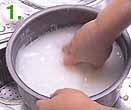 Measure out the rice carefully into your pot and rinse vigorously under running water. Swish the rice around with your hands - the water will turn a milky white color.
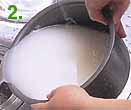 Drain the cloudy water away and add fresh water, and swish the rice around again. Repeat this step 2 - 3 times.
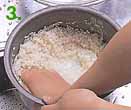 Drain, leaving just a little water, and rub the grains together several times with the palms of your hands gently as if you were polishing them.
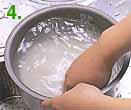 Add plenty of fresh water and rinse out the rice. Drain and rinse until the water is almost clear.
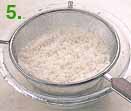 Drain the rice in a fine mesh sieve and leave for a little while, preferably at least 30 minutes.
Put rice in a rice cooker or pot. Add the water to the rice. At this point you should let the rice soak for a while. The length of time depends on the quality and freshness of the rice. The older the rice, the longer it needs to soak. Soaking for at least 30 minutes to an hour is generally recommended, but don't soak for more than 8 hours or so or the rice will get a bit watery and lose any flavor. And if the weather is too hot, it might even start to ferment! (Some rice how-tos emphasize the importance of soaking, but I think the washing and rinsing is the most critical part of making proper rice, which is why it's described in so much detail here.) Brown rice however does need to be soaked before cooking (see cooking brown rice).
If you are using a rice cooker, just switch on (or if you need the rice later, set the timer; you can calculate in the soaking time here.) If you are using a pot, bring to a boil over medium heat then put on a tight fitting lid. Cook on high for 1 minute, then reduce the heat to medium, and cook for another 4-5 minutes until you can see the surface of the rice, then reduce to low heat for about 10 minutes or until the water is completely absorbed. (Don't open the lid to peek!) Turn up to high heat for a few seconds to get rid of any excess moisture if necessary.
If you are using a pot, remove it from the heat and drape a cloth over the pan for about 10-15 minutes to let it fully absorb the moisture and rest. This final step really makes a difference if you want grains that stick together but are not mushy or watery. A good rice cooker includes this resting time in the cooking cycle, and also allows for condensation to evaporate, so you don't need the cloth draping step.
Sushi rice
Once you have mastered plain rice, turning it into sushi rice (shari) just requires a few more steps. Sushi rice (called shari by sushi chefs) is rice that is flavored with dashi, rice vinegar, and salt.
Substitute cooled dashi stock for the water. Cook as per the above instructions.
You will need a large bowl or plate for the next step, preferably a wooden one made for this purpose called a hangiri. You can buy a hangiri at any Japanese kitchen equipment store, and even from Amazon. The advantage of using a wooden hangiri is that the untreated wood absorbs excess moisture from the rice. You can also use a large serving plate or a bowl, though that won't have the moisture-absorbing quality.
You also need a sturdy rice paddle or spatula. rice cookers come with a rice paddle.
Take 1/4 cup of bottled or homemade sushi vinegar (sushi-zu or awase-zu, see recipe below). Moisten your spatula or paddle with a little of the vinegar. Turn your hot rice out into the bowl or plate, Pour the sushi vinegar over the rice.
Working rapidly, turn and mix the rice, taking care not to squish the grains. You should use a cut-turn-fold motion sort of like when you mix in egg whites into a cake batter. This you do with one hand. With your other, rapidly fan the rice to cool it as quickly as possible. This ensures that the grains will be nice and glossy and not mushy. Rope in an assistant to do the fanning, or else do what I do and use a hair dryer on the 'cool' setting. Keep going until the rice has absorbed the vinegar, and has cooled down to about body temperature (it should be just a bit warm to the touch).
Important! Sushi rice should be served when it is slightly warm, or at the least at room temperature - not chilled. This is why the best nigiri-zushi (the standard sushi that everyone thinks of a 'sushi' - an oval ball of sushi rice topped with a piece of fish) is eaten right after it's made, at the sushi counter - cool but not cold fish on top of the barely warm sushi rice.
When making sushi at home, do not refrigerate your rice if you can avoid it; the texture and flavor rapidly deteriorate when it's chilled. If you must make your sushi rice in advance, wrap it up while it's still a bit warm in plastic wrap before refrigerating. The trapped moisture will help to keep the rice grains from hardenening. When you need the rice, warm up for a couple of minutes in the microwave, then open up to cool down again to room temperature.
Recipe: Sushi vinegar mix (awase-zu)
If you can't get prepared sushi vinegar you can make it thus:
Mix 1/4 cup of rice vinegar or mild cider vinegar, 1 tablespoon of sugar, 1/2 tablespoon of mirin, sake or sweet brandy, and 1/2 tablespoon of salt. Heat over low heat in a small saucepan, and stir until the sugar and salt have dissolved. This is enough to flavor 4 cups of rice, so adjust the amount according to the amount of rice you have.
See also
- Looking at different types of rice
- Onigiri 2.0
- About rice cookers
- How to cook brown rice on the stovetop
- Pressure cooker love (with instructions for making brown rice in a pressure cooker)
- How to cook rice in a frying pan - great if you don't have a rice cooker or a heavy pot!
- How to freeze rice over on Just Bento (very useful for speedy bentos and other meals)
Comments are now closed. I encourage you to go to the new step-by-step instructions, which should answer more of your questions.
- Japanese Cooking 101: How to cook great Japanese style rice
- Japanese Cooking 101: How to make sushi rice (shari)
Submitted by maki on 2009-02-17 20:40.

 Welcome to Just Hungry, where we serve authentic Japanese recipes and more! I'm






Comments
Hunter
30 January, 2005 - 22:57
Permalink
Japanese basics: plain rice, sushi rice
For those who don't know their rice varietals, if you're in the US (esp. the west coast) and are having trouble finding Japonica rice, also look for "calrose" (it's also called "California sushi rice"). It's an American Japonica varietal but often doesn't have the word Japonica anywhere on the package. Good eating!
Njoseph
12 January, 2008 - 12:22
Permalink
Japanese basics: plain rice, sushi rice
I am presently working in Saudi Arabia and its very hard to find japanese rice here. We have what you call calrose rice but it comes from egypt. Is it okay to use it (sorry for the stupid question but just wanted to make sure)?
maki
12 January, 2008 - 13:37
Permalink
It’s impossible for me to
It's impossible for me to say for sure, since i've never been to Saudi Arabia or Egypt1 It could be ok. If you buy a small bag and look inside (or can get a peek at some grains before buying) you can compare them to the 2nd photo on this page, which is the kind of rice you want for Japanese cooking.
anon.
22 February, 2009 - 00:23
Permalink
Re: Japanese basics: plain rice, sushi rice
Well i think you can se egyptian rice. the difference is not that big to rice from central-japan.
anon.
17 May, 2010 - 10:54
Permalink
Re: Japanese basics: plain rice, sushi rice
What a great site. I had some Egyptian rice which looks the same as sushi rice and want to make sushi. Lots of useful information here - and the Egyptian rice seems to be OK. Will let you know.
Kelsey
18 July, 2008 - 01:23
Permalink
Thanks. :) My mom bought the
Thanks. :) My mom bought the only rice she could fine with an asian-looking symbol on it and I wasn't sure she got the right kind...but she did. I'm glad.
HyperK2
30 June, 2005 - 20:15
Permalink
Japanese basics: plain rice, sushi rice
And also, if you can't find calrose,(i am east coast) try looking for "Glutinous Rice"
That should be the same thing.
Taber
4 March, 2006 - 02:59
Permalink
Japanese basics: plain rice, sushi rice
...but it isn't. Calrose rice is sticky by American standards, while glutinous rice is much stickier. Because of this, people are confused when I accidentally say "sticky rice" to mean "glutinous rice." What they call sticky rice is just calrose rice.
iao
20 April, 2006 - 08:40
Permalink
Japanese basics: plain rice, sushi rice
Maki, thank you for your detailed instructions. I followed it carefully and a few days ago I made the most delicious rice. It was good on its own!
Niki
1 May, 2006 - 22:38
Permalink
Japanese basics: plain rice, sushi rice
is sun rice any good?
pricca
21 August, 2006 - 06:34
Permalink
Japanese basics: plain rice, sushi rice
Hey! nice recipe, Do you suggest to cook the rice on dashi soup stock only instead of water for sushi ? Thanks!
maki
21 August, 2006 - 11:56
Permalink
Japanese basics: plain rice, sushi rice
pricca, yes cooking the rice in dashi stock works well for sushi rice. You can just put in a small amount (say 1 tsp. for 3 cups of uncooked rice) of dashi stock granules too.
p-blog ::: pier...
16 July, 2004 - 08:36
Permalink
TrackBack from p-blog ::: pierre andersson:
Det här vill jag lära mig! Kolla in i was just really very hungry för en utmärkt beskrivning av hur man lagar sitt sushi-ris på bästa sätt!...
Fred
27 April, 2007 - 18:08
Permalink
How about...
Hi!
Ok, so I intend to make sushi this week-end, yay :D
On the side I also plan to make some wakame soup, basically dashi stock with wakame, spring onion, garlic & roasted sesame seeds.
Would it be reasonable to use some of that stock (filtered of course) to cook my sushi rice? Or will the "extra ingredients" taste too strong for the rice?
Jennifer
7 July, 2007 - 22:29
Permalink
Japanese basics: plain rice, sushi rice
I'm wondering what the difference is between the "white rice" and "sushi rice" setting on my Zojirushi rice cooker. When I lived in Japan, there was only one non-porridge or genmai setting. Now, that I'm back in the US, I'm confused if the "white rice" setting is intended for long grain rice and "sushi" means all Japonica rice? Thanks for any feedback!
Melissa
25 October, 2008 - 04:37
Permalink
Diffrence:
The diffrence of white rice and sushi rice is that, sushi rice is sticky, white is not meant to be. Sushi rice is meant in sushi, white rice, not so much. (Honestly, I dunno what white rice is meant for, I find no good use to it, it's all moving-like and just won't stay together.)
(PS. You got to live in Japan! Lucky!!!!!!!!!)
P. Tomiko
9 September, 2010 - 01:02
Permalink
Re: Japanese basics: plain rice, sushi rice
Cooking rice for sushi requires a drier rice, or it gets too gooey when you blend with the "su", the sweetened vinegar. Though I don't have such a setting on my rice cooker, I would think that it would result in a slightly drier rice than the white rice setting. Just a note: Zorjirushi is an EXCELLENT brand, though a bit too pricey for me. Also, just a hint from a Sansei who grew up cooking & eating mostly Japanese food made by or with a kibei mother... It seems every time I (and all the other Nihonjins & Japanese Americans I know) eat sushi made by a non Japanese cook, it lacks sufficient "su", and the recipes I've read online, direct you to use about 1/3, or less, the amount most Japanese cooks use to make sushi. (I probably use more than triple the amount, and get compliments all the time) So, I suggest you prepare triple the amount of "su" and then mix in slowly to taste. Also, before you finish, let the sushi rice rest for awhile, you will probably find you need to add more su to the mix. One final hint, allow the rice to sit for at least 10 to 15 minutes before opening the rice cooker lid, fluff the rice first (see the process for blending the su into the rice) then drizzle the sweetened vinegar over the entire batch of rice, then use the shamojii (rice paddle) to cut, like a knife, then fold over the rice; repeat, until well blended, then add more su, and repeat the process until you find the sushi rice properly flavored. You will find your sushi will come out better.
maki
7 July, 2007 - 22:44
Permalink
not sure
I'm really not sure since I don't have that model...maybe it's in the manual, or calling customer service might help?
Jess
9 August, 2007 - 20:53
Permalink
Polishing a bit too hard?...
I was planning on making some rice to try to make some onigiri for me and my sister, but after I had finished step 3, the rice was breaking apart into very little pieces, however it was still turning the water milky,
it could be that I was polishing them too much, even though it still turns the water milky when repeating that step, should I just stop polishing after the "several times" mentioned?
maki
10 August, 2007 - 03:07
Permalink
don't rub too hard
Don't rub the rice grains together too hard, or you will end up grinding up the rice itself instead of just polishing off the powdery substance. My husband used to have this problem when he would wash the rice...he'd grind them to hard and break up the grains. Be gentle, like...er, with other things :)
Jess
10 August, 2007 - 11:41
Permalink
Thank you very much, the
Thank you very much, the rice turned out excellent, and my sister loves the onigiri (2.0) we made!
I will try to be more gentle with the rice as well ;D
Anna B.
22 September, 2007 - 17:02
Permalink
Need Japanese Rice!!
Where can I find Japanese rice at a reasonable price in New York City (or Queens)?? I can't find it anywhere and I don't really read kanji very well, but I know when it says "Nihon" or not. Haha. Thanks!
maki
24 September, 2007 - 13:55
Permalink
Japanese rice
In NYC you can get Japanese rice almost everywhere these days I think (I'm pretty sure places like Trader Joe's and Whole Food carry it these days) but you can refer to my Japanese grocery shopping in New York post. In Queens if you are anywhere near Flushing, try the Korean supermarkets there which will carry a lot of Japanese groceries.
beatrice
7 November, 2007 - 05:01
Permalink
plain rice for onigiri
Would using the plain rice work for making onigiri?
The kind of rice that you use for making fried rice? WOuld it work just the same?
Okay thanks!:]
regards-beatrice
Mike
2 May, 2011 - 07:49
Permalink
Re: plain rice for onigiri
If you live in the boon-doggles remote from any Japanese or Asian stores and even local stores don't carry Japanese rice varieties, look for medium grained rice. This is what we did back in the days before the Japanese brands and Californian Japanese rice varieties were available in common-town USA. This, of course was a time even before Karate Kid - a time when the rest of the world was being re-introduced to Japan through the Shogun series. The world was hungry for Japanese culture and cuisine, but it was hard to get the real thing and much of it remained in our imaginations until information and exposure to real Japanese culture finally found us.
Add just a pinch of salt to your rice cooker when using medium grained rice.
maki
7 November, 2007 - 08:55
Permalink
onigiri
I'm not sure what 'plain rice' means to you beatrice, but it does have to be the right kind of rice for making onigiri. See this article all about about onigiri (and this one about different kinds of rice). Hope that helps!
ramon
24 November, 2007 - 06:30
Permalink
water temperature
i read in a sushi book by kenzo that one secret of sushi rice is that it is cooked with water that is already hot. that is, it is not put together with the cold water and then heated until cooked. the book did not say how this was done exactly, did one heat water and pour it into the rice cooking vessel and then put that on the fire (or boil water then pour in the rice), but i suppose it does not matter. i have not tried this but i am intrigued as this is similar concept to the way pasta is cooked, and we know that the texture of pasta is all the better for it.
maki
25 November, 2007 - 16:35
Permalink
cooking rice in boiling water
That's a method called "yudaki"...I've tried it some time ago, but I am not sre there is a big difference in resulting quality. I think that the other factors - the basic quality of the rice, the way it's washed, etc. - make a bigger difference.
Kazuki
15 December, 2007 - 01:20
Permalink
Rice
Thanks a lot for this tutorial! I happened upon this site as I was looking to find out how to make some of the foods I miss eating the most from my stays with family in Japan but just can't get in the eastern US. Bravo!
army_kitten
9 January, 2008 - 03:33
Permalink
brown rice for sushi... and everything
hi maki!
first let me say that i love your blog; i found it only a week ago when looking for new recipes and can't wait to try all the vegetarian ones!
as someone with allergies to wheat and corn (and some macrobiotic leanings, though i do eat eggs, yum), brown rice makes up a huge part of my diet. i've never really been a fan of white rice—i know it has a little bit of protein, but it just doesn't satisfy me the way brown rice does.
i figured out that by soaking short grain brown rice overnight and then cooking it in a pot (my roommate's rice cooker makes it too dry to stick together well, even if it's soaked overnight), i can get a pretty good sticky brown rice. sometimes, though, it seems TOO wet, which is probably just cooking inconsistencies on my part.
you mentioned in your article on different types of rice that you've been making a lot more brown rice lately. do you have any tips for making a better brown rice to use for sushi and onigiri? i think i'm getting close, but i would appreciate any advice you might have!^^
maki
9 January, 2008 - 08:20
Permalink
brown rice for sushi
army kitten, the brown rice cooking method I describe here works pretty well. I have to say that personally I prefer sushi made with really good white rice...though I do love brown rice onigiri. Brown rice onigiri are great grilled (as yaki onigiri) - they take on a nice toasty flavor. Just be sure not to overcook brown rice (it's easy to do that I find), which will make the grains get mushy when you mix in the sushi flavorings or smoosh the rice together.
Eve
2 February, 2008 - 08:01
Permalink
Is sushi rice always made by
Is sushi rice always made by cooking the rice in dashi stock? I was under the impression that sushi was rice was just regular steamed rice (cooked in water) and then mixed with the sushi vinegar. Thanks :)
maki
2 February, 2008 - 11:36
Permalink
Properly made sushi rice is
Properly made sushi rice is cooked with dashi, or at least a piece of kombu seaweed. Actually sushi rice mixes (like sushi rice powder) and some sushi vinegars contain some dashi.
Kaidi
12 April, 2008 - 21:51
Permalink
Last step in cooking rice...
"Remove from heat and drape a cloth over the pan for about 10-15 minutes to let it fully absorb the moisture and rest."
Lid on or off? (This is probably a dumb question - and at any rate it's probably too late because my rice has been rinsed, and is drainign, and I need to cook it in about 1/2 hour!)
Thanks...LOVE this site.
K
maki
13 April, 2008 - 20:46
Permalink
If you are making rice in a
If you are making rice in a pot, you usually drape the cloth over the pot with the lid off, then replace the lid (off the heat of course so the cloth doesn't burn!) and the cloth will absorb any drips and things. I hope the rice cooking went well anyway!
Kaidi
14 April, 2008 - 21:38
Permalink
lol - it did, thank you :)
lol - it did, thank you :) Essentially, I just let it stand for 10 minutes before using it, and it worked out fine. I wasn't sure whether I was trying to keep the pot warm while letting it absorb the moisture (just covering it) or actually wicking away that last bit with the towel (per your instructions). Next time for sure :)
P.S. I thought I'd found this site because of the rice balls like so many others, but I was just going through my bookmarks, and my first love on your site was for your rosti potato instructions about 6 months ago...yum :)
ashan
9 June, 2008 - 20:06
Permalink
to soak or to drain?
Hi Maki, I've been reading up on the perfect way to cook japanese rice, and am getting contradicting information on one point -- to leave the rice in water or to drain it before cooking.
What is the difference between the two, and which is better? If I should soak the rice, how much water should it sit in? After soaking, should I drain it again and put in the right amount of water for cooking?
My rice turned out too mushy and sticky when I left it to drain (for about 15 minutes) beforehand. Do advise! Thanks :)
anon.
18 July, 2008 - 02:21
Permalink
amount of water
i'm using my rice cooker for the first time, but the instructions are a bit unclear... it says to put the water in to the level marked on the inside of the cooking pot, put it doesn't say whether to put the rice inside first or to add the water to that level and THEN add the rice
also, i'm cooking white, organic jasmine rice... so i should use the white/sushi rice setting, right?
maki
23 July, 2008 - 13:39
Permalink
You add the water AFTER the
You add the water AFTER the rice is in the pot already. I guess they didn't think to include that instruction since most people wash the rice in the pot, so the rice is already in there.
If you want jasmine rice that is cooked so the grains are separate and firm (not crunchy, just cooked through) then the normal water level is usually fine in my experience. Otherwise you can add just a bit more water if you want it softer. This also tends to vary a bit depending on the batch of rice - some rice is drier than others.
Willow
21 July, 2008 - 20:53
Permalink
Cooking rice overnight
Hey there!
I love your blogs! I have a question:
If I want to cook rice (brown sweet rice) overnight to make sushi in the morning, should I:
1) Let is soak overnight and then program the cooker (fuzzy logic) to be done at 6am?
2) Cook it in the evening and leave it on warm overnight?
3) Cook it in the evening, put in the fridge and season in the morning?
I'm far from being a traditionalist and am a best a wanna be sushi maker... Just want to play around some. I've seen all 3 ideas and was wondering what would be best. I have a Zojirushi rice cooker that has a brown rice setting and both a "keep warm" and program that last forever.
Help? I've been looking all over for this!
Thanks for any help!! ;o)
Will~
maki
23 July, 2008 - 13:38
Permalink
I would go with option 1,
I would go with option 1, unless your kitchen is very hot and humid (in which case the rice might start to ferment). Otherwise I would go with option 3 - cover the rice with plastic while still a bit warm, and then microwave for a couple of minutes to revive it. I really am not a fan of the 'keep warm' option for rice - it changes the flavor and color in a not-good way if it's for more than an hour or so.
Willow
25 July, 2008 - 00:26
Permalink
Thanks!!
I will try option 1 then, that's kind of what I was leaning toward, but was afraid that soaking the rice might have "ill effects" on it.
I can't wait to see myself make sushi at 6am... LOL
Thanks again!
BarbJ
22 September, 2008 - 01:46
Permalink
japanese rice
In your recipe for plain japanese rice, you don't mention salt. Do you add any salt to the water that the rice is cooked in? I know most western recipes for cooking rice adds a bit of salt to the cooking water.
If salt is not added, I'm guessing because it's often added later, like in onigiri and sushi, would that be correct?
Thanks for your great web sites! I'm lucky to live on the U.S. west coast, so the ingredients are easy to find, but not the recipes or instructions.
Plus the tips you give are great! Those kind of tips are the little things that make such a big difference, and the things most recipe books leave out. Thanks again!
maki
22 September, 2008 - 09:50
Permalink
Hi BarbJ. No salt is added
Hi BarbJ. No salt is added when cooking plain white rice; a tiny bit is added when cooking brown rice though - it's supposed to give a better texture to the rice. In any case, since plain rice is eaten with other foods and is a bland foil for them, it's usually unsalted. I'm glad you find the site useful :)
alucard
25 September, 2008 - 00:08
Permalink
Minute Rice??
can you use minute rice to make onigri im an a inspiring chef and i love anime i would love to learn to make them but all we can get is minute rice and all we have is a veggie steamer anyway to make it work i can't find the recipe if there is one out there. Any ideas for an easy side dish with it??
maki
25 September, 2008 - 06:15
Permalink
No, you can’t use Minute
No, you can't use Minute Rice to make onigiri. It does not have the right sticky nature, and it doesn't have enough body to hold its shape when you squeeze it. To It's also much more expensive than non-treated real rice if you measure by weight. I don't quite understand the 'all we can get is minute rice'...surely you can get other kinds of rice? You can even cook real rice in a microwave with an inexpensive steamer.
See the Looking at rice article to see what kinds of rice can be used for onigiri.
To put it bluntly, I would never use Minute Rice for well, anything.
Mirai Miyazaki
30 September, 2008 - 14:13
Permalink
I’m sorry if this is a
I'm sorry if this is a silly question but how much exactly is one cup and one tablespoon. >.<
atiey
31 October, 2008 - 04:39
Permalink
japonica rice
I came to know there is a few origin for japonica rice, i.e Taiwan, Japan, US, Australia etc. Is there a difference in cooking preparation according to the origin or as long as it is a similar variety, the cooking instruction is also similar regardless of from which country it came from.
maki
31 October, 2008 - 10:26
Permalink
It’s not necessarily where
It's not necessarily where the rice comes from (though many Japanese people will insist Japanese-grown rice is the best by far) but a number of factors - what the specific variety is, in what conditions it's grown, and how old the rice is. Each batch is different really, so you have to experiment a bit to find the optimum washing time, water amount and soaking time. Generally speaking, the older the rice the more of all factors it needs.
Kimmy
2 December, 2008 - 06:18
Permalink
Rinsing Rice
As a girl born in the Southern part of the US, I've never had to rinse my rice when I cook it. I didn't learn until I was older how to make non-sticky rice because I was always stiring it when I prepared it. What I'm asking is, in order to make rice sticky enough for onigiri, do I really have to rinse the short grain rice repeatedly? Would the long grained, stired rice be enough...I guess it sounds lazy to you but that's the rice I grew up making.
maki
2 December, 2008 - 06:45
Permalink
Long grain rice just is not
Long grain rice just is not inherently sticky enough for the grains to stick together to form an onigiri rice ball, or sushi, and so on. The rinsing of the rice doesn't affect its stickiness, but does affect the flavor. The better it's rinsed, the better the rice will taste.
More about types of rice in Looking at Rice.
Suzy
29 January, 2009 - 20:26
Permalink
Soaking rice?
Hello, I love your blog! Thanks for all the helpful info.
I have a question, how important is it to soak rice before cooking? I don't see anything in this recipe for soaking rice before you actually cook it. Is there a benefit to soaking the rice, or what is the result obtained from soaking rice. Here is a link to an example of a recipe:
http://japanesefood.about.com/od/rice/r/steamedrice.htm
maki
17 February, 2009 - 21:19
Permalink
Re: Soaking rice?
Soaking rice is important, and I've added it in the revised version that is up now. But the washing/rinsing part is THE most important part of the whole procedure.
Lionel
17 February, 2009 - 22:06
Permalink
Re: Japanese Basics: How to make Japanese-style plain rice ...
Hello,
Regarding the final cooking step ("drape a cloth over the pan for about 10-15 minutes to let it fully absorb the moisture and rest."), does this only apply to the pot method or to the rice cooker one too?
If it does, where exactly do I put the cloth? Over the rice cooker's lid?
I use an old (older than me in fact) but trusty National model (similar to this one: http://tinyurl.com/aeba8n) to cook rice everyday (I live in a place with a higher rice consumption per capita than China, India or Japan) but I've never put a cloth over it up to now (even when cooking japonica rice).
Thanks in advance for your answer.
maki
17 February, 2009 - 23:12
Permalink
Re: Japanese Basics: How to make Japanese-style plain rice ...
The cloth is for when you cook rice in a pot or pan. Good rice cookers don't allow for condensation to drip on the surface of the rice. If yours doesn't you don't need the cloth.
Folly
22 February, 2010 - 17:15
Permalink
About that cloth...
My 96-year-old Nisei neighbor drapes a small printed cloth between her finished rice and the rice cooker's lid. It is a very old and simple cooker and the cloth came with it.
Years ago, I saw Nobu Matsuhisa do this same thing with a more modern rice cooker when demonstrating rice cooking on Martha Stewart's show. -- Which goes to show how important it is to keep that condensation from dripping back down.
Recently, when helping my dear (and very wise) neighbor make sushi, she instructed me to use slightly *less* water when cooking the rice. Her reason was that the hot cooked rice would absorb liquid from the vinegar and she didn't want to get the finished sushi rice too wet.
Sile
18 February, 2009 - 15:59
Permalink
Re: Japanese Basics: How to make Japanese-style plain rice ...
Wow. I've never taken the time to properly wash rice before. I usually just dump rice and water in the cooker and turn it on. I'm gonna try washing it proper next time to see if I can tell the difference!
Mel
18 February, 2009 - 20:07
Permalink
Re: Japanese Basics: How to make Japanese-style plain rice ...
A question about step 5. I usually do the rinsing in the pot and then immediately soak the rice for the 30 minutes before cooking. Why is it necessary to drain the rice for 30 minutes first and then soak?
Janet Russell
22 February, 2009 - 19:18
Permalink
Re: Japanese Basics: How to make Japanese-style plain rice ...
Thank you so much for this step-by-step tutorial. I've mastered all of these steps except I didn't realize about the soaking after straining. My mom (who is Japanese) thinks the straining step I do is unnecessary and she's never soaked the rice (that I know of), but she's religious about the washing. Needless to say, we've had a few arguments!
^shinigami^
27 February, 2009 - 10:31
Permalink
Re: Japanese Basics: How to make Japanese-style plain rice ...
im amazed with this technique! i usually cook it with a rice cooker but staying at a friends place with no rice cooker i usually had the problem of burnt/stuck rice a the bottom of the pot but with this, its so clean and nothing wasted =D thanks for the share
Migration Mark
7 March, 2009 - 22:47
Permalink
Re: Japanese Basics: How to make Japanese-style plain rice ...
Rice for me is definitely king when it comes to food, and can easily make or break the entire meal.
Cooked properly, rice with any meal, as well as the right kind of rice is extremely necessary.
Great article!
Eric
15 March, 2009 - 04:16
Permalink
Re: Japanese Basics: How to make Japanese-style plain rice ...
I've seen so many tutorials that say to cook the rice at low heat until the water is completely absorbed. How can I tell when the water's completely absorbed?
maki
15 March, 2009 - 07:01
Permalink
Re: Japanese Basics: How to make Japanese-style plain rice ...
If you are cooking rice in a pot, you can tell when the water is completely absorbed when the surface of the rice has little, even holes all over it. You should also not be able to see any water oozing when you tilt the pan. (With a rice cooker of course it's all automatic - when it's done, there should be no excess water.)
Kosetsu
8 April, 2009 - 04:39
Permalink
Re: Japanese Basics: How to make Japanese-style plain rice ...
Question: how do you fluff up rice with the rice paddle that comes with the rice cooker? I have watched the women in my family fluff up the rice countless times, but when I try it for myself, my rice winds up a squishy, flattened mess. Is there something that I'm missing here?
maki
9 April, 2009 - 16:44
Permalink
Re: Japanese Basics: How to make Japanese-style plain rice ...
Basically it means to cut into the rice with your paddle or spatula vertically, then turning and gently raising up the rice, to introduce air. It's like folding in beaten egg whites into a batter. You should never actually stir the rice around or press down on it. Pretend that the rice grains are little bubbles that you don't want to pop, just make dance around in the bowl! Maybe I can show this in pictures...I'll put it on my todo list.
Juan Carlos
15 May, 2009 - 18:20
Permalink
I don't get, why wash the rice?
why wash the rice? If I wash it I'm taking out all of the vitamins and minerals in it.
maki
15 May, 2009 - 19:44
Permalink
Re: I don't get, why wash the rice?
Well, you are not taking "all" the vitamins and minerals out of it. The rice grains are still there! The washing of rice (which in Japanese is called the 'polishing' or 'sharpening' of rice actually) is to remove excess rice bran from the surface of the rice. This is because the excess bran, called nuka, can make the rice not taste as good. Other rice eating societies may not consider this a necessary step. Most people who visit this site are interested in recreating authentic Japanese flavors, and for 'proper' tasting Japanese white rice, the washing step is critical and makes a big difference in flavor.
However, if your primary concern is getting maximum nutrients from rice, you shouldn't be eating any kind of white rice in the first place; you should be eating brown rice, which only requires minimal rinsing.
Juan Carlos
22 May, 2009 - 06:22
Permalink
Re: I don't get, why wash the rice?
oh!! that's why it tastes so different when I do it the your way. that's cleared. My concern is not getting MAXIMUM nutrients. I thought that washing the rice, would get rid of the nutrients, that white rice is enriched with in the first place!
Wow I didn't know that cooking rice would be so bothersome! I tried freezing it, like you said, it's working very nicely!
maki
22 May, 2009 - 14:32
Permalink
Re: I don't get, why wash the rice?
Plain white rice is not enriched with anything; Japanese style rice is usually not enriched. Only rice that says on the label 'enriched' is enriched - that is, vitamins and things are sprayed onto the polished rice - see this explanation of enriched rice. So, washing white rice won't take away much in the way of nutrients anyway. Washing enriched rice probably will. But then again, enriched rice tastes pretty mediocre, and all th added sprayed-on nutrients are artificial, so it's really best IF you do want your rice to be as nutritious as possible to eat brown rice. You get vitamins, minerals, fibre and so on. I myself eat brown rice most of the time, leaving white rice for 'treat' occasions, or I mix grains into it - see zakkokumai.
Juan Carlos
24 May, 2009 - 21:22
Permalink
Re: I don't get, why wash the rice?
Thanks for the tip. I went to the supermarket buy some things and cheked the brown rice. It was super expensive! It was, like, 2 pounds for $5.00! When enriched white rice is $1.95 for 3 pounds. *In other supermarket they sell 3 pounds of enriched for 1.70* I didn't know if the brown rice was good, because, where I live, nobody eats brown rice. You're right, enriched white rice doesn't taste very well.
Hashimoto
11 October, 2011 - 09:06
Permalink
Re: I don't get, why wash the rice?
I just wanted to make note of something here. I've been reading your blog a lot recently and I've noticed you really support the whole brown rice thing and state it being a healthier choice. Its been of some concern to me because this has been proven false. Brown rice is not healthier. Yes, it may have more minerals and vitamins, but the difference with brown rice is that it still has the bran over it. The bran is what holds these extra vitamins and nutrients. However, the bran also has what is called "Phytic Acid" or phytate in it. This is a nutrient that we cannot ingest (because we lack something called "phytase" which breaks down phytate. Interestingly enough, rats and mice have phytase and can break down phytic acid". The extra minerals are bound in this phytic acid and are essentially lost to us.
Your method of soaking the rice helps remove some of the phytate, but it doesn't get rid of all of it. In the end, it doesn't become that much more nutritious than white rice (which has absolutely no phytic acid). So, you're actually getting all/more nutrients from white rice than brown rice.
Just thought I'd let you know... Here are some articles about it if you wish to read further into it.
http://www.rebuild-from-depression.com/blog/2007/05/rice_and_phytic_acid...
http://www.marksdailyapple.com/is-rice-unhealthy/
maki
11 October, 2011 - 11:19
Permalink
Re: I don't get, why wash the rice?
I was not going to allow this comment, but I let it pass - with the caveat to anyone reading this type of thing online, whatever the site.
When it comes to health or nutrition advice, always check your sources, and check your sources' sources too.
I am not saying the commenter is wrong, or right. I have not had the time to look into it. I am inherently sceptical of nutritional advice that is written without sources or valid backup in blogs. (Anyone should be. Including mine!)
Also important: everything should be taken in moderation. If you're ONLY eating a very limited range of foods, you are going to run into trouble!
Mademoiselle
27 May, 2009 - 01:21
Permalink
Re: Japanese Basics: How to make Japanese-style plain rice ...
I agree, the quality of the rice and the washing affect the taste so much... Could definitely tell the difference between an el-cheapo bag of "sushi rice" and the next grade up.
There is one thing that bugs me though. I use a Japanese rice cooker and despite whatever I try, the surface of the rice is always a little dry a few moments after I've first opened the cooker (when serving), even if I close it immediately after.
The rice on the "surface" takes on a shiny sheen and is slightly different from the rice underneath.
What's causing that, is it a problem (other than presentation-wise) and how do I prevent it?
Mike
2 May, 2011 - 07:41
Permalink
Re: Japanese Basics: How to make Japanese-style plain rice ...
The sheen you see is the starch that has been lifted during the boiling process and then falls back onto the surface of the top layer of rice. Don't worry about this. It can be a little bit "slimy" or starchy. Some old timers will put a single layer cotton cloth between the lid and the pot AFTER the cooking process in order to absorb some of the residual steam moisture. This process can help the rice be just tacky enough and not too sticky or soft.
Emilie
5 June, 2009 - 12:37
Permalink
Re: Japanese Basics: How to make Japanese-style plain rice ...
Wow.
I have always been rice-challenged, but thanks to your step-by-step instructions I have made amazing rice for the first time ever. Amazing. Thanks!
Hayashida
23 June, 2009 - 02:27
Permalink
Re: Japanese Basics: How to make Japanese-style plain rice ...
Howdy!!
quick silly question...
in step 5, are you soaking rice at that point or are you allowing it to sit in the strainer and drain?
So basically, after you polish the rice, you allow it to sit for about 30mins and drain. And then add it to the pot (no rice cooker here) with the water that you will be eventually cooking it in for another 30 or so minutes to soak?
Just making sure i got the steps right!
Thanks soo much!
Cheers,
H
maki
23 June, 2009 - 07:25
Permalink
Re: Japanese Basics: How to make Japanese-style plain rice ...
That's right - in step 5, I drain the rice completely, and let it sit to dry out on the surface for about half and hour, Then I add it back to the rice cooker inner pot and add fresh water up to the correct level.
Hayashida
23 June, 2009 - 21:12
Permalink
Re: Japanese Basics: How to make Japanese-style plain rice ...
Sweet! thanks so much!
alucardkpl
5 July, 2009 - 19:19
Permalink
Re: Japanese Basics: How to make Japanese-style plain rice ...
So I'm having some difficulty keeping my rice at high heat for longer than a few seconds. ( I cook on the stove top)
It keeps bubbling up and boiling over, even though the water and rice take up a very small area in the pot.
Did I not wash the rice well enough?
I also used medium grain risotto rice instead of sushi rice. Is this the reason?
maki
6 July, 2009 - 09:59
Permalink
Re: Japanese Basics: How to make Japanese-style plain rice ...
If you're using risotto rice you will need to rinse it a lot more, since it has more of the floury coating substance on the grains, which is needed for the creamy texture in risotto but not desirable for Japanese style steamed rice. That's also probably why your pot is boiling over.
Nora
21 July, 2009 - 19:18
Permalink
Re: Japanese Basics: How to make Japanese-style plain rice ...
Thank you for an excellent tutorial. My son just got back from a 2 week trip to Japan. He traveled all over the country of Japan. One of his trip highlights was a home stay with a Japanese family.
He came home wanting to make authentic sticky rice. We just used your tutorial today. Thank you so much!
lkicarol
5 August, 2009 - 05:40
Permalink
Re: Japanese Basics: How to make Japanese-style plain rice ...
I follow your step cook 2 cups of Japanese-style plain rice using rice cooker , is very nice .
If i using 5 cups rice , then the water also 5 1/4 cups ?
Haruka
11 August, 2009 - 13:32
Permalink
where can i find..
hi i'm from United Arab Emirates .. where can i find the sushi rice?
i have an egyptian rice can i use it ?
thnx..
travis
6 September, 2009 - 20:36
Permalink
Re: Japanese Basics: How to make Japanese-style plain rice ...
I have a question about using a rice cooker here.
The one I have that I bought awhile ago (before I thought of making Japanese rice) is a Black & Decker 6 cup rice cooker (http://www.canadiantire.ca/browse/product_detail.jsp?PRODUCT%3C%3Eprd_id...).
Would I be able to use that for Japanese rice or do I need a better cooker like one from Zojirushi?
maki
6 September, 2009 - 21:36
Permalink
Re: Japanese Basics: How to make Japanese-style plain rice ...
I don't know anything about that particular rice cooker, but I don't see any reason why it shouldn't be able to cook Japanese style rice. The reviews on Amazon.com seem to be mixed.
anon.
10 September, 2009 - 21:49
Permalink
Re: Japanese Basics: How to make Japanese-style plain rice ...
"Cook on high for 1 minute, then reduce the heat to medium, and cook for another 4-5 minutes until you can see the surface of the rice, then reduce to low heat for about 10 minutes or until the water is completely absorbed. (Don't open the lid to peek!) Turn up to high heat for a few seconds to get rid of any excess moisture if necessary."
How am I to know if the surface of the rice is visible, or if all the moisture is absorbed, if I can not lift the lid? This is the only part that puzzles me. :(
However, my attempts so far have been successful! I made onigiri. :)
Kim
6 October, 2009 - 18:24
Permalink
is Stock okay?
I was wondering if I could use chicken stock instead of water? Would the rice still come out good?
maki
6 October, 2009 - 22:21
Permalink
Re: is Stock okay?
Well, if you make it with chicken stock, you will end up with chicken-flavored sushi rice...
anon.
16 November, 2009 - 22:00
Permalink
Re: Japanese Basics: How to make Japanese-style plain rice ...
When washing rice, is it ok to just wash them in a mesh and wait for the water to run clear?
MN
23 November, 2009 - 09:39
Permalink
Re: Japanese Basics: How to make Japanese-style plain rice ...
Hello Maki! I know that you're very busy, but I just wanted to make a comment:
Ideally, the rice should be quite fresh. The best rice is new rice called shinmai, purchased within 3 months of harvest. Unfortunately, it's just about impossible to buy rice that fresh outside of Japan. Just buy the best rice you can afford. Once you learn how to make rice properly, you will really taste the difference between different kinds of rice.
When you wrote this, I read it the first time and I was like... huh? and just assumed all rice would basically taste the same to me. I went on the Japan Center website (I live in the UK, but I ah am... well, semi-nomadic at times, like yourself) and brought some Akita Komachi and then some JFC premium. I had the Akita at home and went to a Japanese retaurant in Birmingham UK and had whatever it was they made. It was... not good as my Akita rice. I think it must've been old nishiki or something. I was really disappointed, and now I don't want to go back to the restaurant... but I'm glad you wrote that!
maki
25 November, 2009 - 10:59
Permalink
Re: Japanese Basics: How to make Japanese-style plain rice ...
There is a good chance that the restaurant served something called 'musenmai' (no-wash rice, or prewashed rice). Now...I know some people don't agree with me, but all the musenmai I've had tastes blah. It saves time for sure but....blaaah. There's nothing to beat good, properly washed rice!
BL
23 November, 2009 - 20:40
Permalink
Re: Japanese Basics: How to make Japanese-style plain rice ...
I normally wouldn't bother with multiple rinsing and leaving the rice to rest in water for 30 minutes.
I would think that I didn't have the time for it, but in reality I just didn't take the time for it.
But now that I've started to eat more Japanese food again (this always happens to me every year around autumn), and a few Korean dishes (mainly bibimbap), I've started to prepare the rice according to the proper method as explained here. The rice turns out very well, and doesn't stick to the bottom anymore. I don't think I will ever return to my former fast and easy method.
evelyn
12 December, 2009 - 02:28
Permalink
How to wash & keep Hangiri
Hi,
I have a Hangiri long yrs ago, but i do not know how to wash to use n after use keep. Can you teach mi how to so can use for a long long times. Thanks in advance!!!!
Pls email mi your reply.
Best rgds
evelyn
maki
12 December, 2009 - 15:16
Permalink
Re: How to wash & keep Hangiri
Hi Evelyn, I do not email replies because that way, only you see the answer and other people may have the same question! Anyway, to take care of a hangiri, just wash it with warm water and let it dry completely between uses. In Japan this is usually done by leaving it out to dry, and sometimes putting it out in the sun.
Krys
29 January, 2010 - 20:04
Permalink
shirakiku rice???
Greetings! I know you are very busy, but I really need advise.
I found an Asian grocer here (in Ottawa, Canada) that sells a variety of rices and they told me that the best rice for me to use for making my sushi would be what was labeled as "shirakiku rice". For vinegar they told me a good brand was Mizkan. I bought both and after following your above directions my rice came out rather slimy, and the nori sheet (after I wrapped the rice) began smelling very badly (though this was a very fresh packet of nori bought that same day).
Is my rice supposed to feel slimy, and if not, what did I do wrong? Also, with the nori... is it supposed to smell like a dead fish that has been left out under the sun for 3 days? I must note that if we ignored the smell it did taste fine, but the smell was enough to put me off and I could not finish it all.
Thanks in advance for any and all answers.
maki
30 January, 2010 - 05:36
Permalink
Re: shirakiku rice???
I am guessing that you put too much water in your rice, so it came out too soft and watery. The amount of water a type of rice needs tends to differ a bit. Next time try making the rice with less water. The nori could have gotten soggy from the wet rice. Did it smell ok out of the packet? If yes then it got too soggy...if not you may have gotten an old or bad packet.
anon.
1 February, 2010 - 22:27
Permalink
Re: Japanese Basics: How to make Japanese-style plain rice ...
does calrose rice and bags labeled "sushi rice" work as well?
Jacob
24 February, 2010 - 00:56
Permalink
Re: Japanese Basics: How to make Japanese-style plain rice ...
I will be attempting "Japanese rice" for the first time soon, and will be using a pot to cook the rice. In you instructions, Amazing instructions by the way, when you say to "drape a cloth over the pan..." I'm assuming this is with the lid off then drape the cloth over the pan. Is my assumption correct?
PatriciaM
10 March, 2010 - 05:29
Permalink
Re: Japanese Basics: How to make Japanese-style plain rice ...
I have recently tried cooking Japanese rice using a rice cooker. I followed all the steps properly except for leaving the rice to soak in water. The rice came out mostly okay, but some of the bottom parts looked a bit burned. I was wondering if this is caused by that step that I missed..
I froze the rice in packs and had one pack at lunch today. It defroze properly although it was still cold. It was edible but I'm sure it could be better. I will try microwaving it tomorrow.
maki
11 March, 2010 - 16:04
Permalink
Re: Japanese Basics: How to make Japanese-style plain rice ...
Your rice didn't come out looking burned on the bottom because of missing any steps, but most likely because your rice cooker is a bit 'off' somehow. Normally, rice cooked in a rice cooker never gets burned. Are any of the metal elements that the bowl comes into contact with burnt or covered with any residue?
PatriciaM
2 April, 2010 - 06:19
Permalink
Re: Japanese Basics: How to make Japanese-style plain rice ...
Hmm, the cooker is practically new since it hasn't been used before I started doing bentos. Technically though, it's around 3 years old. :P
I don't think there's any metal elements in contact with the burnt regions. In general, they are found in the bottommost layer, around 1-2 grains thick. I tried microwaving the rice and it tasted much much better, even with the burnt parts.
Any idea how I could compensate for this? I tried varying the water (adding or subtracting around 1/4 cup) but there weren't any difference.
Rich
9 May, 2010 - 22:58
Permalink
Re: Japanese Basics: How to make Japanese-style plain rice ...
I used to get that too but since going through the whole rigmarole of wash/ rinse/ repeat etc (bit of a chore but the rice is sooo much better and tastier) it's pretty much gone. Personally I've put it down to 2 things: My rice cooker is fairly cheap (it only has off and on, none of these different settings) so I think it may just be a tad too hot where the pot meets the heat element, and also 'cos I'm a bit lazy I don't rinse the rice till the water is absolutely clear so I'm assuming that the small bit of residual starch left on the rice ends up collecting in the bottom and cooking into a very thin film, however as long as you take the rice off the second it's done and give a good once over it'll all get mixed in and disappear no problem. I wouldn't advice playing with the rice/ water quantities though, I've tried that myself and even a tiny bit either way seems to leave it under or overcooked.
Tara
22 May, 2010 - 06:12
Permalink
Is this Japanese rice?
I went to an oriental store last weekend and when I asked the lady working there where the japanese rice was, she pointed me to this rice called Nishiki, is this the right kind of rice? it had the recipe of how to cook it on the back and it was pretty similar to this one, but when I tries it the rice ended up all mushy! If it's the right kind od rice I think I'll just use the recipe on this website since it's other recipes have worked out great for me.
Thank you!:D
maki
22 May, 2010 - 13:22
Permalink
Re: Is this Japanese rice?
Yes, Nishiki is a brand of Japonica type rice (grown in California). If the rice turned out too mushy, try with a water to rice ratio of 1:1 or (as in the recipe) 1:1.1, which should work.
Tara
22 May, 2010 - 20:39
Permalink
what am I doing wrong?
I followed the directions on the website exactly, and the rice wasn't really mushy,but it wasn't sticking together right. It wont stick to gether at all, so I can't make riceballs with it. The rice is sticky enough to stick to my fingers though, I don't understand why. Do I need to do something to the rice after I make it to be ab;e to make it into onigiri?
maki
23 May, 2010 - 13:49
Permalink
Re: what am I doing wrong?
Well, unless you can be way more specific about what is 'going wrong' it's impossible to troubleshoot, but here are some ideas. If the grains are too hard, then you have used too little water or have undercooked the rice. If you have old rice (some stores may have old stock) you may need more water. If you've left the rice until it's cold, it will not stick together properly - onigiri must be made with hot rice (warm it up in the microwave if necessary). If you're trying to make onigiri and the rice grains are sticking to your hands rather than to each other, then your hands are not wet enough (try the cling film method - search for 'onigiri' on the search box).
Tara
23 May, 2010 - 16:40
Permalink
I'm sorry if I sounded a
I'm sorry if I sounded a little rude in my last post, I was a little frustrated and realized my comment may have sounded a little rude. I'll try to explain it more in detail so you can help me found out what went wrong. I would really like to be able to make proper onigiri for me and my friends. I washed one cup of rice 5 times, drained it in a mesh sieve and then let it soak in 1 cup of water for 1 hour and a half. Then I brought it to a boil over medium heat. After it started to boil I immediatly changed the heat to high and let it cook for 1 minute covered. After that I lowered the heat to medium again and let it cook for 4 minutes. When the 4 minutes were up I let it cook on low for 10 minutes. After that I removed it from the heat and covered the oan with a hand towel for 10 minutes. When that was done, the rice was only semi warm. When I touched it it felt like what cooked american rice feels like but it stuck to my hands more. I got my hands wet and tried to make onigiri, even with my hands wet the rice would not stick together, I got my hands even more wet thinking maybe they has to be wetter or something but the rice still wouldn't fit together. After awhile of moving the rice around with a spoon I was able to make a very small onigiri but as soon as I tried to pick it up it fell apart. I then tried the method on Onigiri 2.0, it worked but if I touched the onigiri anywhere with my hands it would fall apart, I had to eat it while it was surrounded by serane wrap, like the serane wrap was a wrapper or something. I thought onigiri were supposed to be sturdier than that but maybe I was wrong, or maybe I made a mistake somewhere. If you can spot one please help me, I really like cooking and making bentos so I would really like to figure this out. Also I was looking at the raw grains of rice and I noticed that even though it's in a Nishiki bag, they don't look anything like the picture of raw japanese rice you posted on Looking at Rice. They're not as translucent, or as round, and there are bits of some white rice that looks like raw sticky rice in the bag too. I'm confused as to why this is also. If you can help me thank you very very much.
maki
23 May, 2010 - 16:53
Permalink
Re: I'm sorry if I sounded a
Well...I am not sure really. Have you ever had plain rice at a Japanese (not generic Asian or "Oriental" or Chinese restaurant)? If so you can compare your rice with the way theirs is. If not...well as far as I know Nishiki doesn't sell anything other than Japanese-type rice, so I doubt it's the rice. Maybe your hands are *too* wet, which would make the grains fall apart. The filling could be too wet too and make the grains fall apart. Onigiri does not make a solid mass, but it should hold together reasonably well. Try making a plain onigiri, with no filling (use a bit of extra salt on the outside) and see if that holds together. If it does, then the problem may be that your filling is too wet.
anon.
24 June, 2012 - 14:09
Permalink
i tell u were u went wrong
AS i have read all u r steps what u have done to make the onigiri, as i again tell u that u idiots dont know how to cook the rice so stop , doing it , u r not capable of making it.
So chill and forget of to make it.
u stupid ,, idiot
Tasukete
28 May, 2010 - 06:36
Permalink
Re: Japanese Basics: How to make Japanese-style plain rice ...
Um... I think you've must have answered this question a gazillion times from other users, and you must be getting annoyed, but may I ask... when making onigiri, must I use sushi rice? Or can I just use the Japanese-style plain rice?My assignment (which is to make onigiri) for Japanese class is due tomorrow, and all I have are Japonica rice, but no dashi stock or the ingredients to make it. Nor do I have sake or sweet brandy to make the sushi vinegar for the sushi rice. All that I have are mirin, sugar, and vinegar (and I don't even have the right vinegar! Only coconut vinegar and palm vinegar T_T) D:
maki
28 May, 2010 - 08:23
Permalink
Re: Japanese Basics: How to make Japanese-style plain rice ...
Something made with sushi rice is sushi, so onigiri is not made with flavored sushi rice. It's usually made with plain steamed rice. The Onigiri FAQ on our sister site Just Bento should answer your onigiri related questions - it links to several other onigiri articles on Just Bento and Just Hungry.
Sheori
5 June, 2010 - 06:02
Permalink
Re: Japanese Basics: How to make Japanese-style plain rice ...
I just found your websites last week and was really glad you made such a detailed post on how to make Japanese style rice. I followed the directions very carefully and the rice came out perfect! I didn't have a rice cooker, but used a large pot instead and it was worth the time that it took. I can't wait to make it again. I cooked a recipe from your bento site that was for teriyaki chicken, it was SOOOO delicious. I took one bite and said out loud "oh my gosh!" I savored every bite and wish I had cooked more. It went perfectly with the rice. Thank you so much for all of your recipe's. Can't wait to try even more! Very few ingredients, simple to make and so much flavor =)
Silvia
12 June, 2010 - 14:58
Permalink
"Sushi no ko":
Hi!
I have a question for you.
My local Asian storeguy recommended to me a product called "sushi no ko", and he told me that I should simply make plain white rice and mix it. Does that mean that rice must not be cooked with dashi stock when using this powder thingie? Or is it just de-hydrated sushi vinegar, so I must use dashi anyway?
Also, what little I can make out of the pictures on the package is that it garnishes 330g rice, but does that mean before or after cooking?
Thanks for your help (and for all those recipes!)
maki
13 June, 2010 - 07:37
Permalink
Re: "Sushi no ko":
Sushi no ko just means 'sushi powder', and it contains dehydrated vinegar, salt, sugar, MSG and flavorings. You don't need to cook the rice with dashi or konbu seaweed if you use sushi no ko. Personally I don't like sushi no ko and only use it in emergencies...well, barely ever really (I don't stock it in my pantry) because the flavor of sushi rice made with it has a very strong 'artificial' flavor to me, but that's just me.
Lee
4 July, 2010 - 23:19
Permalink
Re: Japanese Basics: How to make Japanese-style plain rice ...
Used this to help make some rice for bento and oh my word! I bought some sushi rice from an asian store. This is the first time I have EVER made rice (except the simple easy cook kind) and it has come out PERFECTLY! I am really proud of myself! Really fluffy and just sticky enough! This is also the first time I am making bento and have made a load of the recipes to freeze for the weeks to come at my first full time job :D Thanks a lot for the tips and recipes they have been fantastic help and inspiration! Especially with the rice :D
Koichi
5 July, 2010 - 22:07
Permalink
Re: Japanese Basics: How to make Japanese-style plain rice ...
I lived on Hokkaido for 2 years in the 60's. I can't remember how we stored and used the left over rice. I remember we left it over night in the pot outside during cold months but not how long it will last or how to reheat it. Please advise.
Thank you
Natalie...
7 July, 2010 - 03:34
Permalink
Re: Japanese Basics: How to make Japanese-style plain rice ...
I am going to use your directions for cooking the rice to make onigiri but I am confused about what rice to use. I know which kind I should use, it is just the name on the packet that confuses me. It says Sushi Rice Japanese Style. I thought they were two different types of rice?
The rice looks like the one I am supposed to be using though!
Tara
22 July, 2010 - 21:06
Permalink
Re: Japanese Basics: How to make Japanese-style plain rice ...
OMG I MADE A RICEBALL SUCCESFULLY!!!! It was a little mishapen but it was still a riceball!!! :D I think I wasn't packing the rice in good enough before, and I also realized I WAS using to much salt water, thanks Maki, you're AWESOME :D
Tommy
2 August, 2010 - 01:58
Permalink
Two questions
I've tried making onigiri with the help of your recipes, and while I did think they were delicious (maybe I should have used saltier fillings though...I didn't consider that the rice would soften the flavour so much XD) I read here that the rice shouldn't be "mushy". Now, my rice looked perfectly fine I think, it was white and sticky...but it formed little "clunks" of rice (they separated if you squished them between fingers, they weren't "glued" together)...is this normal for Japanese plain rice? I'm not very sure since I'm used to risotto (which is mostly creamy) and white rice that isn't sticky...but I guess maybe those "clunks" are helpful to eat rice with chopsticks?
I used Vialone 'cause it's easier to find it here (I'm Italian), and washed it well, but maybe I didn't wash it enough?
Sorry if it's a dumb question!
Also, other question: is this plain white rice the one that is usually eaten in japanese homes (like the rice bowls you see in japanese movies and cartoons), or should it be flavoured in some way? Or is that rice cooked in a different way?
Again, I hope it's not a stupid question!
maki
2 August, 2010 - 21:00
Permalink
Re: Two questions
Japanese rice does stick together if gently pressed, as it does with onigiri and sushi. It has a very different texture from risotto. Actually, when you rinse the rice you are rinsing off all the powdery coating on the grains that give risotto its creamy texture. In Japanese cooking, that powdery texture is considered undesirable. And yes, usually the rice you see eaten by characters in anime and such are eating plain white rice, always with other foods that have lots of flavor and/or are salty, so that the plain rice acts as a bland background - rather like plain bread or plain pasta accompanies something with more flavor and salt. Hope that helps!
Ella
24 August, 2010 - 18:16
Permalink
rice catastrophe!
I was just making this rice for onigiri, but I used the manufacturer's amount of rice and water but used your instructions and now all of the rice in contact with the pan is burned. ;-;
Has that ever happened to you?
maki
24 August, 2010 - 23:33
Permalink
Re: rice catastrophe!
Sure, I burn rice all the time! Well not all the time perhaps, but it happens. Next time, just watch the level of the heat - you probably had it up too high or something. If the rice didn't get scorched, you can still eat the non-burned part as regular rice, and the burned crispy parts can be pretty good too. ^_^
Julia
25 August, 2010 - 14:24
Permalink
Re: Japanese Basics: How to make Japanese-style plain rice ...
Hi Maki! First of all, a big thank-you for answering everyone's questions on this... your patience is wonderful. :)
I just needed a quick clarification with the amounts of rice and water, if that's okay. When you say "2 cups of rice", I'm assuming that means measured with the cup that comes with the rice cooker? And so for the water amount, would it be 2 1/4 cups using the same measuring cup? Or is it 2 1/4 Japanese cups? (I'm guessing that 2 1/4 American cups would be way too much water.)
Thanks in advance! :)
maki
25 August, 2010 - 16:08
Permalink
Re: Japanese Basics: How to make Japanese-style plain rice ...
It's the ratio of water to rice that's the important thing, so always use the __same cup__ for measuring both. If you're using a rice cooker, you can safely assume that filling up the inner bowl to the level indicated (e.g. 3 for 3 cups of rice) will work reliably well as long as you're also using the cup included with the cooker (which usually has a 180ml capacity, vs. 240ml or so for a U.S. cup). Some kinds of rice may need a tad more or a tad less water - e.g. basmati rice I find needs a little more water - but that's something to figure out with trial and error.
Meredith
5 September, 2010 - 02:31
Permalink
Re: Japanese Basics: How to make Japanese-style plain rice ...
Hi Maki, I have a quick question. To soak the rice, do you add 2 1/4 cups of water, leave for at least 30 min.-1 hr., and then use the same water for cooking? Or do you drain it out and then add 2 1/4 cups of water? Sorry, it's my first time cooking it. :3 Thanks
Petra
19 September, 2010 - 15:06
Permalink
Re: Japanese Basics: How to make Japanese-style plain rice ...
Hey Maki,
I've made rice through you recipe several times now, and have taken to liking it as (part of) every meal by now :). Now, seeing as I'm not much of a morning person, and I try to get about 8 hours of sleep a night, this means I can only have rice for breakfast in the weekends... Is it maybe possible to let the rice rest throughout the night (after rinsing just before bedtime) and soaking it for 30 minutes in the morning before cooking???
I don't use fresh rice since it's nearly impossible to get my hands on that in the Netherlands, so I do prefer to soak it for more than 1 hour. In this case, is it a better idea to let it soak throughout the night and risk having it sit for more than 8 hours??
Thanks so much for all your wonderful recipes :)
maki
19 September, 2010 - 20:38
Permalink
Re: Japanese Basics: How to make Japanese-style plain rice ...
Hi Petra, if the weather is not too warm (or if your kitchen is not too warm overnight) you can leave the rice soaking overnight with your timer set so the rice finishes cooking around the time you need it. That's what those timers are for - either for setting overnight, or for setting in the morning so you can come home to hot rice in the evening after work.
David_____
29 October, 2010 - 06:48
Permalink
Re: Japanese Basics: How to make Japanese-style plain rice ...
This worked superbly: I used 2 cups of rice and just under 2 cups of water, and it was super delicious :) Make sure not to take the rice cooking times too strictly, I did 1 min on 10/12, 4min on 6/12 then 10min on 2/12. Soaked for 30mins, left after cooking with tea towel for 10mins. Used half the sushi mixture as suggested.
Momma Jorje
31 October, 2010 - 17:06
Permalink
Re: Japanese Basics: How to make Japanese-style plain rice ...
Do you have any experience with or suggestions for using a steamer to cook rice? I was thrilled to find a bag of sushi rice at a major supermarket last night and plan to make onigiri today! :-)
Thanks so much for all the tips you offer on your site! I plan on using your teacup method.
anon
28 November, 2010 - 22:54
Permalink
Re: Japanese Basics: How to make Japanese-style plain rice ...
Have you seen the Naruto sushi video on the TheAdventurous500 youtube channel? It's about How-To make "Naruto" Sushi. Very helpful and it's pretty funny. http://youtu.be/b345kJ-aKLA Good stuff.
Tina007
22 December, 2010 - 20:52
Permalink
Re: Japanese Basics: How to make Japanese-style plain rice ...
Thanks for the description. It really helped a lot. My first try was pretty good.
My question: When you serve rice in addition to the meal, do Japanese People put salt into the rice? You are just using plain water. When I cook rice I usually put salt in the cooking water. This is missing here. So, is Japanese Rice usually not salted?
maki
23 December, 2010 - 00:58
Permalink
Re: Japanese Basics: How to make Japanese-style plain rice ...
No, the rice is usually not salted, since it's designed to be eaten with other foods. You might find this post useful.
Alli
23 December, 2010 - 16:58
Permalink
New take on an old thing?
I found this page almost a year ago now and I used it to make some great "onigiri". But I deviated from the recipe and made coconut flavored rice into rice balls rather than doing it in the traditional ways mentioned in Onigiri 2.0. I cleaned the rice and cooked it as mentioned but I cooked/soaked the rice in water with 1/4 the total amount of water as sweetened coconut instead. (i.e. say you needed 4 cups of water, 1 of them was coconut like for making pina coladas)It turned out great, but was more dessert like than probably meant to be. These pages were really helpful and I look forward to trying the more traditional styles of rice and Onigiri!
kiebeau
13 January, 2011 - 23:39
Permalink
pudding rice.
Hi, i live in the UK and although i can get the uruchi-mai rice, a much cheeper type is whats called Pubbing rice; a short grain sticky rice you add hot milk and spice to. is there such a thing as too sticky?
Bernice
15 January, 2011 - 10:06
Permalink
Re: Japanese Basics: How to make Japanese-style plain rice ...
I'm gonna try this next weekend for sushi! Thank you! :)
I'm hoping that you could post a recipe for kamameshi rice too! It's one of my favorite japanese food. I've bookmark some of your recipes too that i plan to try soon. Just got married to a very hungry man last year. Haha
Christian
19 January, 2011 - 09:13
Permalink
Re: Japanese Basics: How to make Japanese-style plain rice ...
I've been wanting to make some sushi for a long time thus posting a question at: http://answers.jpn.com/questions/36/how-do-you-make-a-sushi and then I stumbled on your page and I'd say it is a really great help. Even the cooking of rice is posted step by step! Thanks for this!
Syazwani
11 February, 2011 - 07:18
Permalink
Why does my home made sushi vinegar smell too strong?
I used rice vinegar and put it on the heat, added sugar and salt. Then when I wanted to add the sushi vinegar to the rice, it smells too strong to the point that I was scared to add in more. I didn't add in mirin. So how do I overcome the strong vinegar smell? Does heat have any effect?
maki
13 February, 2011 - 02:00
Permalink
Re: Why does my home made sushi vinegar smell too strong?
The vinegar is going to smell very strong before you add it to the rice, since you're getting the warm fumes. Once it has been absorbed into the rice and has cooled down, it will smell and taste fine. Don't be scared! ^_^
Mike
2 May, 2011 - 07:22
Permalink
Re: Why does my home made sushi vinegar smell too strong?
Correct. The vinegar acid "acidic acid" has a lower boiling point than water. As you bring the ingredients to a boil, much of what you see boiling is the sour acid.
Thus, as some of the acid is reduced through boiling, the vinegar is slightly less acidic, less sour, and less smelling of vinegar.
James
1 March, 2011 - 13:21
Permalink
Re: Japanese Basics: How to make Japanese-style plain rice ...
I found the easiest way is to use one cup of rice to two cups of water, pop it in a pan and bring to boil. Turn the heat down and cover, cook for 10 mins.
Sammy
24 March, 2011 - 01:11
Permalink
Cooked or...?
Does the awase-zu recipe flavor four cups of cooked rice or uncooked rice?
Varlav
29 December, 2011 - 15:46
Permalink
Re: Cooked or...?
I guess it is 4 cups of raw rice as who would bother measure how much the rice expands once cooked.
Lori
14 April, 2011 - 05:24
Permalink
Re: Japanese Basics: How to make Japanese-style plain rice ...
I tried twice and it stays slimy without all the water/slime water boiling out. I done everything, and closely watched it and read and re-read he instructions on the bag. The slime doesnt go away T_T is there anything I'm doing wrong? And I have even added less water the second time.
Mike
2 May, 2011 - 07:35
Permalink
Re: Japanese Basics: How to make Japanese-style plain rice ...
I am always somewhat saddened when I see the age-old tradition of over-washing white rice.
White rice itself is so low in nutrition, the Japanese tradition of scrubbing the rice effectively peels off any remaining nutrient rich rice germ that might have survived the polishing process. This leaves behind a rice that is nearly all carbohydrate starch and some protein.
This is a tradition more than 100 years old when polished grain process was introduced to Japan by the West and became vogue. Polishing technology was not quite perfect and scrubbing rice was a further step toward "perfection".
The results were apparently noticeable by visiting foreigners who fraternized with the wealthy Japanese who could afford the new diet of mostly polished white rice.
Japanese medical historians speculate that it was not uncommon for wealthy Japanese in the late 1800's became jaundice as a result of this new fashion white rice mono-diet. Hence, the nickname "yellow-man" was born for the Japanese who were, at the time, most probably quite yellow from jaundice and lack of proper nutrition.
The bottom line is that it really is not necessary or recommended to scrub and rinse Japanese rice over and over again. Rinse it once if you must in a colander without scrubbing, but don't deprive yourself or your family of the vitamin rich rice germ that clings to the grains of rice.
nastebu
2 July, 2011 - 18:04
Permalink
Re: Japanese Basics: How to make Japanese-style plain rice ...
Maki addresses this in a post above: http://www.justhungry.com/2003/11/japanese_basics_1.html#comment-11269
In brief, washing white rice makes no difference to the nutritional value, since white rice in general is less nutritious. If you want to prioritize nutrition, make brown rice. The intention of these instructions is to make yummy authentic Japanese style rice.
And jaundice is a liver condition unrelated to diet. Eating exclusively white rice is associated with beriberi, which has nothing to do with skin pigmentation.
maki
3 July, 2011 - 02:45
Permalink
Re: Japanese Basics: How to make Japanese-style plain rice ...
Thanks nastebu. I missed reading that comment before. As you say, he's totally wrong about the jaundice, or Japanese people being called 'yellow' because of that, or polished white rice being introduced 100 years ago (!!) to Japan by foreigners. Geez, the ruling class in Japan had been suffering from beriberi for far, far longer than that.
DC
16 May, 2011 - 21:26
Permalink
Wrong rice?
I bought some 'sushi rice' at a local Asian market (they sell it in plain, unmarked bags and plastic containers).
Now I already had some Water Maid medium-grain rice at home and, comparing the two types, they looked the same to me.
Did I get the wrong type of sushi rice, or are they the same?
maki
18 May, 2011 - 02:40
Permalink
Re: Wrong rice?
Since I have no idea Water Maid rice is, or how either rice you bought looks like, I really can't say!
shereen
20 May, 2011 - 20:46
Permalink
Re: Japanese Basics: How to make Japanese-style plain rice ...
I made your recipe for rice balls today it's soooooooooo good me and my kids love it....the rice is stickey but still firm and nice ....thanks alot for this discribtion... I did the same as in your recipe step by step and the result is amazing ....thank you...
Pre-washed rice?
21 May, 2011 - 23:17
Permalink
Re: Japanese Basics: How to make Japanese-style plain rice ...
I have a question. I just noticed that the sushi rice I bought says that it has been water mist polished and that washing is not necessary. Should I still wash it?
Thanks
jigen
13 June, 2011 - 16:39
Permalink
Re: Japanese Basics: How to make Japanese-style plain rice ...
I have been trying to recreate the various tastes that I developed from japan. I have had some successes and some failures, for example, I can buy gyoza and can recreate yakisoba pretty darn well. But rice... the rice eludes me.
When I was in japan in restaurants or bentous I'd buy off the street, or even my girlfriends crappy free bentous they gave away at her job(I fondly remember the weiner bentous, lol), or even the rice at lawsons... they all had rice so good I could eat it by itself. But no matter what I have tried recently I can not recreate the taste. Mine just states like water, lol. This can be one of two things in my mind.
(1) the rice I am buying sucks
or
(2) I am not following your instructions well enough
So let me tell you the rice I have been using. If you say the rice is okay, then it must be my preparation methods.
My rice is Nozomi brand koshihikari (super premium short grained rice), although its not labelled musenmai, it does state on the back that it does not need to be washed.Is this bad rice? Although it does seem old, I soak it for a bit longer than an hour... I do wash/rinse it about 3 times though.
Am I correct in assuming that you can not accurately tell the flavor of the rice if its hot? If so, how cool should it be?
My apologies for being so long winded...
maki
3 July, 2011 - 02:49
Permalink
Re: Japanese Basics: How to make Japanese-style plain rice ...
Many factors control how good white rice tastes; how old it is the newer the better), how it's been washed, and so on. I'm not familiar with that particular brand of rice, though Koshihikari is a good variety. I am guessing that the rice is old and has been stored for more than a year.
You can tell the flavor of rice when it's hot, certainly, though I guess you can taste more of the flavors when the rice is cooled a bit (but not cold).
Charlotte
25 June, 2011 - 06:26
Permalink
Re: Japanese Basics: How to make Japanese-style plain rice ...
Let me start off with many Arigatos! :)
Your Instructions were very Understandable and Easier than most.
Here's the story:
I've been planning to study abroad in Japan because i'm absolutely fascinated on the culture, food, and the people themselves and so I wanted to leave the United states with at least knowing valuable knowledge on some How-to-Japanese-meals and that is how I came across this.
I followed your every Instructions and It gave me benefits in the end.
My rice came out looking fantastic and very scrumptious and even my mother couldn't take her spoon out of her mouth.
I even made Rice balls with my rice! It was an even mouth watering experience.
Thank you very much! And like I said Many Arigatos :D!
sincerely,
Charlotte Kimura
maki
3 July, 2011 - 02:50
Permalink
Re: Japanese Basics: How to make Japanese-style plain rice ...
I'm glad to hear my instructions helped you ^_^
Daniel
17 July, 2011 - 21:53
Permalink
Re: Japanese Basics: How to make Japanese-style plain rice ...
Good helpfull information
Since all of a sudden I have to take care for my childeren and prepair there obento for school.
Thanks
em
11 August, 2011 - 04:25
Permalink
Re: Japanese Basics: How to make Japanese-style plain rice ...
Thanks for the instructions, my rice came out perfect!
I was so proud of making authentic rice, the extra work was worth it for the great result and you made so easy to follow. Love the blog/recipes I'm gunna keep using them :)
ricecooker
29 August, 2011 - 22:10
Permalink
Re: Japanese Basics: How to make Japanese-style plain rice ...
Am I to understand that the rice is cooked in the water that it has been soaking in for 30 minutes to an hour?
I always thought the rinsing and soaking were for the same reason: to make the rice less starchy. If so, I don't see why the soaking step is necessary after all that rinsing. Especially if you proceed to cook the rice in that water. Granted, you did mention that you don't think this step is as important. I will try to experiment, but if you can shed any light on this that would be great.
Thank you so much for your site. It's making Japanese food so much less intimidating for me.
em
17 September, 2011 - 03:23
Permalink
Help please!
I wrote in earlier when my rice came out perfect...
however when I've tried to double the recipe to feed a lot of people it came out horrible.
After thinking about it, I think it was the cooking time where I goofed. I don't have a rice cooker so what is the time recommended for stove top cooking with double the amount of rice?
Thanks,
Em
Lorna
3 November, 2011 - 20:44
Permalink
Re: Japanese Basics: How to make Japanese-style plain rice ...
Please excuse my stupid question but I don't really like vinegar. Can you make the sushi rice without adding the vinegar preparation? I using the plain organic Sushi rice in London England.
Many many thanks.
maki
3 November, 2011 - 21:46
Permalink
Re: Japanese Basics: How to make Japanese-style plain rice ...
Have you ever had sushi? If so, did you like the flavor? If so...then you did have rice with vinegar in it. If you've never had sushi, you may want to try it before trying to make it. ^_^
The vinegar is in fact a critical part of the flavor. However, you may be thinking of strong vinegars like malt vinegar or distilled white vinegar. Rice vinegar (also called rice wine vinegar) is a lot milder. Plus, it's tempered by the sugar and salt in the sushi-vinegar mix.
Adriana Shah
14 November, 2011 - 18:39
Permalink
Re: Japanese Basics: How to make Japanese-style plain rice ...
Hi there..just want to know if its okay if i mix the glutinous rice together with white rice to make a combination. its hard to find sushi rice in my area so i think of other methods. i did tried one but without the vinegar but its comes out well..
Adara
17 December, 2011 - 05:01
Permalink
Re: Japanese Basics: How to make Japanese-style plain rice ...
Can I make Japanese styled rice with jasmine rice, I dont want to make onigiri I just want to eat it.
maki
17 December, 2011 - 05:24
Permalink
Re: Japanese Basics: How to make Japanese-style plain rice ...
No. The flavor and texture of jasmine rice are utterly unsuitable as a substitute for japonica rice. You can certainly make plain steamed jasmine rice, but it will not be Japanese style rice.
ewana
23 December, 2011 - 01:05
Permalink
Re: Japanese Basics: How to make Japanese-style plain rice ...
I tried to make this rice THREE TIMES using other directions, after which I had to throw whole pots out :(
This was PERFECT! Thanks so much!!
Missing Japan
29 December, 2011 - 18:46
Permalink
I've been missing Japan!
Hi there! My husband and I were stationed in Japan for 3 years and absolutely fell in love with it! Especially the food!! We just returned to the US in October and have not had any good Japanese food, so we decided to make some. This tutorial helped me to make PERFECT rice... on the first try. I was so happy. I also had some tsukemono already made for other purposes, so it was a great meal. The rice was so sticky, but individual granules like you mentioned. Not mushy at all! Thank you SO much!!!
Eilonvi
11 January, 2012 - 17:19
Permalink
Re: Japanese Basics: How to make Japanese-style plain rice ...
Thank you! this is the best guide EVER, better than books I've purchased. Following your guide I managed to cook a proper plain sticky-rice (yet not watery or squashed) (for the first time)!
Next step - Sushi :)
Lydia
22 February, 2012 - 10:30
Permalink
Re: Japanese Basics: How to make Japanese-style plain rice ...
We live in Japan...and finally decided to take the plunge and made rice this evening...it was PERFECT and おいしい!!
Dauphine
8 March, 2012 - 22:42
Permalink
Re: Japanese Basics: How to make Japanese-style plain rice ...
Is there a way to clean rice without using so much water? I feel guilty using that much, especially while there's a drought in my locale.
Sachi
9 May, 2012 - 07:39
Permalink
Re: Japanese Basics: How to make Japanese-style plain rice ...
I’m sorry I don't have any good ideas.
No-wash rice, (musenmai) that does not have to be washed before cooking, is sold commercially everywhere in Japan and it's widely used in restaurants, company cafeterias and convenience stores. And it is now popular among young people.
This type of rice has been processed to remove the germ, bran and especially sticky coating bran.
Using this rice will save water.
Wayne
13 August, 2012 - 09:38
Permalink
Re: Japanese Basics: How to make Japanese-style plain rice ...
http://www.amazon.com/Botan-Musenmai-Calrose-Rice-20-Pound/dp/B002MCHN8Q...
Is this the same as the 'no-wash' rice that you're talking about? I'm not really worried about saving water, just time.
maki
14 August, 2012 - 09:10
Permalink
Re: Japanese Basics: How to make Japanese-style plain rice ...
Yes it's the no-wash kind of Calrose rice. (No-wash rice just refers to the state, that it doesn't need rinsing, but many kinds of rice are no-wash.)
asyrafsani
27 August, 2012 - 10:07
Permalink
Re: Japanese Basics: How to make Japanese-style plain rice ...
Can i use red rice or malaysian rice to make the rice look like japanese rice. i just want to eat the rice using chopstick
anon.
12 October, 2012 - 20:17
Permalink
Re: Japanese Basics: How to make Japanese-style plain rice ...
Do you have any tips for making rice at high altitudes?
Shirayuki Sakuryu
8 November, 2012 - 05:31
Permalink
Re: Japanese Basics: How to make Japanese-style plain rice ...
Can I prewash rice? Like get a bag of it, Wash it then store it before cooking it?
vozbox
1 January, 2013 - 09:32
Permalink
Re: Japanese Basics: How to make Japanese-style plain rice ...
Followed the procedure for sushi rice and was beyond pleased. I don't have a rice cooker, but I found that a heavy-bottomed pressure cooker works very well. I attached the lid but didn't turn it to lock the pressure valve. In this way, you contain most of the steam in the same way a rice cooker would.
Anita
30 January, 2013 - 16:47
Permalink
Re: Japanese Basics: How to make Japanese-style plain rice ...
Hi!
I've used this recipe several times now and the rice has always turned out perfect! I was worried since I don't have a rice cooker that it would be hard to get it right using a pot but it worked from the first time! Thank you!
I was just wondering, since the recipe calls for leaving the rice to drain after polishing and before soaking, could you do the first steps (up to and including draining) days in advance and then store the rice in a container (when it's fully dry) so that whenever you want to cook the rice you only need to complete the steps of soaking and cooking etc?
Just trying to figure out a way to save time! Thanks for any advice!
(^-^)
maki
31 January, 2013 - 15:01
Permalink
Re: Japanese Basics: How to make Japanese-style plain rice ...
Dry rice grains are very absorbent. Once they get washed/soaked, they become waterlogged and very porous (and easier to cook), which means they will start to spoil very fast - at best they'll pick up all kinds of nasty smells, and at worst they will get moldy. I would recommend just cooking the rice and then storing the cooked rice wrapped in portions in the freezer, as described here.
Leslie G.
26 February, 2013 - 03:31
Permalink
Re: Japanese Basics: How to make Japanese-style plain rice ...
The rice at my favorite Japanese takeout restaurant is sticky, plump, and has a delicious addictive light sweetness to it. Do you think it is the rice itself, or an ingredient mixed into it?
Ally
1 March, 2013 - 04:36
Permalink
Re: Japanese Basics: How to make Japanese-style plain rice ...
I'm not sure if this has already been asked, but would Nishiki rice work?
yvonne breckenridge
3 March, 2013 - 23:01
Permalink
deep fried??
i followed your recipie precisely, it worked fantastically, i then tried to clone one of our favourite dishes from the sushi bar, we mixed the rice with fresh crab meat, coriander and chilli, rolled the balls in breadcrumbs and deep fried, they seemed to fall apart slightly until they were almost cool, yet at the restaurant they are served warm. Any suggestions to stop them falling apart. I have to say, fantastically clear and concise directions and so glad i fully read about buying the correct rice and how to prepare it.
maki
4 March, 2013 - 11:13
Permalink
Re: deep fried??
Well the use of coriander tells me that dish is most likely not Japanese, since that's a herb never used in Japanese cooking (only for ethnic dishes), but beyong that the only things I can think of, having never tasted or looked at the dish, is either they are draining the crab very very well (so it's not watery) then pressing the rice together very well while still warm, using short grain or 'sweet' mochi rice, or using some kind of binder. But I'm just guessing since I don't know the dish at all.
Glo
20 March, 2013 - 23:15
Permalink
Re: Japanese Basics: How to make Japanese-style plain rice ...
So do you know what supermarkets do to their sushi?
Because it is usually always in a cool-cold environment when I buy ready made and boxed sushi from a store, but the rice is never hard.
And it seems they stay in that condition all day.
And according to you, what is the best brand of rice, and rice vinegar to use?