
Japanese basics: Osekihan (Sekihan), Festive Japanese Red Rice and Beans
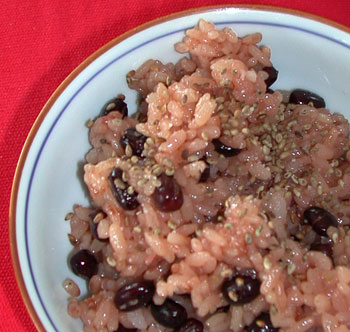
I haven't posted a basic Japanese recipe here in quite a while, so it's about time I did again! The main basic here is the method for cooking sweet rice.
Osekihan (お赤飯) means "red rice" (actually, 'honorable red rice' would be a literal translation, since the o makes it honorable). It's a holiday or special occasion dish in Japan, mainly because of its red (actually a very pleasing purplish-brown) color and the azuki beans in it (Beans are a symbol of good luck and fertility). It can be eaten at any time though - I made this batch for our annual Oscar-watching party.
Sweet rice is otherwise known as sticky rice, glutinous rice, or short grain rice. The Japanese characters usually used on packages are もち米 - mochigome or mochimai (mochi rice). Mochi is a very sticky gluey substance made by pounding the sweet rice. It is not the same as regular Japanese style rice ( うるち米 - uruchimai), which is also sometimes called short grain rice. It might be more accurate to call that kind of rice medium-grain rice; it's the same kind of rice in many ways as rices such as arborio and vialone.
Sweet or sticky rice grains are almost round, and when cooked have a very sticky, glutinous texture. People seem to love this or hate it. I love it, whether it's cooked as osekihan, or with various vegetables and meat and steamed in little bamboo leaf packets as chimaki, or wrapped in lotus leaves and similarly steamed with meat and vegetables Chinese style.
Now, if you have read my previous entry about the unreasonable choice of sweet rice or sticky rice as an ingredient for a 50 minute cooking challenge, you will know that sweet rice just has to be soaked in water for a while before cooking to fully cook it and bring out that characteristically gluey texture. My mother always soaks it overnight, and that is what I do. You can get away with soaking it for just an hour though.
Azuki beans are, next to soy beans, one of the most beloved beans in Japanese cooking. The most common use for them is in sweets, where they are turned into a paste called an. As I've said here before, I'm really not a big fan of an, but I love the azuki beans in osekihan - slightly al dente, and a good foil to the gluey sticky rice. It's the azuki beans that give the red color to this dish.
Osekihan is usually served at room temperature, with a sprinkling of gomashio, which is sesame seeds mixed with salt. You can buy readymade gomashio, but I don't like to since I think that premade gomashio tends to be too heavy on the salt. So I make my own as I need it - the simple instructions follow.
A note for people watching their calories: osekihan is very filling, what with the sticky rice and the beans. A small bowl goes a long way. And of course, it's fat-free, unless you count the small amount of fat in the sesame seeds.
Osekihan
- 3 cups of sweet (sticky) rice
- 1/2 cups azuki beans
- Water
- 1/2 tsp. salt
Wash the rice in several changes of water until the water is clear, then soak in fresh water for at least one hour, preferably overnight. (See this article for a step-by-step illustration of how to wash rice.) Drain the rice into a sieve at least one hour before you plan to cook it.
Wash the azuki beans. Put in a small pan with 2 cups of water, and bring to a boil, then simmer for about 30 minutes. Drain the beans, reserving the cooking liquid. Keep the beans covered so they don't dry out.
When the cooking liquid has cooled, measure it and add enough water to it to make 3 cups. If you have a rice cooker, put the rice, beans, water and salt into the cooker and switch on. If you don't have a rice cooker, put all the ingredients into a heavy bottomed pan, bring to a boil then lower the heat to low, put on a lid and let it steam-cook for 20 minutes, then switch off the heat and leave the lid on for an additional 20 minutes.
Serve at room temperature with a sprinkling of gomashio.
Link to a much better recipe for gomashio than the one I had here previously!
Submitted by maki on 2006-03-05 23:52.
If you enjoyed this article, please consider becoming my patron via Patreon. ^_^
 Welcome to Just Hungry, where we serve authentic Japanese recipes and more! I'm







Comments
Sovel
6 March, 2006 - 00:40
Permalink
Japanese basics: Osekihan (Sekihan), Festive Japanese Red Rice a
I really love your blog, great recipe again, thanks :)
foodcrazee
6 March, 2006 - 08:33
Permalink
Japanese basics: Osekihan (Sekihan), Festive Japanese Red Rice a
wow! that does sounds great - soaking for an hour is enough ? hmm...i usually soaked overnight like you do - guess mum knows best..
Thanx for the great post..
maki
6 March, 2006 - 20:32
Permalink
Japanese basics: Osekihan (Sekihan), Festive Japanese Red Rice a
Sovel and foodcrazee, thank you for your nice comments! It's really encouraging. :)
mizumi
12 March, 2006 - 20:28
Permalink
Japanese basics: Osekihan (Sekihan), Festive Japanese Red Rice a
i love rice so you made me happy with this recipe. i'll try it for sure. but i got a big doubt after reading your post.
i buy japanese rice which is sold as "sushi rice" or "short grain rice" at chinese supermarkets, how can i know if it's mochi rice or uruchimai? as far as i know both of them are sticky but i think i have never eaten mochigome but in mochi or manjuu form, so i don't know how mochigome tastes. i believe the one i eat is uruchimai.
the thing is that a japanese friend of mine told me to soak the rice for 30-60 minutes before cooking it so that it gets sticky, and he was talking about the most usually used rice. that one used everyday is uruchimai rice, isn't it?
so both need to be soaked in water to get sticky but uruchimai rice needs 30 minutes and mochimai, one night, is that right? (hehe, i'm so confused, hope you can help me out)
thanks again for writing about japanese food, your recipes look always so yummy :9
maki
13 March, 2006 - 13:15
Permalink
Japanese basics: Osekihan (Sekihan), Festive Japanese Red Rice a
Mizumi, actually any kind of rice that you intend to steam-cook benefits from a soaking in water beforehand. This helps the rice to cook quicker, and the grains to become plumper. Since the objective of Japanese rice is that plumpness, that's why it's usually recommended to soak the rice beforehand.
The times you've heard are recommended minimum times for soaking. Uruchi-mai (regular medium-grain Japanese rice) should be soaked for at least half an hour before cooking, but 1 hour or more is fine too. It cooks up fine if it's just cooking right away but it does taste better if it's been soaked. Busy home cooks in Japan often wash the rice in the morning, put it in a rice cooker with a timer function, so that the rice is cooked at dinner time. Or if they are making obento for lunch in the morning they wash the rice and set the rice cooker timer in the evening.
Mochi/sweet rice is much stickier than uruchi-mai, and the grains need to be plumper, so that's why the minimum recommended time is 1 hour. I would not soak rice any more than a few hours though.
Mochi/sweet/sticky rice is labeled quite clearly, and is also sold only in smaller bags. Plus there are only a couple of brands of mochi rice - the most common one has a picture of a rabbit making mochi in an usu (a sort of barrel) by pounding the rice. Most of the various rices you see sold as 'sushi rice' or 'short grain rice' is actually uruchi-mai, or regular Japanese rice. Finally, if you compare a mochi rice grain with an uruchi rice grain they look very different - the mochi rice is almost round.
Hope that helps!
mizumi
15 March, 2006 - 00:29
Permalink
Japanese basics: Osekihan (Sekihan), Festive Japanese Red Rice a
maki, your explanation is so great, thanks to you i finally have understood the difference, the mistery is solved ;) thank you very much!
Lucy
11 September, 2006 - 01:49
Permalink
Japanese basics: Osekihan (Sekihan), Festive Japanese Red Rice a
Thankyou for the recipe, i will try to make it on this week.
Looks so good.
I love red beans.
Nini
4 January, 2007 - 22:38
Permalink
Japanese basics: Osekihan (Sekihan), Festive Japanese Red Rice a
Can you use brown sweet rice? If so, should it be treated differently?
maki
5 January, 2007 - 17:51
Permalink
Japanese basics: Osekihan (Sekihan), Festive Japanese Red Rice a
Lucy, you can probably use sweet brown rice, but you'd need to soak it a lot longer, and use more water. If you have a rice cooker that can handle brown rice, give it a go! I've never tried it with brown rice though so no guarantees...
yuki
12 March, 2007 - 14:03
Permalink
Difference between red bean and azuki bean
Hi.
May I know what is the difference between red bean (those used to make red bean paste/soup in chinese cusine) and azuki bean?
maki
12 March, 2007 - 14:10
Permalink
the same thing
Yuki, if you mean the sweet red bean used in sweet soups and mooncakes, it's the same thing as azuki beans.
anon.
8 November, 2007 - 20:46
Permalink
Are these the same as the
Are these the same as the small red beans you'd find at the grocery store?
maki
9 November, 2007 - 01:03
Permalink
Depends...
I guess it depends on where the grocery store is, but in most cases azuki (adzuki) beans are labeled with that name these days, even the ones sold at Indian groceries.
gaijin
9 March, 2008 - 20:59
Permalink
So full..
It's probably the Americanized me, but I was wondering if anything should be added to the sekihan? Is it usually served as a side dish or the main course? I just felt it needed some salt or sugar, but that's probably me being uncultured or something.
It is extremely delicious though, I was happy it actually game out red with the bean juices. and you're right, one small bowl goes a long way...I'm just full from what I thought was half a serving...
maki
10 March, 2008 - 15:13
Permalink
gomashio
I myself think that plain osekihan is well, too bland. Plenty of gomashio on top makes it good! It's usually served with other things at a meal, like stewed vegetables (onishime) and so on.
Della
3 May, 2008 - 07:32
Permalink
Red Azuki Beans and Rice
I would love to make this Festive Red Beans and Rice, but I would like to substitute the sweet rice with short-grain brown rice because of its nutitional value and higher fiber and complex carbs. Will it work with short-grain brown rice?
maki
3 May, 2008 - 19:21
Permalink
Short brown rice should work
Short brown rice should work fine, though keep in mind that the beans themselves add quite a lot of fibre and nutrients anyway.
Paul
24 May, 2008 - 04:00
Permalink
Is this the same thing?
I've been looking for a recipe for this stuff for years. I lived in Japan for a few years and had lots of Japanese friends who would invite me to festivals (Omatsuri, etc.) and they would often serve sticky rice with red beans, wrapped in some sort of leaves/husks. I've always wanted to find out how to make that recipe, and just wanted to find out if this was the same thing -- and if so, if anyone knew what type of leaves they used (similar to corn husks wrapping tamales, but they definitely weren't corn husks). Thanks!
maki
24 May, 2008 - 10:51
Permalink
There are so many regional
There are so many regional differences that it's impossible to say if it is the same thing unless I've seen it myself, but I would guess it is so. It doesn't hurt to try and make it! The leaves used for wrapping the rice are probably bamboo leaves (sasa). When sticky rice is wrapped in bamboo leaves and steamed it's usually called chimaki. See this okowa recipe for another way to cook sticky rice.
Barbara
8 October, 2008 - 17:27
Permalink
Azuki beans
I noticed you did not comment on soaking the beans. I have made this 4 times already. I love to eat it for breakfast or with dinner. I am single so it works for me. An older Japanes women suggested I soak the beans because I told her I didn't like the taste of beans I cooked previously.
The 3rd time I soaked the beans for a few hours and the taste was better and the beans not so hard. Also the color of the rice was better. Alos, I omitted the sesame seeds because I don't care for them and added a teaspoon of salt to the rice. What do you think?
Please reply.
maki
8 October, 2008 - 19:12
Permalink
Sure, whatever works for you
Sure, whatever works for you is best for you! Older azuki beans do benefit from longer soaking, though fresher ones don't need it as much. A lot of people love sesame, but salt alone is good too.
Dennis
4 February, 2009 - 03:32
Permalink
Re: Japanese basics: Osekihan (Sekihan), Festive Japanese ...
If dried adzuki beans can't be found, can one substitute canned adzuki beans?
anon.
11 March, 2009 - 20:00
Permalink
Re: Japanese basics: Osekihan (Sekihan), Festive Japanese ...
Do you know of a way to make small batches of mochi without an usu and a big strong man? (^_^) I love love love mochi balls, but living in Maryland doesn't exactly give me a lot of places to buy them (nobody likes sweets made from beans :( ). Thanks!
Ball
11 November, 2009 - 20:32
Permalink
Re: Japanese basics: Osekihan (Sekihan), Festive Japanese ...
"Soga" = "Wakarimachita" = All right ?
Oh! I see.
Thank You!
Madelyne
21 January, 2010 - 05:38
Permalink
Re: Japanese basics: Osekihan (Sekihan), Festive Japanese ...
I love this recipe! So delicious and simple to make. I add a ton of gomashio, probably a 1/2 tbsp per serving=). I like sesame. I was able to make this successfully with sweet brown rice, which is all I had on hand. I just cooked the azuki beans for 15 minutes instead of 30 (since they would be cooking with the rice longer). I used a 1:2 water/ratio. It worked wonderfully. Thank you for the great recipes.
Madelyne
21 January, 2010 - 05:40
Permalink
Re: Japanese basics: Osekihan (Sekihan), Festive Japanese ...
Oh, I might add that the sekihan made with brown rice was not quite the pretty purple color you get when using white rice, but oh well...
anon.
3 August, 2010 - 02:23
Permalink
Re: Japanese basics: Osekihan (Sekihan), Festive Japanese ...
thats so good im doing japanese food for a project and i think im going to make this! thanks
anon.
18 August, 2010 - 03:56
Permalink
Re: Japanese basics: Osekihan (Sekihan), Festive Japanese ...
Hi!
I was wondering the best way to store this? I always have a dilemma when I store rice...Can you tell us about storing rice (this, and other kinds?) Thanks!!!
I really love your recipes and information by the way. SUPER fun and interesting to read :)
maki
18 August, 2010 - 08:26
Permalink
Re: Japanese basics: Osekihan (Sekihan), Festive Japanese ...
The best way to store rice long term is to freeze it - see how to do that over on JustBento.
Jill Moberg
21 November, 2010 - 08:12
Permalink
Re: Japanese basics: Osekihan (Sekihan), Festive Japanese ...
Is it possible to make any of the components of this dish in advance? Also, in your instructions you suggest soaking the rice overnight, but in a question in the comment section you say (March 13, 2006) "I would not soak rice any more than a few hours though." Can you clarify please. Thanks for the recipe my son is having a classmate from his University join us for Thanksgiving dinner and I am hopeful this will be a dish that reminds him of home in Japan.
maki
21 November, 2010 - 14:55
Permalink
Re: Japanese basics: Osekihan (Sekihan), Festive Japanese ...
The rice used here is not the regular Japonica rice that is used every day in Japanese home cooking; it's the type known as mochi rice or 'sweet' rice (see Looking at rice) and needs a bit more soaking.
Geo
19 July, 2011 - 16:10
Permalink
Re: Japanese basics: Osekihan (Sekihan), Festive Japanese ...
I have the mochi rice but the only red beans I could find were the canned variety. Can I use those? If so, at what point in the cooking process would I add them? Thanks in advance!
Judy
29 April, 2012 - 06:25
Permalink
Re: Japanese basics: Osekihan (Sekihan), Festive Japanese ...
Hi Maki-san,
I've been a closet reader of your blog for a while now, and I really enjoy all of your recipes.
I recently read your post about some of the challenges you've been facing since falling ill, but I hope you know that many of your readers, including myself, hope that you are feeling better soon and hope for your quick recovery.
I noticed that you had included 1/2 teaspoon salt in your ingredient list for this osekihan recipe, however, I think I might have missed exactly where I should use this salt when I was reading the instructions. Should I use the salt when boiling the azuki beans, or should I use the salt to cook it with the mochigome, or should I use the salt as seasoning, to sprinkle on top of the osekihan when it is done. Please advise. I'm looking forward to trying your recipe.
Thank you so much, sending positive energy and thoughts your way - - -
Judy
maki
29 April, 2012 - 09:27
Permalink
Re: Japanese basics: Osekihan (Sekihan), Festive Japanese ...
Oops, I see I repeated rice twice and omittied the salt. It's added together with all the other ingredients. I've corrected it now ^_^
Judy
30 April, 2012 - 17:26
Permalink
Re: Japanese basics: Osekihan (Sekihan), Festive Japanese ...
Thank you!!! :) My mom didn't have a sekihan recipe to share with me but she loves to eat it. I'm going to make this for her. Have a wonderful week, Maki-san.
Adrien
1 April, 2013 - 16:34
Permalink
In the pot with water VS In the bambou basket.
(Not sure my previous comment worked. Sorry if it is a doublon).
Hi and thank you for this goo website.
Usualy recipes call for rice to be cooked in a rice cooker or in a pot with water.
Yet in some books, the rice is laid on a clothe in a bambou steam basket on top of the pot. The rice is then covered with the clothe and during the cooking time some liquid is adding directly on the rice.
Does this second method have a specific name?
What are its pro and cons taste wise?
Thanks a lot!!!
Adrien
maki
2 April, 2013 - 13:57
Permalink
Re: In the pot with water VS In the bambou basket.
It's just steaming; rice can be steamed (like vegetables, or dumplings, etc) as well as cooked in water. Some types of rice lend themselves well to steaming, e.g. very stickly glutionous, aka sweet or mochi rice (this is not the same as regular Japanese type rice).
Adrien
2 April, 2013 - 15:57
Permalink
Re: In the pot with water VS In the bambou basket.
Thanks!
That is what I had come to understan myself. Glutinous rice are better cooked with steaming. I am experimenting with both types of cooking techniques.
Usualy cooking rice in water (boiling) is often called steaming.
Would you be so kind as to post your recipe of ginger rice?
Merci encore pour ce blog!
Adrien
Adrien
2 April, 2013 - 15:50
Permalink
How to get more Azuki taste.
Hi,
Thanks for this recipe.
Look and texture were great.
Yet I d like to get more azuki taste.
Maybe I am not that use to azuki taste and more to anko which taste is stronger.
I am thinking to add a little sugar.
What do you think?
Adrien.
maki
3 April, 2013 - 03:17
Permalink
Re: How to get more Azuki taste.
Sugar will not work at all in this recipe. It is not a sweet dessert. You may want to try adding more beans, or finding a better quality of beans.
Simon
4 February, 2014 - 11:14
Permalink
Re: Osekihan
I tried making this recipe twice over the weekend ... the first time didn't turn out so well, because I forgot to soak the dried beans first, but the second batch is delicious! The flavor and texture of the beans reminds me of roast chestnuts.