
Toshikoshi Soba or Year-End Soba: A bowl of hot soba noodles to end the year
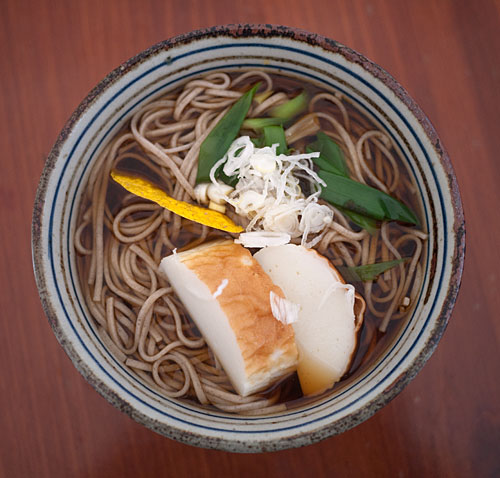
Revised and updated: This recipe for Toshikoshi Soba, or Year-End Soba, traditionally eaten in Japan on New Year's Eve, is one of the earliest recipes posted on Just Hungry. I've expanded the directions so that you can use various methods for making the soup. Originally posted December 30, 2003.
Even though Christmas has become big business in Japan in recent years, the real holiday at this time of year is New Year's Day. The end of the old year, called 師走 (しわす shiwasu), is a hectic time, as people are busily celebrating with friends and colleagues at 忘年会 (ぼうねんかい bounenkai), "forget the year" parties - besides wrapping up things at work and getting ready to go home for the holidays.
New Year's Eve itself (大晦日 おおみそか oh-misoka), however, is celebrated rather quietly by many people. There isn't the big urge to go to a party, to send off the old year with champagne and fireworks and tooting horns. In a way Japanese people do things the opposite of how people in the West celebrate Christmas or Hannukah vs. New Year's Eve and New Year's Day: Christmas is an excuse to have a party (it also happens to be a big 'date' day, when couples stay for the night at a luxury hotel for a romantic party of two). New Year's Eve, New Year's Day and the few days afterwards are when you spend time with family at home. On New Year's Eve, you'll stay home and reflect on the old year, watch some year-ending entertainment programs on TV, and perhaps go to the local temple at midnight, while hearing the 108 rings of the bell to "ring away" the evils of the old year.
The traditional evening meal to have while waiting to greet the new year is a bowl of hot soba noodles, called 年越し蕎麦 (としこしそば toshikoshi soba), which roughly means "end the old year and enter the new year soba noodles". There is no one set recipe for this soba - they are probably as many varieties as there are households. At our house my mother simply prepared a straightforward bowl with hot soup, something on top such as a slice of kamaboko, a rather rubbery fishcake; perhaps some spinach or othe green leavy vegetable, a raw egg dropped on top just before serving. When a raw egg is used like this in a bowl of hot noodles, whether it's soba or udon, it's called 月見 (つきみ tsukimi) - moon-watching.
Hot soba noodles can be enjoyed at any time of the year of course, but since I usually prefer cold soba, New Year's Eve is usually the only day I have this. It is quite good and comforting.
When I originally wrote this article 5 years ago, soba (buckwheat) noodles, were generally only available at Japanese grocery stores. How times have changed! Now you can buy them at many general supermarkets, health food stores and such. There are many different brands, at all price ranges. Look for one that has smooth, mostly unbroken (a few strands may break) noodles that are fairly thick. Avoid the very cheap brands; with soba you really do get what you pay for.
Recipe: Toshikoshi Soba: Year-End Soba Noodle Soup
Note that the toppings are not that important here. What is important is properly prepared noodles, and a good flavorful soup. I've given three methods for making the soup, ranging from best (using kaeshi) to ok (using storebought readymade sauce).
Per 1 large bowlful:
- About 60 g / 2 oz. dried soba noodles
- basic dashi stock
- Kaeshi, or soy sauce, mirin and sugar
- OR instead of the dashi and ingredients above, a bottle of tsuyu or mentsuyu (readymade noodle sauce), available at Japanese grocery stores
- Toppings such as kamaboko, spinach leaves, egg (optional)
- Green onions, finely chopped
- Nanami or shichimi tohgarashi- seven-ingredient red pepper spice (see notes)
Bring a large pot of water to boil. Put in the soba noodles and lower the heat to a simmer. Cook until the noodles are not quite al dente - it should be cooked through. (Dried soba noodles, unlike dried semolina pasta, is rather delicate so you don't want to cook it in a rolling boil.) As soon as it's done, drain the noodles, and plunge it a bowl of cold water. Change the water frequently as you rinse the noodles. The objective is to get rid of any sort of starchy service on the noodles. Once this is done, drain the noodles and set aside in a colander. (See the very detailed instructions on how to cook and rinse soba noodles here.)
Make the basic dashi stock, and use an extra handful of bonito flakes. (You can also use vegetarian dashi stock if you prefer.)
If you are using kaeshi, mix 1 part kaeshi to 5 parts dashi stock. Vary to your tastes (don't make it too weak or too strong, but remember that you'll be putting soba noodles in it, so make it just a bit stronger/saltier than you think is necessary).
If you are using soy sauce and mirin straight, first mix the soy sauce and mirin in a 2 to 1 ratio (e.g. 2 Tbs. soy sauce and 1 Ts. mirin). Add a little sugar (for 2 Tbs. soy sauce add 1/2 tsp. or so of sugar). Add dashi to taste, at about the same 1 (soy sauce + mirin + sugar) to 5 (dashi) ratio.
If you are using store-bought tsuyu or mentsuyu (noodle sauce) in a bottle (such as this one), add plain water to the until it tastes right to you. The ratio depends on the brand and type. Note that even ones that say they are 'straight' (as in, not concetrated) will need to be thinned out for hot noodle soup, since they are meant to be used 'straight' for cold noodle dipping sauce, which is a lot stronger.
Heat up the soup. Put in the rinsed soba noodles, and gently simmer until the noodles are heated through.
Put noodles into serving bowls. Add soup, and any toppings. If you're adding a raw egg (be sure you're only adding a 'safe' egg!), add it at the last moment.
Garnish with a little of the chopped green onion and/or shichimi tohgarashi on top. You could also add a dab of wasabi, a small sheet of nori seaweed, and so on.
Notes
七味唐辛子 (しちみとうがらし shichimi tohgarashi or nanami tohgarashi) is a mixed ground spice, containing red pepper, dried citrus skin, sesame seeds, etc. It's a commonly used table spice. You could use ground up red papper flakes as a substitute, though it won't have the same complex flavor and aroma. It's quite inexpensive and lasts a long time, so look for it at a Japanese food store. (Or you can buy it from Amazon Groceries.) I consider it to be a very important ingredient in my Japanese pantry.
Soup made with dashi, soy sauce and mirin is used for most Japanese noodles. The saltiness or strength of the soup is controlled by the ratio of soy sauce to dashi - the more dashi, the thinner the soup.
See this kitsune udon recipe for a vegan topping alternative (simmered aburaage or tofu skin). Of course, you could just enjoy the noodles with no topping, just the green onion and shichimi tohgarashi.
Japanese people usually don't do much drinking on New Year's Eve, because it's considered to be a good thing to greet the New Year bright and early. (Drinking during the New Year's festivities is another matter.)
Submitted by maki on 2008-12-29 10:20.
If you enjoyed this article, please consider becoming my patron via Patreon. ^_^
 Welcome to Just Hungry, where we serve authentic Japanese recipes and more! I'm






Comments
elise
1 January, 2004 - 00:24
Permalink
Toshikoshi soba: noodles to end the year
I love soba! Especially zaru soba, though I guess that's more of a summer dish. Thanks for posting this recipe. I lived in Kyoto for a year and miss the food almost as much as my friends.
maki
1 January, 2004 - 21:18
Permalink
Toshikoshi soba: noodles to end the year
Elise, the one thing I miss all the time about Japan is the food...that's partly why this blog exists! :)
carsten
2 January, 2004 - 00:45
Permalink
Toshikoshi soba: noodles to end the year
Looks great. But there's one thing I don't like about japanese food: too much fish. :)
I just bought some miso to try out your miso-recipe and it came with some extra dried seaweed which also tasted to fishy to me. Is there any chance to make a adequate dashi stock without using Bonito or other fish?
maki
2 January, 2004 - 01:55
Permalink
Toshikoshi soba: noodles to end the year
Carsten, dried bonito flakes don't really taste fishy...but if they do to you, you can try using instant dashi powder or granules. They are sold under names such as Hondashi, and are ok for regular use. Seaweed shouldn't taste fishy though...unless it got humid and old or something, which is not good.
I'll try to post some non-fish Japanese recipes too. There are lots of them!
elise
2 January, 2004 - 05:02
Permalink
Toshikoshi soba: noodles to end the year
I only lived in Japan one year, but I missed the food every day for years. It's only now, while I'm getting my retired parents to teach me how to cook the food they love, that my attention is more focused on American food. I loved the way that you could get a teishoku - a set meal - at a corner one room restaurant, set up mostly for young bachelors, for $5 and be completely happy. I was studying martial arts in Kyoto and didn't have much money to spend, nor could I recognize most of the foods in the grocery store, so these little neighborhood places kept me alive. Oyako donburi, zaru soba, miso soup, and my favorite - nasu gengaku. Yum. I couldn't get enough. Happy New Year maki, and thank you for making this wonderful web site!
maki
3 January, 2004 - 20:53
Permalink
Toshikoshi soba: noodles to end the year
Happy New Year to you also elise! I've added your beautiful site to my food blog sitelist too. :) I'll be visiting frequently!
Lisa
30 December, 2008 - 03:32
Permalink
Question about Moon Watching
Hi - love your blog - I lurk on it religiously. I have a question on the egg thing.
It looks yummy, but is it only the yolk? It doesn't look like the white is in the soup. Is it completely raw, or slightly poached? Are you supposed to mix it in, and does it get all "egg drop soup"y then?
maki
30 December, 2008 - 21:14
Permalink
It’s a raw egg, which is
It's a raw egg, which is mixed into the soup which cooks it a bit. It becomes a sort of sauce then. (Japanese people love using raw egg in this way, e.g. the 'sauce' for sukiyaki is a raw egg.)
mewmew
30 December, 2008 - 19:21
Permalink
How I love your blog. I
How I love your blog. I heard about End of Year Soba only once, thanks for giving us the recepy. Really, food is nothing without the emotions in its wake. I´m going to make some, even if it´s not New Year´s eve. I wish everyone around here a wonderful NewYear!!
gretchen
30 December, 2008 - 20:19
Permalink
happy new year makiko
thank you so much for posting, i missed it the first time. i have just come back from a trip to japan and am very much missing the food right about now. i have been thinking about making some soba, we usually make fox style udon at home because the kids love it...but this time i will try the egg (moon) soba for new year (soba seems so much healthier than udon), best to start out the new year healthy! thank you again!
grace
30 December, 2008 - 21:01
Permalink
end of the year soba
Thank you for this post and soba recipe - I'll be making this for sure tomorrow night! It brings back lovely memories of past New Years.
Have a safe and happy new year!
BrookeJ
31 December, 2008 - 14:50
Permalink
Thanks for this - I missed
Thanks for this - I missed it the first time around! I tried this out last night and it was delicious. Like you, I usually prefer cold soba so I don't really think of making it in the winter. This is a great way to start getting back on track after the gluttony of Christmas.
Pattie
31 December, 2008 - 19:11
Permalink
Happy New Year
Thank you for posting this recipe. And now that I've found your blog I see how the rest of my day is going to be spent. ^__^ Nice to meet you!
Mary
31 December, 2008 - 19:53
Permalink
toshikoshi soba ftw!
This will be the second year that I've served this toshikoshi soba at the party following my aikido dojo's New Year misogi. It was a huge hit last year -- hungry people coming off the mat after a hard workout wanted something yummy, and toshikoshi soba fit the bill! The dashi and the kaeshi are ready, the noodles are cooked -- now all I have to do is survive misogi, and I'm all set!
Nolwenn
1 January, 2009 - 09:09
Permalink
I do love soba in a hot soup
I do love soba in a hot soup ! I prefer it with green onion or finely chopped leek and abura-age (my 3 yo daughter LOVES abura-age !!!!).
I'll try with these toppings even if I'm afraid of raw egg.
I wish you a wonderful new year Maki and hope you'll continue to share Japanese cooking and homestyle with us :)
SBS
2 January, 2009 - 01:56
Permalink
OK, I tried it New Year's Eve
Very good, actually, made with a little spinach for the greens, etc., and no raw egg. Sort of a basic soup, but now I know how to make a good broth for it and experienced the hands-on washing of the soba noodles. Will try the noodles cold sometime in warmer weather this year. The photos and instructions are excellent. Thank you, Maki. Without your instructions and history of the dish, I wouldn't have known to try it.
If you've ever had Hamura's saimin on Kaua'i (they even make their own fresh noodles), you'll know what I'm comparing this soup to. This must be the old-time generations-back basic recipe that Hawai'ian saimin is based on.
Today, New Year's Day, it's pork and sauerkraut, mashed potatoes, applesauce, and a happy belly for me. Thanks for the recipe: I really will make it again. Wishing all of you a prosperous Happy New Year as you enjoy your traditional foods, too.
EJ
2 January, 2009 - 10:16
Permalink
Nanami v. Shichimi...
First off, thanks for the great blog! Made Japanese food seem accessible for the first time for me, and I finally made my first successful dashi stock/miso soup. Secondly, as I've just filled my pantry with all sorts of Japanese staples...
Is there any big difference between nanami versus shichimi tohgarashi? I meant to get shichimi but I bought nanami instead. Trying to decide if it's worthwhile to exchange it. From what I've read it seems that nanami is more citrusy than shichimi, but I thought I'd get your personal take on it.
Thanks and happy new year!
maki
2 January, 2009 - 22:35
Permalink
nanami and shichimi are the same thing
nanami and shichimi are two different ways of reading the same thing - 七味 - meaning seven flavors. So you don't need to exchange it!
EJ
2 January, 2009 - 23:36
Permalink
Ohhh… Well, you learn
Ohhh... Well, you learn something new every day. Thanks!
Emski
2 January, 2009 - 23:44
Permalink
Great site, I’m taking it
Great site, I'm taking it as a good omen that I found it right at the beginning of this year! Looking forward to exploring it!
Reina West
1 February, 2010 - 22:16
Permalink
Love your website
Any idea on how to make" suiton"?? It's similar to dumplings with a champon like broth.. I think. my Mom would stop by this little shop for a quick bite on our way to Nagano every winter. I also have a few other dishes that I need some updating on!! Thank you!!
vessel sinks
29 March, 2010 - 07:56
Permalink
Re: Toshikoshi Soba or Year-End Soba: A bowl of hot soba ...
A lot of dishes recipes are spread all over the world.
kristen
29 June, 2010 - 00:49
Permalink
Re: Toshikoshi Soba or Year-End Soba: A bowl of hot soba ...
Firstly, this is my first time posting but I have been enjoying your blog for some time now! I make this soup at home and I don't usually use the fish cakes, but I bought some and would like to try it. After you thaw the frozen fish cakes, how long do they stay good in the refrigerator? thanks!
anon.
5 August, 2010 - 12:14
Permalink
Re: Toshikoshi Soba or Year-End Soba: A bowl of hot soba ...
Thanks so much for this recipe. I know I shouldn't be eating this every day but you've made a hungry student very happy :-)
Auntie Aku
26 December, 2011 - 18:56
Permalink
Re: Toshikoshi Soba or Year-End Soba: A bowl of hot soba ...
I've been looking for this recipe, so thousand thanks!
But say, if I can't get my hands on dashi stock, and don't have time to make it myself, is it okay to use "normal" fish stock sold in the closest supermarket? ^^;
maki
27 December, 2011 - 19:06
Permalink
Re: Toshikoshi Soba or Year-End Soba: A bowl of hot soba ...
Well, it may taste okay but it will certainly not taste like it should. See if your supermarket has something called 'hondashi' or 'dashi powder'. Whole Foods carries this, at least in the larger stores.
takako
26 December, 2012 - 00:05
Permalink
Re: Toshikoshi Soba or Year-End Soba: A bowl of hot soba ...
I am Sansei, 3rd generation Japanese-American. My nisei mom never liked dashi for her soba so we ate toshikoshi soba in chicken broth. My son however, prefers traditional dashi so that is how we eat it now.
anon.
31 December, 2012 - 18:22
Permalink
Re: Toshikoshi Soba or Year-End Soba: A bowl of hot soba ...
my recipe Mirin-3Tsp Dense-Soy-Sauce-2Tsp Sake-1Tsp Boiling.
Katsuobushi-Handful Water 150cc-200cc in and Boling.
eat while watching the moon
Layma V
1 January, 2013 - 04:27
Permalink
Re: Toshikoshi Soba or Year-End Soba: A bowl of hot soba ...
Made this tonight as I was all by myself for New Year's Eve and absolutely loved it! Thanks for posting - I think this is going to be my tradition now too. :)
B
2 January, 2014 - 14:03
Permalink
Re: Toshikoshi Soba or Year-End Soba: A bowl of hot soba ...
Thank you! I made this on NYE and it was delicious. 美味しかった
Katharina
28 December, 2014 - 18:07
Permalink
Re: Toshikoshi Soba or Year-End Soba: A bowl of hot soba ...
Yesterday I had this yearning for an udon soup and instantly looked for a recipe on your site. Luckily I had all the ingredients and made this very delicious soup. Thank you, for your great site and the anazing recipes. I am reading a lot of them and tried also a couple