
Okonomiyaki, Osaka style
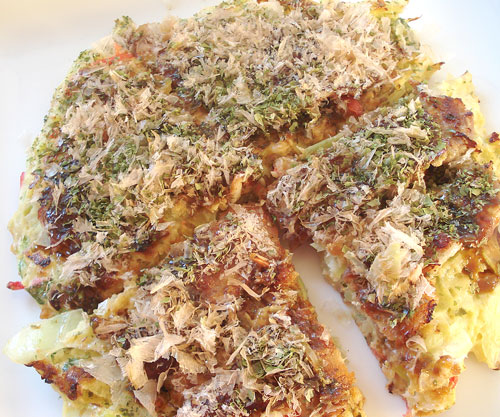
Okonomiyaki is getting slowly more popular outside of Japan. It's often described as a Japanese pizza, but it's more like a savory pancake.
Okonomiyaki was invented, they say, in Osaka, which is a city famous for cheap and good eats. Okonomiyaki is a snack more than a full meal, though it is pretty filling. It's a quintessential yatai or streetside food stand food, though nowadays you're more likely to eat it indoors than sitting at an outside stall. It's a very communal type of food, especially if you cook it on a tabletop griddle.
This is a fairly authentic recipe I think, or as authentic as a Tokyo born-and-bred girl can get.
The essential ingredients
Okonomiyaki uses some very Japanese ingredients which may need some explanation. (Check out the ever growing reader-contributed list of Japanese grocery stores to find these ingredients.)
Nagaimo
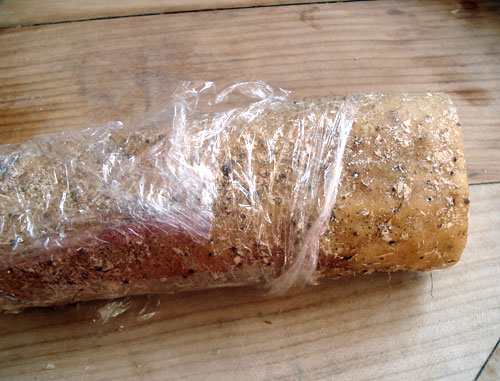
Nagaimo is a starchy root vegetable, which can be known under the names taro root or under that annoying generic term for any starchy root vegetable unfamiliar to to the Westerner, yam. It is usually sold in cut up lengths wrapped in plastic. It looks like this:
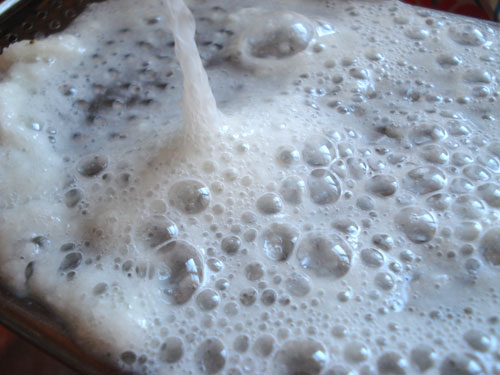
You will use this grated into a gooey, sticky pulp, which looks like this. (This is where some juvenile surfer discovers this page and snarks about how it looks like spit, sperm, or a combination of both.)
A lot of people have a mild allergic reaction to raw grated nagaimo. I have that reaction - it makes me itch a bit. So I avoid skin contact with the raw surface by only peeling as much of the root as I need (for this recipe, about 4 inches or 10 cm) and holding the root in its plastic wrap while grating. To keep the rest of the root, let the exposed cut end dry off a bit then wrap securely in plastic.
The glutinous, gelationous quality of the nagaimo gives the okonomiyaki batter a certain bounce. I've tried substituting grated potato, which sort of works, but nagaimo is better. The only subsitutes for nagaimo are even harder to get outside of Japan, yamaimo or yamatoimo. I can get raw nagaimo in my tiny local Japanese grocery, so any decent Japanese grocery store should have it.
There is a dried yamaimo powder which can be used instead. (In practice though, I've found that if a store has dried yamaimo powder, it's also likely to have the raw nagaimo root too, and I prefer to use the latter. If you can only get stuff by mailorder though, the powder is more handy. Japan Centre carries it.)
Aonori
This is a dried, very green version of nori seaweed. It's usually sold in finely shredded almost-powder form. It's quite inexpensive, so it's worth buying. A substitute would be finely shredded regular nori, but aonori is usually a bit cheaper. Used as a topping.
Katsuobushi
Dried bonito flakes. One of the essential Japanese ingredients. Used as a topping with aonori.
Okonomiyaki sauce
This is a sweet version of tonkatsu sauce, which is described here. This is available at Japanese grocery stores. You can use tonkatsu sauce instead. It's not essential to use this sauce - my mother for instance prefers a little drizzle of soy sauce on her okonomiyaki instead.
Japanese mayonnaise
Mayonnaise is used as the sauce on top of the okonomiyaki by a lot of people, though it does make the whole thing very rich. A Japanese brand like Kewpie is preferred, though Hellman's or whatever works too. It adds richness and a touch of acidity.
Dashi stock
The base of Japanese food! Here is the basic recipe, but you can use a pinch of dashi stock granules (such as hondashi).
Beni shouga
Pickled and red dyed ginger. Colorful, cheap, and cheerful. Available at any Japanese grocery store.
Tenkasu
Tenkasu is little bits of batter that fall into the oil when you are frying tempura. It's used as a flavoring ingredient in a surprising number of dishes. You can actually buy premade tenkasu in a well stocked Japanese grocery store, but I find it hard to justifying spending money for something which is just oily bits of batter. On the other hand, I don't really make tempura often enough to have a stock of tenkasu around. So what I do is to make some of the okonomiyaki batter into impromptu tenkasu. I'll show you how in the instructions.
Sakura ebi
Tiny dried shimp. This is an optional but nice ingredient to put in.
Thinly sliced pork belly
This is the part of pork that gets turned into bacon. In Japan you can get this part very thinly sliced, as a normal supermarket cut (butabaraniku usugiri). Elsewhere, you may have to ask your butcher to slice it for you. If you can't get it pre-sliced, get a chunk of pork belly, freeze it until it's quite stiff but not a solid ice block, and slice it yourself.
Cabbage, eggs and flour
You should have these around. Regular flour is fine - you only need a little bit of it as a binder.
Professional okonomiyaki stores may use beautifully finely shredded cabbage, but if your knife skills do not measure up, roughly chopping it (even in a food processor) is fine.
So, if you've managed to get all the ingredients together, let's make okonomiyaki.
Recipe: Okonomiyaki
This makes 3 medium or 2 big okonomiyaki. A medium okonomiyaki would feed one person. A big appetite can handle one big okonomiyaki. You can also cut them into slices to serve many as appetizers or beer snacks. Increase the amounts proportionately for more servings.
- 120g / 4 oz. grated nagaimo, or the equivalent amount of reconstituted yamaimo powder
- 4 to 5 tablespoons of dashi stock, or water with a pinch of dashi powder
- 60g / 2 oz all purpose flour, sifted
- 3 'large' (60g each) eggs
- 2 to 3 tablespoons of beni shouga
- 4 tablespoons of tenkasu
- About 300g / 10 1/2 oz. (about 2 packed cups) roughly chopped cabbage
- 6 to 8 thin slices of pork belly
- 3 tablespoons of chopped green onion (optional)
- 1 tablespoon of sakura ebi (optional)
- Oil for cooking
The topping:
- aonori
- katsuobushi
- okonomiyaki sauce or tonkatsu sauce plus optional mayonnaise
Equipment needed:
- a griddle plate or a large non-stick frying pan
- a smaller frying pan
- a wad of paper towels or cotton wool
- a grater
- a brush for the sauce (optional)
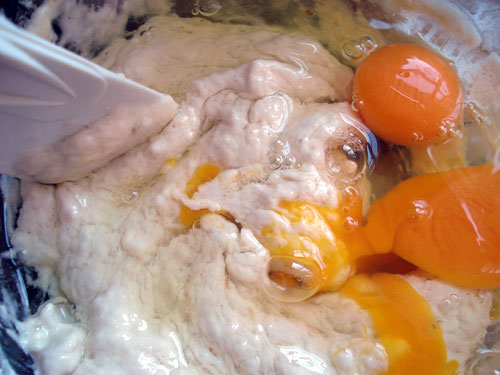
Peel and grate the nagaimo, following the hints above for protecting your hands. Mix with the dashi and flour, and add two of the eggs. It should be a rather loose batter.
At this point, if you don't have any tenkasu on hand, heat up some oil in a small frying pan. Dribble some of the batter in the hot oil.
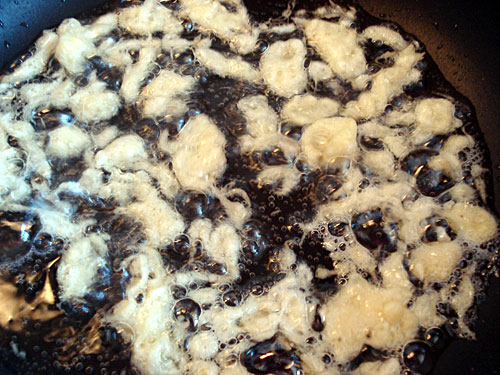
Cook until golden brown. Drain off the oil (you can use it to cook the okonomiyaki) and allow the tenkasu to cool.
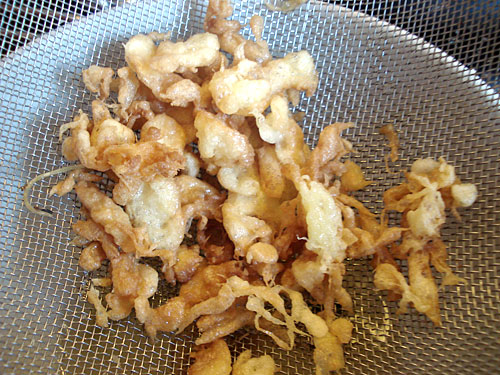
Add the chopped cabbage to the batter.
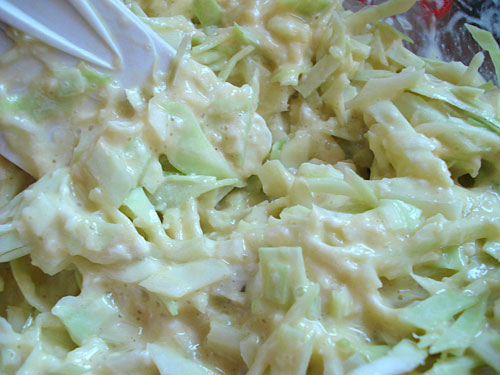
Add the other egg. Stir with a big spoon or a spatula to combine.
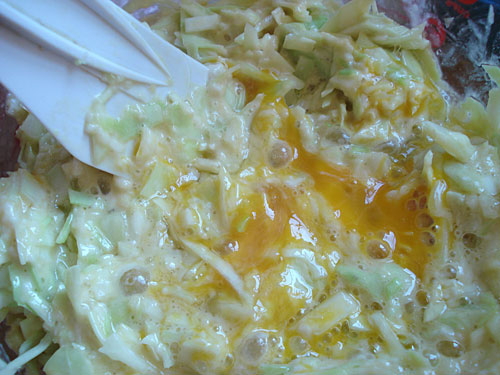
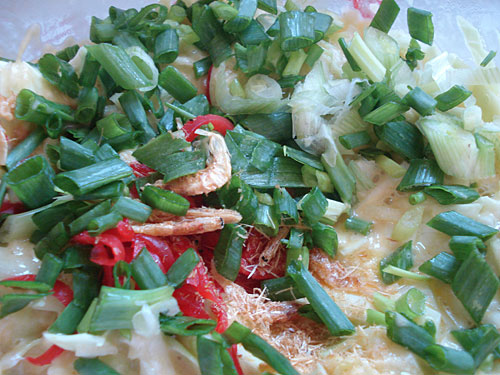
Add the other ingredients except the pork. Crumble the tenkasu with your hands a bit before adding. Stir to combine.
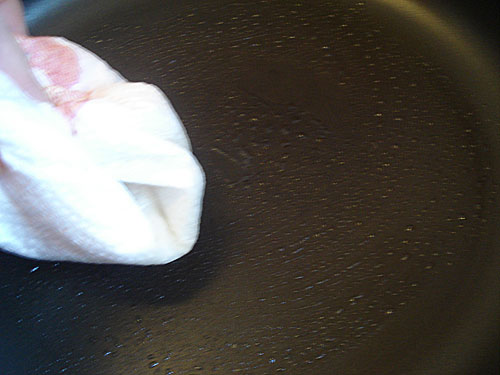
Heat up your griddle pan or big frying pan. Take a wad of cotton wool or paper towels, and spread around a thin layer of oil.
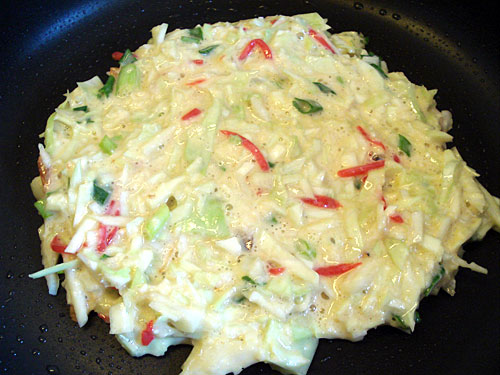
The heat should be about medium-low. Spread 1/3 to 1/2rd of the batter in a circle on the pan. If this is your first time, go with the smaller size to make flipping easier.
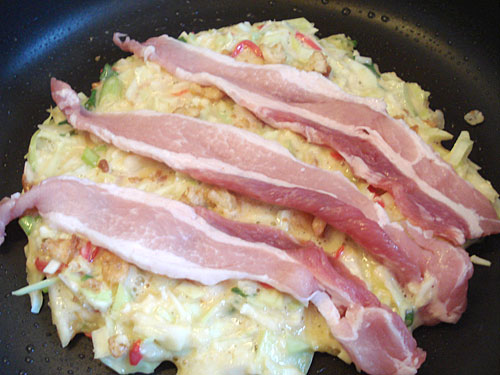
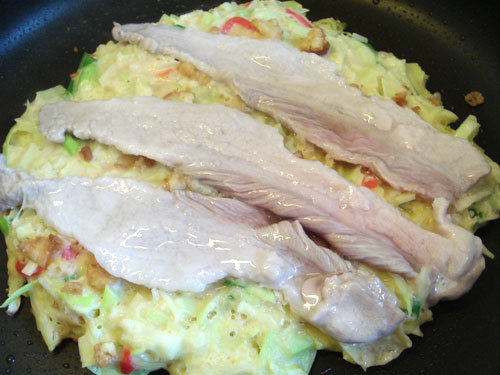
Place 2 to 3 strips of pork as flat as possible on top of the batter.
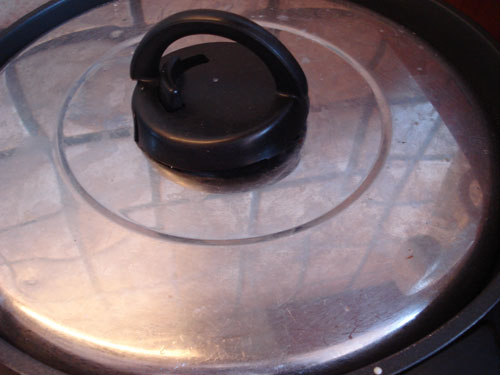
Put on a lid, and let it steam-cook for about 5-6 minutes.
When the pork has lightened up in color, it's time to flip the okonomiyaki.
Take two spatulas and flip the thing over carefully. Voila! Continue cooking without a lid for about 3-4 more minutes. Lower the heat if it's cooking too fast, or turn it up a bit if it isn't. Try to resist the urge to press down on the okonomiyaki at this point - doing so will squeeze some air and fluffiness out of the okonomiyaki.
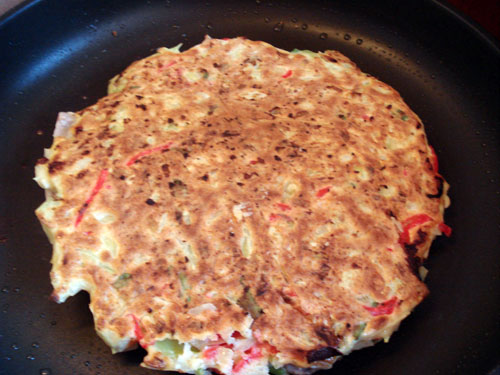
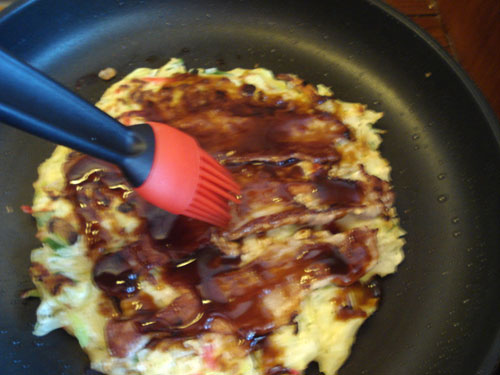
Flip over once more, so the pork side is facing up. Brush with the sauce of your choice - straight okonomiyaki sauce, a mix of okonomiyaki sauce and mayonnaise, soy sauce, etc.
Sprinkle on some katsuobushi and aonori liberally.
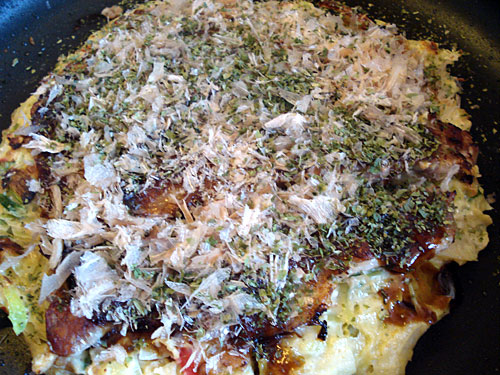
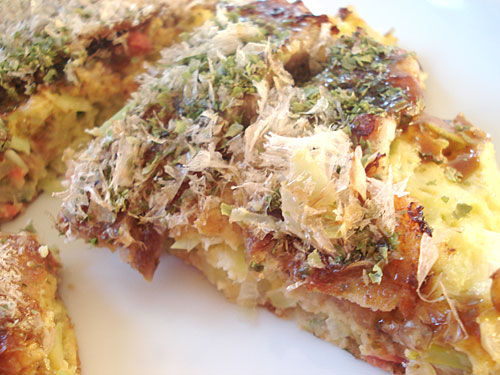
To serve, cut into 4 pieces (the pro does this on the plate with a spatula, but you can use a knife on a cutting board).
The inside should be just cooked through, not doughy or runny. Eat while piping hot. (Okonomiyaki is edible enough when it's cold, but it's one of those foods that is so much better when it's freshly made.)
Notes
A Hiroshima-style okonomiyaki is either two of these with some yakisoba (pan-fried noodles) in between, or one of these as a base, topped with a mound of yakisoba, and then a fried egg. One Hiroshima-style okonomiyaki comes in at around 1000 calories. Enjoy.
You can omit the pork belly slices. You can try substituting bacon, but that would flavor the whole thing.
You can get okonomiyaki mix, which has flour, nagaimo powder, dashi, and things already in there. You just add water, or water and egg, depending on the kind. But, that's not nearly as much fun.
Submitted by maki on 2008-02-08 20:50.
If you enjoyed this article, please consider becoming my patron via Patreon. ^_^
 Welcome to Just Hungry, where we serve authentic Japanese recipes and more! I'm







Comments
Nico
8 February, 2008 - 23:20
Permalink
WOW
My eyes popped when I saw this recipe!!! It looks... filling. I bet it would make a good bar snack or hangover food, but to these American eyes it reminds me most of an appetizer you can get at the Unos Pizza chain... the one with mashed potatoes in a deep dish pizza crust with cheese and bacon and onion topping. I think it was ranked one of the worst foods in the world in terms of fat content and lack of nutritional value, but oh boy is it ever tasty.
I bet if I ever made this for a party and served with beer, all the men in the room would stampede for it. :)
anon.
9 February, 2008 - 01:21
Permalink
this looks so delicious…
this looks so delicious... :)
maki
9 February, 2008 - 08:33
Permalink
It is very filling…but not
It is very filling...but not that bad nutritionally. It has very little oil in it, only 2 or 3 thin slices of bacon-like meat, and at least a whole cup or so of choppped cabbage. I think it's probably around 250 calories for a whole one, or 300 if you load up on mayo in the sauce.
And yep, it is delicious! :)
anon.
29 March, 2011 - 00:29
Permalink
Re: It is very filling…but not
An Osaka style okonomiyaki is around 1000 per serving. Not necessarily because it's unhealthy but because there are a lot of ingredients in it.
Izumi
9 February, 2008 - 15:40
Permalink
I love okonomiyaki! Living
I love okonomiyaki! Living in Osaka, it's my favourite food hands-down. Glad to have a recipe onhand for whenever I leave Japan. :)
anon.
26 September, 2010 - 00:44
Permalink
Re: I love okonomiyaki! Living
Your not going to leave Japan if you keep eating those my friend...
Kevin
9 February, 2008 - 19:51
Permalink
Great, super informative
Great, super informative okonomiyaki post! It has been a while I last made okonomiyaki.
Mitch
9 February, 2008 - 21:22
Permalink
Wow. I didn’t realize how
Wow. I didn't realize how intricate the recipe was. All the ingredients are readily available here in Honolulu but I have only had it freshly prepard at food counters from Japanese department stores here (Shirokiya, Daiei). I have also come across a couple of Japanese restaurants that specialize in this dish. I am not familiar with nagaimo but had yamaimo growing up. My grandfather used to grate it up and put into miso soup and enjoyed it that way, I call it tororo. I however, had difficulty eating it like that as it was really slimy. Lol. Funny thing, I just looked up 'tororo' on wikipedia and it says that it was used during the Edo period as a homosexual lubricant. I can see why, but not sure why it wasn't used as a heterosexual lubricant.
kantogirl
10 February, 2008 - 09:37
Permalink
as other ppl previously
as other ppl previously said: wow.
i'm not sure if i can get all the ingredients here in manila, but i know this stall in a mall downtown that makes decent okonomiyaki. makes me want to go there really soon and get me a fix.
Jennifer
31 December, 2008 - 07:14
Permalink
Fellow Manila-ite~
Actually, there are some great Japanese grocery stores along Pasay Rd., near Greenbelt 3. I've been able to find all of the ingredients at one store called 'Sakura', except for namaimo and except for real dashi stock (they have dashi powder). There's also apparently a store called 'Hatchin' on Sacred Heart Rd., near Makati Medical Center. Hope you get to try making the recipe too. :)
Thanks for the recipe, Maki~ Can't wait to try making it tonight for my family. :D
a*coz
17 June, 2009 - 19:38
Permalink
Re: Fellow Manila-ite~
[quote=Jennifer]Actually, there are some great Japanese grocery stores along Pasay Rd., near Greenbelt 3. I've been able to find all of the ingredients at one store called 'Sakura', except for namaimo and except for real dashi stock (they have dashi powder). There's also apparently a store called 'Hatchin' on Sacred Heart Rd., near Makati Medical Center. Hope you get to try making the recipe too. :)
Thanks for the recipe, Maki~ Can't wait to try making it tonight for my family. :D[/quote]
If you guys want to try out okonomiyaki made by an actual Japanese community in Manila, you can check out Kagura which is in Little Tokyo (yes it's the Japanese counterpart of Binondo or Chinatown in Manila) along Chino Roces Ave. formerly Pasong Tamo. They have a bunch of other restaurants and groceries there too.
a*coz
29 April, 2009 - 09:12
Permalink
Re: as other ppl previously
[quote=kantogirl]as other ppl previously said: wow.
i'm not sure if i can get all the ingredients here in manila, but i know this stall in a mall downtown that makes decent okonomiyaki. makes me want to go there really soon and get me a fix.[/quote]
Where in Manila do they make okonomiyaki? I'm actually from Baguio and have been making my own okonomiyaki thanks to Maki's recipe. But it would be great to see and taste how the pros do it (in case I've been doing it wrong all this time) haha. Thanks! ^_^
Gigi
10 February, 2008 - 14:03
Permalink
Wow Pretty Yummy!
Wow! I'm visiting Osaka in a few weeks! I will be sure to seek this out!!!
Thanks Maki!
Phil
10 February, 2008 - 14:11
Permalink
I’m a huge okonomiyaki
I'm a huge okonomiyaki fan, and have always wondered if there was some relationship between okonomiyaki and Korean kimchijeon/pajeon? Did one inspire the other?
maki
10 February, 2008 - 20:48
Permalink
I rather doubt that either
I rather doubt that either one directly influenced the other - they are both after all, just pancakes. Almost every country/culture that has some sort of flour has a pancake-type recipe. Both are delicious though!
Adina
11 February, 2008 - 02:17
Permalink
Thank you!
I visited Japan for the first time last summer, and had okonomiyaki twice in Hiroshima. It was so delicious. I'm very glad to now have a recipe so that I can make it for myself here at home, and don't have to wait until the next time I visit Japan.
Lori
11 February, 2008 - 09:27
Permalink
Mmmm
Hi Maki,
I really enjoy a good okonomiyaki but don't find them too often around my area. I get to eat it only once every 3 or 4 months!
Storyweaver
11 February, 2008 - 18:56
Permalink
Very close to the recipe I
Very close to the recipe I use at home. Dashi is hard hard hard for me to come by, so I've used homemade chicken stock instead, which works nicely. Also, someone I know suggested using rice krispies as a sub for the tempura bits. I like your idea of cooking some of the batter instead!
keiko
11 February, 2008 - 20:19
Permalink
Hi Maki-san - I’m REALLY
Hi Maki-san - I'm REALLY hungry now...!
maki
18 February, 2008 - 17:19
Permalink
sumimasen, keiko san ^_^;
sumimasen, keiko san ^_^;
Pat
11 February, 2008 - 21:53
Permalink
This is awesome!
I love this dish, but only knew how to make it using okonomiyaki mix. The mix usually makes the pancake really dense, too much for my liking so I'm excited to try this recipe. There's an okonomiyaki restaurant I go to all the time and they have some fun & interesting choices of ingredients in lieu of pork belly, such as: ground beef and miso, mochi and cheese, natto, spam and cheese, pork and kimchee...to name a few. I've tried them and they were surprisingly good. Another tip for others that are new to handling nagaimo, wear a new/clean rubber glove when peeling and grating them. They are super slippery so this allows a good grip and provides extra protection for your hand. I learned that the hard way.
Ami
14 February, 2008 - 02:39
Permalink
Saving the nagaimo in the freezer?
I was wondering if you could grate the whole nagaimo and place the pre-measured goo into silicone cups and freeze it? I always end up with a huge chunk left after making okonomiyaki, and it seems like a waste to throw it out.
maki
14 February, 2008 - 10:30
Permalink
sure, you can freeze the
sure, you can freeze the grated nagaimo. Spread it out thinly, and break off as much as you need to use!
Jin
15 February, 2008 - 21:49
Permalink
what to do with leftover nagaimo?
The last time I wanted to make okonomiyaki, I bought the okonomiyaki mix that contains powdered nagaimo. Since the mix is a little pricey, I'd rather buy the nagaimo separately.
What else I can do with nagaimo, since they sell it in about one foot-long sections here in the States. I'm not the biggest fan of tororo.
I forget where I read it, but instead of tenkasu, you can use crisped rice cereal for a similar crunch.
maki
18 February, 2008 - 17:15
Permalink
Jin, you can freeze the
Jin, you can freeze the leftover nagaimo (see above comments), or make ganmodoki (tofu fritters). Nagaimo is used as a binder in a lot of things.
I don't really agree with substituting rice krispies for tenkasu in this case, becase the tenkasu isn't really adding crunchiness here, it's adding a sort of oily-fried flavor, which rice cereal definitely doesn't have. (adding oily-fried flavor may sound disgusting, but that's what makes deep-fried food tastes good...)
Jason
17 December, 2008 - 17:05
Permalink
Tenkasu Substitute
I substituted those fried onions you can buy in a can for the tenkasu as I didn't have any at the time and it was a nice surpirse! Still the oily flavor crunch and some added onion flavor which I love!
Shubo
19 February, 2008 - 03:20
Permalink
One of my favorite Japanese dishes
Wow, it seems like a lot of work. No wonder my mom uses a mix. Even then, I love it.
Wakkun
19 February, 2008 - 18:33
Permalink
Nagaimo question....and kelp powder help please. Thanks!
Hi Maki,
I would very much like to try this recipe and finally found a store here that sells the nagaimo.
Having never cooked with this before, I still have some questions. When you actually grate this veggie, do you have to peel off the skin first, or is the skin grated with it as well?
Does this keep in the fridge for long?
Thanks a lot.
PS: a bit off topic, but a friend recently found that her natural store carries bulk kelp powder. She asked me if instead of soaking kelp in water for 20 minutes to make dashi, if she could just use the kelp powder and then add katsuobushi flakes directly into it to make dashi (better than the store bought instant dashi granules she said).
I have no idea, any ideas? And what would one use kelp powder for in cooking. Thanks a lot.
maki
21 February, 2008 - 12:22
Permalink
Nagaimo should be peeled
Nagaimo should be peeled before grating.
By 'it' do you mean the nagaimo? If so, nagaimo does keep for a pretty long time in the fridge - a month or more even, as long as the ends are dried off before wrapping (an oldstyle way of doing this was to dip the end in some sawdust. I just wipe it off well with a paper towel and let it air-dry).
I don't know what kind of kelp your friend got...if she finds it very fragrant and flavorful I guess she could use it for dashi. Follow your nose and tongue and see where it leads!
Mitsu
21 February, 2008 - 08:22
Permalink
Hiroshima Okonomiyaki
I must say, when I tried the Hiroshima style I couldn't eat Osaka style okonomiyaki anymore lol. Also..the whole 1000kcal thing...I don't think I could eat the whole thing okonomiyaki. I always have to half it because it's so filling.
This recipe is really helpful, since when I try to make it I fail horribly. I hope you post the Hiroshima style okonomiyaki recipe soon ^^
ahiru
25 February, 2008 - 21:05
Permalink
thanks!
I'm just so happy that I live near a Mitsuwa market where all these very difficult-pricey items are nearby. Fate man, fate
hyrcan
11 March, 2008 - 08:42
Permalink
yay!
Finally something that looks like what I had when I was there in Osaka! All the other recipes I found made it with a ton of batter... like eating a thick pancake with a bit of cabbage inside. :P
Though I didn't remember the cabbage being chopped so small...but it -has- been awhile... I'm going to give it ago! It looks tasty!
Thanks for putting this page up!
Loretta
15 March, 2008 - 07:25
Permalink
Thank you!
I have a couple of books with recipes for okonomiyaki which I've dutifully followed. Occasionally I brace myself to have another go (also with recipes from the internet). The results are invariably disgusting.
Not with yours.
FINALLY I've made a version to be proud of. Really tasty!
Only difference is that I sprinkled on some vegetarian bacon flavoured bits (the flavour is a bit 'junky' but seems to go well with the okonomiyaki sauce).
And your recipe is such a good base that even when I tried to make it the third time and had run out of nagaimo, substituting grated boiled potato (and a little extra dashi) worked out beautifully. It's even converted my non-okonomiyaki loving husband.
I can't tell you how happy we are that you posted this recipe!
anon.
22 April, 2008 - 04:24
Permalink
The BEST recipe
I've tried a couple of other okonomiyaki recipes online and none of them turned out as well as this one! Thank you so much Maki! I really love your site!
Denise
29 April, 2008 - 21:26
Permalink
Thank you!
I was in Kobe for a month in summer 2002, and have occasionally craved the okonomiyaki I had there. The other recipes I saw omitted the nagaimo (one referred to it as "Chinese yam" which was fascinating when I was looking for it in the Vietnamese market ages ago) and appropriate seasonings, or used ingredients I was certain would not give the right texture.
Thank you for posting your recipe! I am looking forward to making this next week (after I munch through the backlog of leftovers from a potluck this weekend).
Loretta
7 May, 2008 - 12:28
Permalink
Nagaimo in London
We eat this so regularly now that sourcing nagaimo has become an issue.
Apart from the Japan Centre, Piccadilly, it can be found at
See Woo (or Seewoo) supermarket, 18-20 Lisle Street WC2H 7BE
currently at 2.87GBP per kilo
Here it is called by its Cantonese name; Wai-san root 淮山
It took us a long time to work out where to get nagaimo economically, I hope someone else can benefit.
Asami
26 June, 2008 - 18:36
Permalink
Backerbsen as substitute?
Hello,
I would like to thank you for the recipe. I nnated to ask if one can substitute Backerbsen for the Tenkasu? They are both bits of deep fried batter.
maki
26 June, 2008 - 18:53
Permalink
If you crush them up a bit
If you crush them up a bit they should work. That's a really good idea btw...I'll have to try it out sometime!
anon.
30 June, 2008 - 22:07
Permalink
Love nice!
It looks super scrumptous and fulfilling!oI have never tryed okonomiyaki but everytime i see some my stomach has a storm!
Nekojiru
4 July, 2008 - 06:19
Permalink
Note from a resident of Osaka...
Ooh, nice homemade batter recipe!
The tenkasu is definitely more of a Hiroshima thing, I've noticed. Osakans seem to be pretty particular about how they like their okonomiyaki, and I rarely see them made with tenkasu around here.
To me, Hiroshima style, while tasty, was a whole different world of okonomiyaki. I prefer Osaka style though, and we have it usually once a week for dinner. I generally cheat and use some fancy bag mix for the batter, though. ;)
meme
6 July, 2008 - 08:02
Permalink
if you can't find nagaimo...
Though I have never used nagaimo in my okonomiyaki, I have had great luck blending all-purpose flour half and half with potato starch which provides some of the lightness that must come from the nagaimo. I love okonomiyaki and have made it for years. DH & I found the potato starch to be a great improvement on our original recipe. It keeps well, it's cheap and easy to find in any Asian grocer and many other shops.
anon.
24 July, 2008 - 16:03
Permalink
Nutritional valueeee
Hi! I never thought of searching for this recipe since i didn't even know its name but THANK YOU SO MUCH FOR POSTING IT HERE! IT LOOKS UTTERLY AMAZING! the only glitch? I'm trying to stick to a diet plan so...could i trouble you to tell me an approximation of the calories, etc. of this mouth-watering meal?
Thank you!
maki
24 July, 2008 - 17:17
Permalink
If you eat the whole thing
If you eat the whole thing is about 600 calories I think... though you can share it with someone! It's not exactly diet food...but (wo)man cannot live on just righteous food :)
Meggy
24 July, 2008 - 18:36
Permalink
… well it does look like
... well it does look like sperm.... <.<
i've gotta try this recipe sometime!
Guillaume
29 July, 2008 - 21:12
Permalink
Maki-san's Okonomiyaki
Maki - どもうあせがとうございます!! Not sure the hiragana wil l show up in the post, so domo arigato gozaimasu!
Each time I go to Tokyo I go to my favorite Okonomiyaki place where I indulge (adding butakimuchi to the experience), and then when I'm back in Seattle I lament at the total lack of Okonimaki offering.
Not anymore! Your recipe is great, and you put a big smile on my face! :)
Guillaume
Roosashi
18 August, 2008 - 06:28
Permalink
Thank you! Arigato Gozaimasu
Thanks so much Maki! I have been looking for the batter recipe everywhere not only did you help with that I now know a fantastic new stock... looking forward to making this! When we were in Japan going to an Okonomiyaki restaurant was something I will never forget! so much fun.
deshi
23 September, 2008 - 06:10
Permalink
Never knew about the nagaimo before
I've made Okonomiyaki before using recipies from off the actual okonomiyaki sauce bottle, but that one left out the nagaimo, and it was alright, but boy does the nagaimo make a huge difference in the taste and texture, its so much better with it IMO. Thanks for posting this!
I made it with thinly sliced beef (rib meat) instead of the port for less fat content and it was still very tasty.
for a funky looking okonomiyaki, try making it with the red cabbage variety. :)
Albert
31 October, 2008 - 08:45
Permalink
Mirin bonito flakes and dashi
Hi there!
Are there any good substitutes for those?
Redkhanum
3 December, 2008 - 03:26
Permalink
Oily-Fried Flavour
Has anyone tried adding just salted crisps to this instead of the deep fried batter? Crisps being potato chips to the rest of the world, of course.
Crisp rolls are a treat if you walk along the canal on a spring afternoon as well ;).
Red
Claudia
3 December, 2008 - 18:27
Permalink
Thank You!
Thank you so much for this wonderful recipe, Maki! I tried it tonight, and it is just fabulous. It's my first time making okonomiyaki so I was really pleased it worked out so well - your recipe and instructions are all so detailed and clear. Thanks again :)
lexy
14 December, 2008 - 19:42
Permalink
This recipie is mostly right
when I saw this recipie i could help but say this- in osaka, they put bacon due to the fact that the recipe is Okonomiyaki, there are four different kinds according to regional areas of japan. when makeing this , please show recpect and ad bacon.
maki
15 December, 2008 - 01:54
Permalink
何を言いたいのかよくわかりません。言葉の問題でしょうか。
I have a hard time deciphering what you wrote, but bacon as it is known in the West does not exist in Japan. (In fact, the very word bacon is imported as ベーコン.) Every Osaka style okonomiyaki I have known uses 豚バラ肉の薄切り or similar.
It also states clearly, in the title, that recipe also clearly states that it is one for Osaka style okonomiyaki, which is the most popular kind. It doesn't say "this is a complete history of every kind of okonomiyaki". When I post a recipe for Spaghetti Bolognese, I don't go into an entire history of meatbased pasta sauces either. Perhaps at some other point I'll post recipes for Hiroshima style okonomiyaki or monjayaki etc.
So, I really don't know what you mean by 'show respect'.
IrohaSingapore
9 January, 2009 - 04:22
Permalink
Okonomiyaki In Singapore
I know of an OKONOMIYAKI restaurant in Singapore that serves delicious authentic Osaka Okonomiyaki just like what you displayed in this blog. Your explanation is very good and well detailed. Thank you for sharing..... If you are in SINGAPORE, go to Okonomiyaki House Iroha 168, Basement 1 of Orchard Hotel Shopping Arcade, Orchard Road. A nice little cosy restaurant that serves Okonomiyaki, ModanYaki and Teppanyaki. The Owner and Chef is Japanese and was trained in Osaka to do this. The best in Singapore, as I know Japanese and Singaporean keep going back as regular customers.
Beth
12 January, 2009 - 08:54
Permalink
Re: Okonomiyaki, Osaka style
Can't wait to try this one. After I started watching Ranma 1/2, I kept asking myself, "What is okonomiyaki, and why does it sound so delicious just watching it on an animated show?" Well, I had to answer the question and got okonomiyaki in the one place in Seattle that offers it. It was delicious.
Then I went back to the same restaurant 2 years later. I decided to have it before starting my New Year's healthy eating plan. It was mushy, soggy and tasteless, and took 45 minutes to receive after ordering. What a bummer. I was thoroughly disappointed and for the $15 meal, I probably could have made better okonomiyaki at home for everybody. Anyway, if anyone else asks me about okonomiyaki, I'll be pointing them here instead of that restaurant :)
Rainier Bautista
24 January, 2009 - 05:00
Permalink
Re: Okonomiyaki, Osaka style
We were curious about making Takoyaki but along our research we come along with this Okonomiyaki. We found out that one food cart business in our place named Takuyaki is not a real Japanese Takoyaki since there is no squid in it and we wonder why they have cabbage fillings in it. The result: they are using an Okonomiyaki ingredients cooked in Takoyaki pan. Sounds like Okonomiyaki Balls...Ha-ha-ha!
Its hard to make one when ingredients are not all available. We do have replacements like for the batter, instead of Dashi, we used flavor powders like shrimp. We did twice already and doing well.
The one we read in this website is very inspiring. We know it adds up to our research until we can came up with a local version. Thank you. More Okonomiyaki to come.
Amy in Yokohama
22 February, 2009 - 12:57
Permalink
Re: Okonomiyaki, Osaka style
Tonight I made this for the first time - hubby and I loved it! (I've had it in restaurants, and this was just as good!) Thanks!
banjr
14 April, 2009 - 06:17
Permalink
Re: Okonomiyaki, Osaka style
sumimasen, maki san.
we just returned from kyoto where we had okonomiyaki several times, both homemade (at neighborhood hanami) and at a wonderful, hole-in-the-wall okonomiyaki restaurant (3 tiny tables). yours is the first recipe i've found that does it right, and it answered many questions i had about the finer points.
any ideas for a recipe to make a substitute for kewpie mayo without the msg? american mayo just isn't the same. i was thinking of adding a bit of rice vinegar, sugar and water. what do you think?
domo arigato gozaimasu!
maki
15 April, 2009 - 09:49
Permalink
Re: Okonomiyaki, Osaka style
I am not sure that you can add things to American mayonnaise. It seems that Kewpie gets its characteristic taste from the rice vinegar, a bit of sugar, and also double the amount of egg yolks 'regular' mayo has. Since say, Hellman's uses a different kind of vinegar and so on, I am not sure adding more vinegar would make a difference...and sugar would make it taste odd probably. You could try to make mayo from scratch, though I haven't yet figured out a Kewpie-like formula!
Here is a translation I did from the Kewpie site about their formula and so on.
Ali
1 May, 2009 - 17:11
Permalink
Re: Okonomiyaki, Osaka style
Thanks for your clear and detailed explanation! I made these last night, and they were terrific!! You can see my version here.
Bhernie
6 May, 2009 - 06:19
Permalink
Re: Okonomiyaki, Osaka style
B.Salas
This is so yummy... I'm glad that I came across your very educational, interesting and wonderful site. I can now try to cook this recipe at home for my family and let them enjoy its taste and the good nutrition it can provide! More power and good luck!!!
Justin
13 May, 2009 - 13:48
Permalink
Re: Okonomiyaki, Osaka style
Can I substitute Yamaimo with Gobo?(Burdock) Because im from Singapore and its rather hard to find Yamaimo. I found the mix though and its really expensive!
maki
13 May, 2009 - 21:20
Permalink
Re: Okonomiyaki, Osaka style
Gobo is not a good substitute for yamaimo in any way...totally different texture. You can try substituting grated potato or (maybe better) grated satoimo or taro root.
rae
9 July, 2009 - 11:55
Permalink
Re: Okonomiyaki, Osaka style
Don't even need to bother with Yamaimo really. You can get Nagaimo from the Isetan supermarket, B1 at Isetan Scotts (it's at the vege section on the left as you enter the store) or from Meidi-ya at Liang Court. Both carry Nagaimo. Good luck with the Okonomiyaki!
diabla
15 June, 2009 - 22:18
Permalink
Re: Okonomiyaki, Osaka style
I am wimpy, having only made okonomiyaki with a mix - so it's quite a treat to see you do it so studly from scratch with so many photos. Thank you so much for sharing!
The Lone Jo
25 July, 2009 - 00:56
Permalink
Re: Okonomiyaki, Osaka style
I haven't tried to make this yet but I want to. The only problem that seems to present itself is the sauce. I know I can get it on Amazon, but I'd like to try to make it myself first. Do you know a good recipe that's not too hard to make?
Kevin
19 April, 2010 - 22:21
Permalink
Re: Okonomiyaki, Osaka style
Try this;it's sweeter than tonkatsu sauce.It tastes fantastic drizzled over mayo on okonomiyaki.Try it on breaded,fried seafood or chicken tenders too.
1 c catsup
t grated garlic
t soy sauce
T worcestershire sauce
t wine,sake or mirin
t grated ginger
2 T brown sugar
Mix well,allow flavors to blend.You can try more garlic/soy/worcestershire and ginger if you like it more pungent.
Erin Calderon
22 August, 2009 - 04:01
Permalink
other uses for Okonomiyaki Sauce! (I think?)
I have a bottle of this okonomiyaki sauce that I was given as a gift from a dear friend who lives in Northern Japan. (She found out that I love Okonomiyaki and Takoyaki). My problem is that I am pretty intimidated by making either of these dishes (I can't make American pancakes! How can I make Japanese ones!!). So I have a bottle of sauce in my cupboard and I don't know what I can use it for! Any suggestions? She also gave me the Aonori and I think I can find uses for that but this sauce? What to do with this sauce?
maki
22 August, 2009 - 11:35
Permalink
Re: other uses for Okonomiyaki Sauce! (I think?)
Hi Erin. You can use the okonomiyaki sauce just as you might use steak sauce, on hamburgers for instance (esp. Japanese style hamburgers). You can use it as a a sauce on korokke (Japanese croquettes) and menchikatsu - recipes on site. You can use it as a flavoring whem making stir fried noodles. Or even for stir fried vegetables. If it's too sweet for you you can try tempering it with ketchup, or siracha sauce, and so on.
黒崎狐
14 September, 2009 - 21:59
Permalink
Re: Okonomiyaki, Osaka style
Do you think a Korean grocery store would have that stuff?
There are no Japanese Import stores here. I live on the Atlantic coast of the US.
Thank you for posting all this comfort food. I haven't eaten this kind of food since I was a kid growing up in SoCal.
Holly
17 September, 2009 - 22:04
Permalink
Re: Okonomiyaki, Osaka style
Our family enjoys any type of 'sit around the table & cook your own' type of meal. So we own a few fondue pots, but all that gets old after awhile. A few months back, I bought a raclette grill, and we've been enjoying that ever since. This summer I even built a kotatsu table, knowing from my 2 years in Japan over 25 years ago how very great it would work for our 'cook your own' meals - especially with our cold, cold winters here in the White Mountains of New Hampshire!
Now, I have something else to try - because despite a raclette being intended for an entirely different type of food, I think the grill part of it would work just great for this. I may even be able to sneak cabbage in the kids bellies without them knowing - I'll tell them it's lettuce - yeah, that's the ticket!
Thanks for sharing!
Mallory
28 September, 2009 - 20:25
Permalink
Re: Okonomiyaki, Osaka style
Upon browsing through your list of 100 Japanese foods to try, I came across this recipe and I became really excited. About 10 years ago, I visited Japan on vacation with my mom, dad, and brother and, while in Osaka, tried okonomiyaki and loved it, my dad especially. He's been searching for YEARS for the right okonomiyaki sauce, which was used at the restaurant where we ate, but to his dismay, nothing we can find here in the US comes close (even at the Japanese supermarket in our hometown!). I was wondering, do you know if okonomiyaki restaurants make their own sauce? If so, would you happen to have a recipe? If not, is there a particular brand of the sauce that you would recommend I use?
maki
9 October, 2009 - 07:04
Permalink
Re: Okonomiyaki, Osaka style
Some okonomiyaki places do make their own sauce. It's impossible for me to tell though unless I try that particular store myself though!
オタク
30 September, 2009 - 21:46
Permalink
Re: Okonomiyaki, Osaka style
I got these little black fuzzy balls that they told me were nagaimo at the store, but they don't look like yours. Would they work?
maki
9 October, 2009 - 07:02
Permalink
Re: Okonomiyaki, Osaka style
Hmm, did they look anything like these? If so they are satoimo, not nagaimo, and they are well, different. I would suggest substituting plain old white potato rather than satoimo for nagaimo.
Edit: My mom mentions that there is a kind of yamaimo that is round and brown and hairy, so it could have been that.
Michael
8 October, 2009 - 22:36
Permalink
Re: Okonomiyaki, Osaka style
I know okonomiyaki is a Kansai dish, but if you're in Tokyo I strongly recommend Sometaro (in Askakusa near the Tawaramachi subway station). It's sit on the floor, cook your own, but they have instructions in English :-) and the waitresses are happy to help out. Great fun and a great variety of okonomiyaki and yakisoba choices.
Rebecca
10 October, 2009 - 10:27
Permalink
Oh, so yummy!
Hi Maki,
A while ago, we watched Anthony Bourdain’s Osaka trip (I think it was No Reservations) and the next day went and bought Okonomiyaki sauce. Only, I never managed to make Okonomiyaki and ended up using the sauce for all kinds of mischief...
Now, finally I just tried a slight variation of your recipe, and it was a hit with both my husband and me. So thanks for your yummy, yummy recipe!
My variations were these three (in case anyone’s interested):
1) Since I didn’t have taro at home I substituted a finely grated plantain (cooking banana which has absolutely no banana taste when it’s green). That gives a light, slimy goop, too, when you grate it into salt water (or dashi).
2) As a gluten free substitute for 60g flour, I used 20g tapioca starch, 20g rice flour and 20g cornstarch. Worked a treat.
3) No pork, since there wasn’t any in the household - I’m currently having a not-much-meat phase... springtime in the southern hemisphere, you know.
Since I’ve never been to Osaka, none of the Japanese restaurants around here have Okonomiyaki, I have no “original” to compare it with, but hey, I don’t think I need to.
This will definitely be on our menu again!
Cheers from Wellington, New Zealand.
maki
10 October, 2009 - 23:44
Permalink
Re: Oh, so yummy!
Plantains instead of yamaimo is an interesting idea. I'll have to try it sometime.
anon.
11 October, 2009 - 00:56
Permalink
Re: Okonomiyaki, Osaka style
I substituted tapioca powder instead of nagaimo - worked great but use 2 eggs instead of 3! Thanks for the recipe - what a great site.
Sultana
19 October, 2009 - 09:04
Permalink
Re: Okonomiyaki, Osaka style
it's really interesting to note that the lowly nagaimo has lots to offer. i forgot how we call it in my dialect, my family simply called it 'root crop'. my mother would boil the 'root crop' until cooked and we would dip it in sugar. it was a joy eating it when shared with the whole family. a variation would be to cut it into cubes and cook in coconut milk and sugar with local crops like sweet potato, jackfruit, taro, cooking banana... delicioso!!!
Erika
23 November, 2009 - 23:53
Permalink
Re: Okonomiyaki, Osaka style
Out of all of the Okonomiyaki recipies I've been digging through, this one is the most helpful, articulated, and punctual. Thank you very much for helping! I'm so lucky to live in Victoria where we have a Chinatown and I can hopefully find the perfect ingredients!
kate
18 December, 2009 - 19:50
Permalink
I <3 Okonomiyaki
Hello Maki and thank you for the wonderful recipe and directions! Okonomiyaki is my favorite food. My stepmom Ritsuko is from Osaka and she makes it for me when I visit. I also had it several times when I visited Japan, twice in Osaka and once in Hiroshima. I couldn't believe I was able to pull it off here in Boise, Idaho but it was a huge success and my boyfriend loved it too! I did have to use Tonkatsu sauce instead of Okonomiyaki sauce, but the flavor was very close. Thanks soooo much!
anon.
10 January, 2010 - 23:57
Permalink
re: Taro root
I just wanted to make a quick comment as I'm a HUGE taro root fan, that the Taro root is called Satoimo, and is from a completely different plant than Nagaimo. It even looks very different. I'm sure you can probably substitute it but just wanted to make that clear as to not confuse some people.
maki
11 January, 2010 - 09:44
Permalink
re: Taro root
I am very well aware that satoimo is the root most commonly called taro root (see here); however, my point was that I have seen nagaimo ALSO being sold labeled as taro root or 'yam'. That is why I included the picture.
anon.
8 February, 2010 - 03:14
Permalink
Re: Okonomiyaki, Osaka style
So delicious! The hardest thing to find was the nagaimo but worth it. It is expensive but you can freeze the leftover "yam puree". Use the circular Japanese grater for it (I found it at Daiso, a Japanese dollar store chain w/shops around the world) which makes the job easier. Substituted fried onion rings (like that for Green Bean casserole) for the tenkasu, sliced breaded chicken strips for shrimp since I didn't have any, and turkey bacon for pork belly. You really can put in anything you want. With all these additions, I didn't have as much batter but it still turned out wonderful. Better than the restaurants' versions and so much less expensive.
missymoo999
16 February, 2010 - 21:10
Permalink
Re: Okonomiyaki, Osaka style
I made this last night .
It tasted just like the kind I get in japan.I was so happy,I danced .
Id never have thought I could make it from scratch.
I too prefer Osaka style.I like Hiroshima style,but the added egg and yakisoba seems to just add calories.
I only eat it if I am actually IN Hiroshima.
I am also used to my okonomiyaki with pork, shrimp ,and octopus or squid.
The places I love in Tokyo,also let you cook your own on the grill at the table.
They also do add the crispies .Not in Osaka though.
They cook it on the grill for you,in front of you ,in Oska .
Where I go anyway.
And I've actually become allergic to shrimp in the last 3 years,so I put a bit more pork,and also I took a small round mochi,and cut it into 1/4th inch cubes.
The place I go in osaka adds mochi at your request,and I love it,but I don't like it in one big hunk.
The little bits of it through out were awesome !
I'm am definately gearing up to try my hand at takoyaki now.
I have to buy the grill,but that's next.
Arigato !
Xxoo
Missy
Jason
2 March, 2010 - 12:55
Permalink
Re: Okonomiyaki, Osaka style
Try subsistuting 'prochutto' for pork or bacon. Delicious and comes thinly sliced, doesn't need cooking.
Quincin
10 March, 2010 - 22:35
Permalink
Re: Okonomiyaki, Osaka style
Thanks for this recipe! My Japanese friends taught me how to make it once and they used bread crumbs instead fritters. To make it healthier I also added more cabbage and use thin pork slices instead of bacon. Our local okonomiyaki restaurant also makes different varieties with seafood, which is another way to make it healthier.
I have already bookmarked a few recipes to try! Will let you know how they go!
Brian Darby
27 April, 2010 - 18:25
Permalink
Re: Okonomiyaki, Osaka style
Have just come back from Osaka where I fell in love with okonomiyaki.Beats a big mac by miles. This is now my favourite fast food, gimme, gimme, gimme. Thanks for the info on how to cook, will get adventurous and try. Wish me luck.
Robato
20 June, 2010 - 02:53
Permalink
Re: Okonomiyaki, Osaka style
Just happened to have these leftover items in the fridge and made something like okonomiyaki with it: prepared sesame noodles, baked chicken, celery, onion, garlic, eggs, and flour. Topped it with a hoisin sauce mixed with a Kobe garlic sauce. Loved it. Couldn't a done it without your help. Served with a side of green salad to lighten the load. Makes me want to go out drinking in Osaka!
Zac Siegrist
11 July, 2010 - 06:23
Permalink
Re: Okonomiyaki, Osaka style
I was watching a movie the other day and it had okonomiyaki's in it. I thought they looked very tasty. i like to cook eat new things, so i found your recipe online it was very helpful. Thank you!
Zac
Ps.Just as i suspected it was very tasty. My wife loved it, this will not be the last time we have it!!
Soph
1 August, 2010 - 04:13
Permalink
Re: Okonomiyaki, Osaka style
Over two years after you posted this... I made this tonight, and it was excellent! I just wanted to say thank you so much for posting this recipe with clear instructions and photos. I had okonomiyaki when I was in Japan but I'd never made it at home, so it was nice to feel like someone was holding my hand as I cooked. Thanks!
anon.
20 September, 2010 - 15:12
Permalink
Re: Okonomiyaki, Osaka style
Thanks so much for this recipe! I tried it today and it was incredible. Couldn't find taro or the powder, so I had to use the potato instead - but it was still quite delicious :)
anon.
26 September, 2010 - 00:40
Permalink
Re: Okonomiyaki, Osaka style
These are delicious - however it is so far from the simple art of traditional Japanese cooking that it is actually a little sad, for the culture and the waistline of the people. I reckon this must have been invented to keep fat Americans happy?
maki
26 September, 2010 - 10:32
Permalink
Re: Okonomiyaki, Osaka style
Absolutely not, it was invented by Japanese people for themselves. Japanese cuisine is far more complex and varied than you are probably thinking.
Iris
17 July, 2012 - 00:36
Permalink
Re: Okonomiyaki, Osaka style
When I was in a homestay in Japan I had a host mother who cooked the most fantastic array of food, both traditional and modern, so I feel I have a good sense of the type of traditional cooking that is still within the grasp of a working mom. For starters, a lot of dishes have a lot of oil (tempura and other deep fried foods are well-loved) or a lot of fat (because they don't trim it when they prepare the meat). Soba and udon can be quite healthy and are on the simpler side, but can be accompanied by tempura or onigiri. Ancient meals involved several bowls of rice so the other dishes were all called side-dishes, but nowadays a meal consists mostly of the side dishes and comes with rice. In short, it is hard to stereotype Japanese cooking because it really does have all the variety of the cuisines present in the U.S. (including regional and international cooking styles).
If I had to choose something that was invented to keep Americans happy, it would be the California roll. Due to the differences in availability of vegetables and fish in different parts of the world we make adjustments, and the California roll made sense for the ingredients available in California. Even so it is not so different in nutrition or taste than Japanese sushi.
Jane
30 September, 2010 - 10:19
Permalink
Re: Okonomiyaki, Osaka style
Hey, just wondering. When I make my okonomiyaki, it turns out kinda soft-ish but I prefer mine bouncier and chewier. Do I just make more of the batter. Or should I add more flour, put more nagaimo, etc? thanks!
maki
30 September, 2010 - 12:20
Permalink
Re: Okonomiyaki, Osaka style
If you want it to be denser and chewier try one or more of these steps
- add more flour
- use a stronger flour (e.g. use all-purpose flour if you were using cake flour use bread flour if you were using all-purpose)
- mix the batter longer and more vigorously to develop the gluten in the flour
(I should mention that chewy okonomiyaki is not considered to be 'correct', in case you want to serve it to picky people ^_^)
Jane
8 December, 2010 - 04:07
Permalink
Re: Okonomiyaki, Osaka style
I'm gonna make them today again. Thanks for the tips! :)
And yeah I know they're not suppose to be chewy but I found I like mine chewy XD
Owen
9 October, 2010 - 01:55
Permalink
Excellent Recipe!
I can't find Okonomiyaki anywhere in Denver. This tastes just like what I had in Japan. Thank you.
Yuri
12 November, 2010 - 04:11
Permalink
Re: Okonomiyaki, Osaka style
Hajimemashite! I put Okonomi yaki Osaka style recipe to my blog also. I am grad you describe the ingredients. I put picutres for mine. Okonomi yaki is getting popular in U.S.
but unfortunately in my town in the high class Japanese restaurant, it is not really close to real one. So I try to let people know the real taste. One restaurant in downtown have Okonomi yaki and it was very small (maybe less than 10cm diameter) and it was $16!!
I woule like to say, "people!! you can make this in your house and much better taste!!!!!"
I use Okonomi yaki no Kona (Okonomiyaki flour) and you used Nagaimo and flour. Also I use Tenpura ko (Tempra flour). It is hard to find if you don't have asian store in your town. Especially Yamaimo.
My girl friend like this recipe very much and she cooks it and bring to office often. My ex mother in law said "Yuri, what is this? It's moving, It's arrive!!!" she was talking about bonito flakes... It was funny.. Don't worry its not some insects... (^-^;)
Thanks!
anon.
8 January, 2011 - 19:15
Permalink
Re: Okonomiyaki, Osaka style
MAKI CHAN!!
I can't thank you enough for such a wonderful recipe!
I made this today and it was so much better than those mixed okonomiyaki flour and the one I used to order at a Japanese food court here in Chicago.
Thank you so much. This is definitely a keeper! Happy New Year!
Ren
4 March, 2011 - 08:56
Permalink
Re: Okonomiyaki, Osaka style
Hajimemashite! vatachiwa Ren desu.
I never had Japanese pizza before, Ahhh it look so good. Most of Japanese food that I like are Ramen and Sushi. Hopefully I will get to eat real Japanese pizza soon.
anon.
7 April, 2011 - 20:45
Permalink
Re: Okonomiyaki, Osaka style
If we have too much batter, can we make the okonomiyaki, let it cool, and then wrap it with plastic wrap to store in the freezer? If it can be frozen without compromising taste and texture much, about how long would it last?
What is the best way to store leftover sakura ebi, aonori, and katsuobushi? Thanks!
USMC Sgt. Rett
20 April, 2011 - 01:51
Permalink
Re: Okonomiyaki, Osaka style
I lived in Iwakuni, Japan for 18 months. While there we found this little hole in the wall restaurant with a moma-san who brought us over some Okonomiyaki to try. It was excellent and for 34+ years I have been looking for the recipe. I can't wait to try it with the Japanese pan noodles as described in the Hiroshima version since Iwakuni was 30k south. Most restaurants here in the states do not have this; many of the waitresses said that it was an old dish that their grandmothers made but no one knew the recipe. Domo to the person that added this.
burijido
28 July, 2011 - 05:31
Permalink
Re: Okonomiyaki, Osaka style
Okonomiyaki is one of our family favourites... about the only way my kids will eat cabbage, which we grow and end up with copious amounts of!
Just a couple of points:
- "okonomi" means "whatever you like", so use the basic batter and cabbage and add the things YOU like. We often use bacon, left-over cold meats, corn, or whatever's in the fridge!
- haven't used the nagaimo... will give it a try if I can find some. We just use flour, egg & a little water.
- we've experimented with cabbage... we like the chinese cabbage (more water content and less strong flavour) and have also used purple cabbage from our garden.
Thanks for the recipe - I'm looking forward to experimenting!
pato
28 July, 2011 - 23:12
Permalink
Re: Okonomiyaki, Osaka style
I think its worth mentioning that okonomiyaki means "grill as you like it" - so really there is no wrong way to make this! There are a lot of ingredients you can add in to make it fit your taste :)
Also, one tip for people who can't find okonomiyaki sauce or just can't afford the calories, okonomiyaki is delicious if you eat it dipped in dashi or shoyu-dashi. Whenever I eat it this way I omit the toppings (sauce, mayonaise, katsuobushi and nori). I think this might be Akashi style.
Thanks for all of your recipes! This is the best Japanese food blog I've found!
lafou
12 October, 2011 - 02:17
Permalink
Re: Okonomiyaki, Osaka style
I just had this in the Sunrise Mart in NYC. This is a Japanese Frittata! I love it.
Richard
16 October, 2011 - 23:49
Permalink
Re: Okonomiyaki, Osaka style
I discovered okonomiyaki - or rather it discovered me - while buying clothes in Camden Lock market,London, UK. There's a bustling food stall area full of enthusiastic cooks thrusting samples at you as you meander through the maze. A young Japanese guy, who was running his stall solo, handed me a chunk of something, he said it was traditional Japanese street food. It was delicious so I ordered one, he cooked, we chatted.
I had no idea what this thing was called but a quick search of the interweb led me here. I'm now a fan and I have since bought your book from one of my favourite London stores - The Japan Centre.
Thanks a bunch Maki
anon.
25 November, 2011 - 07:34
Permalink
Re: Okonomiyaki, Osaka style
I have made this three times now and even with grating the nagaimo and making on-the-go tenkasu this is remarkably quick and easy to prepare and in fact quite relaxing. It also seems to be nearly fool-proof, it's worked perfectly each time and I no longer refer to the recipe, just do it by eyeballing how it looks, thank you Maki!
Matt
6 August, 2012 - 17:27
Permalink
Re: Okonomiyaki, Osaka style
Maki,
I made these for the first time last night, and they were fantastic! My wife is vegetarian, so we substituted sliced baby portabella mushrooms for the pork belly. I can't wait to make these again.
I really enjoy reading both of your blogs. I have not made a bad-tasting Japanese dish yet, thanks to you!
anon.
20 October, 2012 - 18:24
Permalink
Re: Okonomiyaki, Osaka style
i read that this is top 10 must eat in singapore, can you tell me where to eat Okonomikyaki in singapore?
thank you
maki
11 November, 2012 - 13:09
Permalink
Re: Okonomiyaki, Osaka style
I have never been to Singapore I wouldn't know. It's interesting if it is indeed a must eat in Singapore since it's not a Singaporean dish at all. I would say that it is a must eat in Osaka or Hiroshima.
yaya
30 December, 2012 - 13:38
Permalink
Re: Okonomiyaki, Osaka style
OMG! I LOVED this while we lived in Japan. I always got it when we were out at festivals. I am going to have to try to find these ingredients to make it myself now! This is the most authentic looking one I have seen yet!
Youyang
16 January, 2013 - 22:13
Permalink
Re: Okonomiyaki, Osaka style
How do you grate the potatoes or the nagaimo? Do you need a really fine grater? It will just come out as liquid with a grater?
Nilli
3 February, 2013 - 18:00
Permalink
Re: Okonomiyaki, Osaka style
Me and my boyfriend tried Okonomiyaki this spring when we went to Japan (Tokyo) for the first time, and we i loved the dish. I've been wanting to try this recipe for a while now but never got around to it. Now finally we have, and it sure felt like we were back in Japan. Unfortunately we had no bonito (I've tried the kind available at our local Asian grocery store, but it had gone bad), but it tasted delicious anyway. We will definitely make Okonomiyaki again, soon! Thanks for sharing the recipe. I love your blog! Love from Sweden!
Asia
27 June, 2013 - 22:08
Permalink
Re: Okonomiyaki, Osaka style
Maki, is it possible to substitute something like arrowroot powder for the nagaimo? I can't get nagaimo anywhere near where I live, but I think arrowroot is available.
Or would it be easier to just increase the water?
Nance
22 July, 2013 - 19:32
Permalink
Re: Okonomiyaki, Osaka style
Just made this for lunch, using your recipe with some needed substitutions. YUM!
A suggestion for the goo-factor if nagaimo is not available, is a bit of guar or xanthan gums along with the blended or grated potato. About 1/4 teaspoon would do it. And as maybe someone already wrote, instead of the fried bits, fried onion crispies work well. I found that 2 oz. flour is a little over 1/2 cup.
Thank you so much for the authentic recipe!
Sheeria
19 August, 2013 - 22:55
Permalink
Re: Okonomiyaki, Osaka style
Hi there, I just made okonomiyaki for the first time, folliwing your recipe. It was great! Thanks so much for the detailed recipe!
Some substitutes I used:
Since I wasn't able to get nagaimo, I used egg-substitute (normally used for vegan cooking, I've got mine in a health-food-store) - it worked like a dream.
As for tenkasu, I used "Backerbsen", which are readily available in Switzerland (Germany and Austria too, I think). Those are little round morsels of deep fried simple dough, normally used to put in soup.
anon.
23 October, 2014 - 11:31
Permalink
Re: Okonomiyaki, Osaka style >> root substitute
hi is it possible to replace the yamaimo w/ kudzu dessicated ?
olaf thiel
28 November, 2014 - 19:12
Permalink
Re: Okonomiyaki, Osaka style
Dear Makiko,
Thank you for your recipe. Had in mind to try to remake versions eaten in Japan(Tokyo, Nara, Kyoto and Onomichi, that must have been Hiroshima-style), but lacking "longpotato" I hesitated working with ordinary potato. Found your site and the recipe with potato worked great. I adjusted the amount of different vedgetables to the amount of batter given, and it tasted wonderfull.
For the sauce I used chinese oystersauce, wourchester and ketchup in about equal quantities.
It tasted so good we needed no toppings like furikake.. But dancing katsuobushi I cannot resist..
Greetings,
Olaf Thiel