
Ganmodoki or Hiryouzu: Japanese tofu fritters
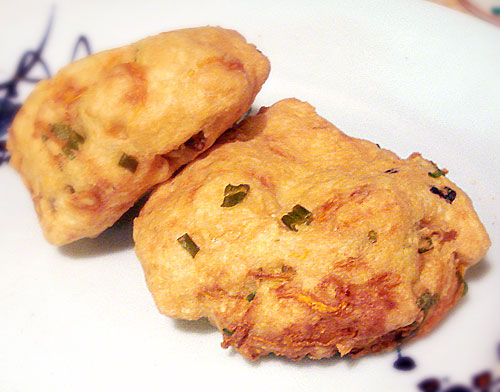 Ganmodoki or hiryouzu are small deep-fried fritters made of tofu and various ingredients. They are either eaten as-is or cooked in a broth. They are used as a meat substitute in sho-jin ryouri, vegan buddhist cuisine. (They are supposed to taste like deer meat, though they don't at all.)
Ganmodoki is sold pre-made in supermarkets, in the refrigerated section, and is usually eaten in an oden, a sort of stew of various fishcakes and such. But store bought ganmodoki, which has the texture of a sponge, is nothing like freshly made ganmodoki. Once you have tried a freshly made, piping hot ganmodoki, it's just about impossible to think about saving them for later.
I have tried baking these or pan-frying them instead of deep frying, but the texture just isn't the same. It just demands that crispy-crunchy delicate crust given by the oil. If it's any consolation, they don't really absorb much oil.
Yamaimo
One ingredient that gets omitted in a lot of English-language ganmodoki recipes is yamaimo, often called Japanese Yam. It is a root vegetable that is tremendously viscous in texture, sort of like the inside of an okra. It gives a sort of bouncy yet light texture to whatever it's added to. You can find fresh yamaimo in the produce section of Japanese grocery stores, cut into sections and wrapped in plastic. It's quite expensive but you usually only need a little bit of it, and keeps quite well in the refrigerator well as long as you re-wrap it in plastic to prevent the ends from oxidizing. The cut ends were traditionally dipped in some fine sawdust for storage. You may also be able to find yamaimo powder (Note to European readers - Japan Centre in the UK carries this). Regular grated potato can be used as a substitute if you can't find yamaimo - it gives a different texture but still adds that sort of bouncy quality. It has to be grated to a fine pulp, not into shreds.
The other ingredients
All the additions to ganmodoki are there to add texture, umami, or both. You can vary it quite a bit by adding things that capture your imagination. You can even turn it into a more Western-flavored item by adding things like green peas, finely chopped and cooked mushrooms, and so on, and eating them with a bit of Worcestershire sauce or even ketchup. However, to my mind the traditional Japanese flavor is the best.
Ganmodoki
- 400g / 10oz firm tofu, as fresh as possible
- 1 dried shiitake mushroom, reconstituted in water, squeezed dry, and finely chopped
- About 2 Tbs finely grated (into shreds) carrot
- 2 Tbs finely chopped green onion
- 3 Tbs. finely grated (to a pulp) yamaimo or potato
- 1 egg white or egg white substitute
- 1 tsp. salt
- 1 Tbs. corn or potato starch
- Oil for deep frying
Optional additions - choose one or several. I've listed them in the order I prefer them:
- 1 Tbs. canned or blanched gingko nuts, roughly chopped or whole if you have tiny ones
- 1 Tbs. dried sakura ebi (tiny little shrimp)
- 1 Tbs. boiled edamame beans (don't add both gingko and edamame, use one or the other)
- 1 Tbs. cooked hijiki
- 1-2 kikurage (tree-ear mushrooms), reconstituted in water, squeezed dry, and finely chopped (instead of the shiitake, or use 1/2 shiitake and 1/2 kikurage)
Dipping sauce: _karashi jo-yu_ (mustard soy sauce)
This step is very important and cannot be skipped to ensure your ganmodoki turn out properly. Drain the tofu, and wrap in a clean non-terrycloth kitchen towel. Place on a cutting board, then put another cutting board or similar flat item on top of the tofu. Place a weight on top (such as a small pan filled with water) and leave for about 15-20 minutes, to drain out some of the moisture from the tofu.
In the meantime, very briefly blanch the carrot in boiling water (about a minute).
If the tofu still feels a bit web, put the tofu in another cloth and squeeze very gently - you don't want the tofu to be totally dry, it should be the texture of small curd cottage cheese. Mash up the tofu with your hands or with a potato masher.
Mix all the ingredients with or without the optional additions in a bowl, until it's rather creamy.
Heat the oil to about 160°C / 320°F. Form the tofu mixture into small patties and fry 2-3 at a time (don't overcrowd the frying pot).
Drain well, and serve immediately with soy sauce and mustard (karashi jo-yu). They are also pretty good at room temperature, so are great for obento (pack with a soy sauce foil packet or wee plastic bottle).
Submitted by maki on 2007-02-21 14:49.
If you enjoyed this article, please consider becoming my patron via Patreon. ^_^
 Welcome to Just Hungry, where we serve authentic Japanese recipes and more! I'm






Comments
Jason Truesdell
21 February, 2007 - 20:35
Permalink
Yamaimo
Hi Maki, I think the imo cut into sections is actually nagaimo (it's long, so it's sometimes difficult to use the whole thing). The yamaimo I've seen in Japan are usually pretty small, and seem to need more effort to peel.
That being said, they can be used interchangeably; they have the same basic texture inside.
Hiromi's favorite ganmodoki is made with goma; I think it's served at a little organic restaurant in Chofu sometimes. I feel like the hijiki is sort of obligatory, but I think I'll try to make them with ginnan next time.
maki
21 February, 2007 - 23:03
Permalink
imo imo imo
Hmm interesting...two veggie naming controversies in one day :) I tend to think of the longish beige root as yamaimo (the one that makes tororo imo), though I'm not too clear if it's different from nagaimo, or indeed yamato imo. (I've heard people say yamato imo is a refined variety of yamaimo.) If by yamaimo you are referring to the small rounded or rather bulb shaped imo, I think of those as sato imo, which also has a rather viscous texture but is not the same, and is usually cooked rather than grated. The powder I have which is supposed to be a sort of instant tororo is called "yamaimo no kona".
(for people who don't know Japanese, 'imo' is the generic name for all kinds of potato-like roots. The 'regular' potato is jagaimo, sweet potato is satsumaimo.)
Lisa
21 February, 2007 - 21:25
Permalink
Oooo yum
This recipe is one I'll try. I'm always looking for new and different ways to make tofu. Thank you!
Lisa
21 February, 2007 - 21:28
Permalink
Yum!
This looks good. I'm always looking for new ways to make tofu. Thank you!
Jason Truesdell
22 February, 2007 - 22:00
Permalink
Yamaimo
I wonder if there are regional differences in what is called yamaimo. It might actually be a general name for mountain tubers.
Near Mitake-san, what I saw called yamaimo I've seen from roadside vegetable stands and supermarkets has a texture just like nagaimo, but it was small. I've never seen it outside Japan, except maybe in powder.
It's also possible that nagaimo is just a variety of yamaimo... If you cook nagaimo, as I did in the second photo on http://blog.jagaimo.com/archive/2006/04/22/2379.aspx, it retains a mostly crisp texture.
Satoimo is sticky (by which I mean neba-neba) but is not as watery as the yams (yamaimo, nagaimo), so satoimo can be boiled and retain a potato-like texture. I wouldn't usually serve satoimo raw, but I think some people in Okinawa do.
The yamaimo and nagaimo that I know are digestable when raw, and I only cook them on rare occasions (okonomiyaki, some kinds of dango, ganmodoki, and that dengaku dish I picture in the above link). I really like them sengiri with a little soy sauce and nori, maybe a little umeboshi.
maki
23 February, 2007 - 12:05
Permalink
the oracle
Well, according to the oracle (that is my mom) nagaimo and yamaimo can both be used in the same way. She thinks of yamaimo = yamatoimo. So for the purposes of this recipe either would work. (Either are fine cooked also, says the oracle) (There's also another imo called izoimo...to make things even more complicated)
I'm also wondering how similar it is to the yam used for poi in Hawaii now...but I guess I will need to go there to find out...
maki
23 February, 2007 - 12:08
Permalink
should also mention
Some people are allergic to raw yama/naga/yamato-imo, and can have an itchy skin reaction to it. I know people, e.g. my stepfather, who always get rather red and itchy around the lips when eating it grated and raw (tororo or yamakake) but eat it anyway because they love it. Sort of like eating fugu in the face of possible death, in a mild and itchy way. (But since it's cooked in the ganmodoki this shouldn't be an issue here.)
Jason Truesdell
27 February, 2007 - 23:05
Permalink
Poi
Poi comes from taro-imo, which seems most like a big satoimo.
Oliver Slay
22 April, 2009 - 00:55
Permalink
Re: Poi
Satoimo can be split into various types .. koimo is the smaller Satoimo .. Satoimo is a Taro / Eddo ... it is not technically a yam. It is a corm.
As a vegan, I'm a fan of Kanou Yumiko's books, Sai Sai Gohan .. and I have made a few of her satoimo recipes (Satoimo & Cashew Nut Blancmange, Satoimo Crepes and regularly use satoimo in her Oden recipe with shirataki and tofu)
I've just eaten a nagaimo pancake... simply made by making nagaimo tororo with a suri-oroshi (fine grater), adding salt and frying .. when browned add chopped naga negi and fold over... only takes a few minutes - served with nama shouyu.. tasty!
Yamatoimo, Yamaimo and the other one mentioned are all types of nagaimo...
It's also known as Chinese Mountain Yam, Korean Moutain Yam, Japanese Mountain Yam.
The nagaimo that I bought today from a Japanese shop in Swiss Cottage, London (at a good price too - about a third the price of nagaimo at the Japan Centre)... i was told they get it from France. It's not as long as I imagine a Nagaimo to be.. but definitely a variety of nagaimo.
brady banana
8 April, 2007 - 09:24
Permalink
heavenly tastiness
rice just seems to be one of those things my body knows how to digest having grown up eating it all of my life. so i was super thrilled to find this recipe since it's always exciting to find good protein packed recipes to go with my tasty bowl of rice. i've made it twice now for my meat eating friends and they've loved it too!
oh and on the ongoing yamaimo discrepancy debate, i went to our amazing japanese grocer here in Toronto and asked for it by name and they showed me a shrink wrapped portion of root vegetable that is long and cylindrical with skin like the outside of a yukon potato. it grates very viscously and makes my skin itchy if it stays against my skin for too long in its gooey, grated form.
thank you for posting these, i check the website everyday for inspiring ideas and for the charming commentary :)
Heather
11 August, 2007 - 22:13
Permalink
Firmness of tofu
Thank you so much for listing the firmness of the tofu required for this dish. I am fairly new at cooking with tofu so I am currently unable to divine such knowledge from a mere gander at the recipe. I've viewed several recipes and your's was the first to list the firmness. It was very helpful. Thanks again!
Pam
11 February, 2008 - 23:02
Permalink
My husband used to get these
My husband used to get these when he was studying Japanese in Berkeley, so I was really happy to find your recipe. So is he! I've made this twice now, and firm tofu (as opposed to extra firm) is much easier to work with. The second time I forgot to get the yamaimo, so I tried grated potato. The texture seems right, but potato can give a sort of tater tot flavor to it.
Thanks!
earthprincess
13 May, 2010 - 21:27
Permalink
Re: Ganmodoki or Hiryouzu: Japanese tofu fritters
Hi, just came across your site when I was searching for ramen noodles, now I'll tink twice about eating them alot. Would love to go to Japan and try it though. Love your site. Going to try this tofu recipe. I'm fasting right now so looking for some tofu options
maki
14 May, 2010 - 04:01
Permalink
Re: Ganmodoki or Hiryouzu: Japanese tofu fritters
Hi earthprincess - it's wonderful that you find my site useful! Just one thing though - you say you are fasting, but tofu is not exactly a zero calorie or even low-calorie product (unless I misunderstand what you mean by 'fasting'....)
Mommaholic
12 January, 2012 - 10:09
Permalink
Re: Ganmodoki or Hiryouzu: Japanese tofu fritters
Hi Maki, I love your website! Was looking for the ganmodoki recipe and was led to your page. Tried making it yesterday, but mine sank to the bottom of my pot, got stuck and kinda shrank/disintegrated in the hot oil. It didn't look pretty, but man, it was tasty!
maki
12 January, 2012 - 13:54
Permalink
Re: Ganmodoki or Hiryouzu: Japanese tofu fritters
I am guessing, but maybe you didn't drain the tofu well? It has to be de-moisturized (see the step in the recipe) in order for the ganmodoki to be moist yet light. (I've added an emphasis in the recipe now.) Glad they came out tasty in any case! ^_^
lg
18 November, 2013 - 18:10
Permalink
Re: Ganmodoki or Hiryouzu: Japanese tofu fritters
Hi, I'm going to try this recipe for my vegan husband. Any suggestions for substituting the egg? Thanks.