
Japanese Basics: SaShiSuSeSo
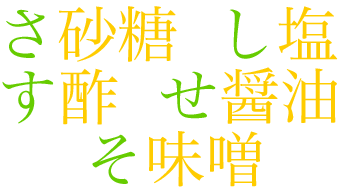
Top row: Sa (satoh=sugar), Shi (shio=salt); Middle row: Su (su=vinegar), Se (shoyu=soy sauce);
Bottom row: So (miso=fermented soy bean paste)
Besides dashi stock, the basic flavors of traditional Japanese cuisine are sugar, salt, soy vinegar, soy sauce and miso. While not many sauces uses all of these ingredients, many use at least 3.
The order in which these ingredients are used is quite important. Basically, the ingredients whose flavors are most susceptible to being changed by heat are added last = soy sauce, and miso. Sugar and salt are added first, and vinegar in between. The way we remember this is with Sa Shi Su Se So, which is the "s" row of the phonetic alphabets (hiragana and katakana) in Japanese.
There are regional variations in just how these ingredients are used. The refined Kyoto style of cuisine, which originated from the meals served at the emperor's court, tend to use avoid sugar, dark soy or strongly flavored miso. Tokyo (or Kanto, the name of the region where Tokyo is) style cuisine on the other hand is more strongly flavored. Since my family is from the Kanto region, most of the dishes I describe on this site are from the Tokyo style.
Submitted by maki on 2003-12-18 16:37.
If you enjoyed this article, please consider becoming my patron via Patreon. ^_^
 Welcome to Just Hungry, where we serve authentic Japanese recipes and more! I'm







Comments
Zelnox
18 December, 2003 - 18:10
Permalink
Japanese Basics: SaShiSuSeSo
Maki, you watch Iron Chef? ^_^
Alberto
18 December, 2003 - 23:42
Permalink
Japanese Basics: SaShiSuSeSo
Maki, maybe a silly question: what sugar is used in Japanese cooking? Is it the normal refined one you find in europe or more like the chinese "rock" sugar?
maki
19 December, 2003 - 02:23
Permalink
Japanese Basics: SaShiSuSeSo
Zelnox, I love Iron Chef! I think I have almost all the episodes that aired on the Food Network in the US on tape.
Alberto, the most commonly used sugar in Japanese cooking is a white refined sugar called "san-on-toh"...meaning three-temperature sugar. It's supposed to dissolve easily at various temperatures, and is a bit finer than granulated sugar. Rock sugar is only used when making some preserves or cordials (like home made plum wine). Soft brown sugar is used often too.
Mei Ying
30 March, 2008 - 13:38
Permalink
uhm... not really related to food but~
Uhm Maki, why 醤油 is shortened as 'se'? i don't see any se in shouyu... or perhaps it's the hidden meaning in the kanji?
Thanks before ;)
maki
31 March, 2008 - 09:51
Permalink
The best explanation I have
The best explanation I have seen for the 'se' is that shoyu can also be written 正油、and that it used to be read in 'old japanese' as sei-yu. Besides, I guess if it was shi it would be confused with shio (salt) in the mnemonic. :)
marnen
24 August, 2011 - 16:42
Permalink
Re: The best explanation I have
I feel strange explaining Japanese spelling issues to a native speaker. Maki, if I got anything wrong, feel free to rip me apart mercilessly. :)
Up until WWII or so, Japanese kana usage was less regular than today, and more etymologically based, especially for words of Chinese origin. So shō could be written しよう ("shiyou", as in modern usage except that the よ (yo) isn't written small), but might also be written しやう ("shiyau"), せう ("seu"), or せふ ("sefu"), largely depending on Chinese etymology. If I understand the Japanese Wikipedia articles on sashisuseso and shōyu correctly, the proper older spelling for shōyu is actually しやうゆ ("shiyauyu"), but somehow せうゆ ("seuyu") became common and found its way into sashisuseso. This is at the limit of my Japanese reading skills, but I gather that this may have something to do with 正油 being used as ateji for shōyu instead of the standard 醤油 (is 正 shō spelled せう in historical usage?).
Hope this is useful!
Matt
7 April, 2012 - 16:10
Permalink
Re: The best explanation I have
I can't comment on the specific case of the sashisusego, but the above comment about classical kana usage (歴史的仮名遣い) is mostly correct. In classical Japanese the modern [yô] was written as either [eu] or [efu]. For example what is nowadays read as "kyô" (today) was written as "kefu" back then, or more relevant to the above case "shôshin" (small stature) was written as "seushin".
As the sashisuseso is quite old the above explanation makes sense. :)
Noel Southall
12 October, 2009 - 07:20
Permalink
The sake and mirin spanner in the mnemonic's works
Hi Maki,
I am familiar with the さしすせそ rule but where do sake and mirin fit into all this? All recipes that I have use at least one of these two if not both. As fundamental ingredients, I thought they would have made it into the mnemonic.
At a guess, sake would go in quite early as it neutralises the odour of meat and fish. Mirin is a pain as it has no sa shi su se or so in its name! This, I guess would go in quite early too as it has a high quantity of sugar in it.
Can anyone shed any light on this?
maki
12 October, 2009 - 13:26
Permalink
Re: The sake and mirin spanner in the mnemonic's works
Some variations of sa shi su se so make 'sa' to mean 'sake'. Anything with alcohol in it is used as an underlying flavor or to get rid of meat/fish odor, so it's usually added at the start. Besides, mirin in particular is added for sweetness as much as anything else, so it's added at the top. On the other hand, non-alcoholic mirin seasoning is added near the end.