
Produce: Mushrooms, on the wild side
One crisp day in the fall when I was about 12, my cousins and I went for a foraging hike in the forests of the Okuchichibu mountains with our Aunt Naoko. (Relatives of another aunt had a farm there.) We were looking for wild rakkyou (a kind of wild onion), fuki (coltsfoot), and whatever wild mushrooms we could find. We found plenty of rakkyou, but had no luck with mushrooms, until we suddenly came upon a clearing full of brown caps. They were big, luscious shiitake mushrooms, growing on rotted logs.
"Wow, can this be real?" we asked ourselves. "Is this really wild? Doesn't it belong to someone?" I don't know why the fact that they were growing on sawed logs didn't tip us off, but somehow we assumed - Aunt Naoko as well as us kids - that they were wild, and proceeded to pick more than half of them.
Later on, the relatives at whose farm we were staying got an angry phone call from a neighbor. Those shiitake were indeed being farmed. Oops. I think my aunt settled it by paying for what we'd picked...it couldn't have been cheap, because the four of us came away from that clearing with a big bag full each. They were sure delicious though!
I'm not sure if the memory of that afternoon is why I love mushrooms so much. When I say wild mushrooms, I'm talking about mushrooms that are not the old, boring white button mushrooms, even though some of the 'wild' mushrooms are cultivated, especially shiitake. Some of the mushrooms you'll see at the markets right now are gathered wild - fall is the perfect time for them, when the weather turns cool and moist.
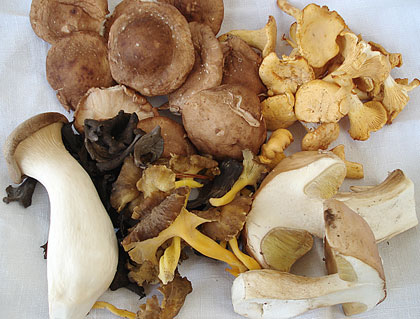
There many different kinds of mushrooms, and the variety depends on where you live. The photo here is a sampling of the mushrooms available at the "mushroom man" stall at the Wednesday market in the Zürich main station. You may recognize the brown capped shiitake (top left) and bright yellow chanterelles (top right). The big sliced ones in the bottom right are wild porcini, called Steinpilz here, and the big, white one on the left is an oyster mushroom or Krauterseitling (pleurotus eryngii). In the middle is a mixture of thin, delicate mushrooms that are just called wild mushrooms. They are similar to the chanterelles in texture.
The method of cooking depends on the texture of the mushroom. Meaty, substantial mushrooms like mature porcini or the gigantic 'puffs' you can get in some places can stand up to grilling and frying, but delicate chanterelles will fall apart if you cook them too long. If you're doing a mixed mushroom dish, start cooking the meatier varieties before the thinner ones, or slice them thinly. Instead of slicing mushrooms, it can also be fun to just shred them apart with your hands.
I like to cook mushrooms in two ways: Japanese, and European. With Japanese methods you don't add any fat. European methods usually require quite a lot of butter or oil, but it's worth it of course. The better or more fragrant the mushroom, the simpler the method used to prepare them.
Cleaning mushrooms
Ideally you do not want to wash mushrooms at all, and do not ever soak them. If you must wash them, do so under running water, and immediately dry them off. The more delicate the mushroom, the more they will be damaged by water-washing.
I like to clean them gently with a moist and well-wrung out kitchen towel, and I cut off any impossibly dirty bits, like the root end of maitake mushrooms.
Mushroom foraging
Don't, unless you really know what you are doing. Many mushroom picking courses are offered around this time of year, and can be great fun (though dress warmly - you will get very cold).
Recipes
Some of my favorite mushroom recipes are already on the site:
- Mushroom rice, or kinoko takikomi gohan - mushrooms are marinated briefly then cooked with rice. Fat free! (ok, you get some calories from the rice.) We tried this recently with spelt instead of rice, and it was really good.
- Mushroom lemon soup - made with wild mushrooms, this is much better than the version with button mushrooms.
- Melange of mushrooms soup - A lot of cream in this, and totally worth it.
Mushroom pasta
This is a very simple recipe, but that's really the best way to enjoy mushrooms when they are at their best. The subtle sourness of the crême fraiche really accentuates the mushroom flavor. You can add some freshly grated Parmesano if you want, but try it without first.
If you can afford it, try this just with chanterelles.
- 1 pack fresh fettucine (8 oz or 225g)
- 10 oz / 250g (or so) wild mushrooms, ideally chanterelles
- 1 tsp fresh thyme leaves, or dried thyme
- 2 cloves garlic
- 2 Tbs. unsalted butter
- 3 Tbs. crême fraiche
- Salt and pepper
Start boiling the water for your fresh pasta.
Finely slice the garlic. Start sautéing them in the butter in a pan, until they turn tender.
Clean and slice or rip apart your chosen mushrooms.
When the water has come to a full boil, toss the mushrooms into the pan, toss rapidly over high heat, until it all starts to wilt and brown and emanate a wonderful smell. Add the thyme, and the crême fraiche. Season with salt and pepper.
In the meantime, put the fresh pasta in the boiling water - it should cook in a couple of minutes.
Drain (a little moisture should still be clinging to the noodles), and add to the pan with the mushrooms. Toss well and serve immediately.
Submitted by maki on 2006-10-04 16:57.
If you enjoyed this article, please consider becoming my patron via Patreon. ^_^
 Welcome to Just Hungry, where we serve authentic Japanese recipes and more! I'm






Comments
kelsey xiong
10 September, 2008 - 09:14
Permalink
Delivery place: Chengdu
Delivery place: Chengdu Airport, Shichuan, China Transfer airport: Amsterdam Destination: European airports Unit:EUR/KG
Name of products Specification Packing Delivery time Qty. / Year Reference prices ( EUR)
FOB Chengdu airport CNF European main airports
Truffles Fresh truffles Grade M: 2-4cm 1. Clean inner vacuum bag, 1kg/ bag, 10-20kg to a carton.
2. 10-20kg / plastic basket Each year, from Oct. to March of next year. 50—100MT EUR 30-35/kg EUR 35-40/kg
Grade L: 4-6cm EUR 35-40/kg EUR 40-45/kg
Grade LL: Over 6cm EUR 38-43/kg EUR 43-48/kg
Dried slice
truffles Thickness: 25mm
Including: Peeled, with
skin, light color, dark color. Inner plastic bag, 10kg / Carton. All year 20—50MT EUR 38-43/kg EUR 43-48/kg
Frozen truffles Grade M: Below 3cm Inner foam box, ice bag,
10kg / Carton All year 50—100MT EUR 31-36/kg EUR 36-41/kg
Grade L: 3-6cm EUR 37-42/kg EUR 42-47/kg
Grade LL: Over 6cm EUR 39-44/kg EUR 44-49/kg
Trichotoma
matsutake Fresh Grade 1: Over 5cm
Its cap hasn.t been opened Inner foam box, ice bag,
8-12kg / Carton Each year, from July to Nov. 20—60MT EUR 30—40/kg EUR 35—45/kg
Grade 2: Over 5cm
Its can is half opened EUR 30—38/kg EUR 35—43/kg
Grade 3: Over 5cm
Its cap is whole opened. EUR 25—30/kg EUR30—35/kg
Salted Grade 1: Over 5cm
Its cap hasn.t been opened Plastic barrel, 50kg / barrel All year 50—100MT EUR 25.1/kg EUR 30.1/kg
Grade 2: Over 5cm
Its can is half opened EUR 22.1/kg EUR 27.1/kg
Grade 3: Over 5cm
Its cap is whole opened. EUR 18.1/kg EUR 23.1/kg
Dried Mixed, no rotten, no.dark point, no insect. Inner plastic bag, 10kg / Carton. All year 5—10MT EUR 63.19/kg EUR 68.19/kg
Cantharellus
cibarius Salted 2-4cm Plastic barrel, 50kg/ barrel with inner bag. All year 20—50MT EUR 8.1/kg EUR 13.1/kg
4-7cm EUR 9.1/kg EUR 14.1/kg
dried Length of stem and cap: 2-5cm Inner plastic bag, 12kg / Carton. All year 5—10MT EUR 30/kg EUR 35/kg
Frozen 2-4cm Inner foam box, ice bag,
10kg / Carton All year 20—50MT EUR 8./kg EUR 13./kg
4-7cm` EUR 9./kg EUR 14./kg
Morels
mushroom Fresh Cap length: 1-3cm
Remove mud feet 1kg / Inner foam box, ice bag, 8kg / Carton Each year, from Feb. to July. 20—50MT EUR 22/kg EUR 27/kg
Cap length: 3-5cm
Remove mud feet EUR 23/kg EUR 28/kg
Cap length: Over 5cm
Remove mud feet EUR 24/kg EUR 29/kg
Dried Cap length: 2-7cm;
Stem length: Over 2cm; Inner plastic bag, 12kg /
Carton All year 5—10MT EUR 210/kg EUR 215/kg
Cap length: 2-7cm without stem. EUR 230/kg EUR 235/kg
Frozen Cap length: 2-7cm;
Stem length: Over 2cm Inner foam box, ice bag,
10kg / Carton All year 20—40MT EUR 24.2/kg EUR 24.7/kg
Boletus
edulis Dried Grade A: 3-7cm (Whole) Inner plastic bag, 12kg /
Carton All year 5—10MT EUR 45/kg EUR 50/kg
Grade B: 2-5cm EUR 42/kg EUR 47/kg
Salted Grade A: Whole Plastic barrel, 50kg / Carton All year 30—50MT EUR 5/kg EUR 10/kg
Grade B: Some cap or
stem are not complete EUR 4.5/kg EUR 9.5/kg
Frozen Grade A: Whole Inner foam box, ice bag,
10kg / Carton
All year 10—20MT EUR 6.5/kg EUR 11.5/kg
Grade B: 3-7cm
It is not complete. EUR 6/kg EUR 11/kg
Agaricus Salted 1-2cm Plastic barrel, 50kg / Carton All year 40—60MT EUR 2.3/kg EUR 7.3/kg
2-3cm EUR 2.7/kg EUR 7.7/kg
Boletus
Ornatipes
peck Dried No mud foot, film and
dark point Inner plastic bag, 12kg / Carton All year 10MT EUR 25/kg EUR 30/kg
Salted 3-8cm whole, no insect
foot. Plastic barrel, 50kg / Carton All year 20—50MT EUR 2.5/kg EUR 7.5/kg
Catathelasma
imperiale Salted Over 4-8cm; Whole, Cap isn’t opened Plastic barrel, 50kg / Barrel All year 50—100MT EUR 3/kg EUR 8/kg
Sarcodon
imbricatus Dried 5-12cm Inner plastic bag, 12kg /
Carton All year 10—20MT EUR 35/kg EUR 40/kg
Salted 4-18cm Plastic barrel, 50kg / Barrel All year 20—50MT EUR 4/kg EUR 9/kg
maki
10 September, 2008 - 14:40
Permalink
...
eh....whut?
(I was going to just delete this but it doesn't have any links and...it's just odd, so I'm going to leave it. So...anyone missing a mushroom shipment in Amsterdam? ;)
David
9 July, 2009 - 06:06
Permalink
Re: Produce: Mushrooms, on the wild side
please send me some info about how to produce mushroom.
i really apreciate if you send some picture or video
best regards David