
The choices we make
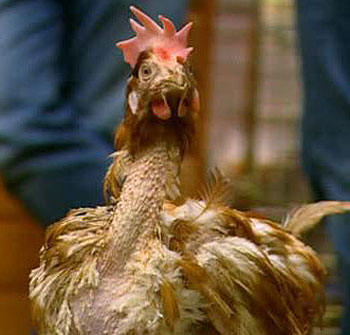
I don't usually talk about this kind of topic here, but this is something very close to my heart. The picture above is that of a battery chicken. It's a screenshot taken from a series running on the BBC called Jimmy's Farm. It's about Jimmy Doherty, an ex-City worker who now running an organic farm in Essex. One of the things Jimmy does is to buy battery chicken rejects - chickens that have been bearing eggs in egg factories, aka batteries, and have started to slow down. Most of the eggs the so-called advanced world consumes comes from such batteries.
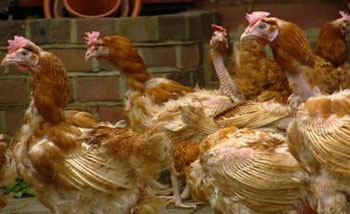
Battery chickens are kept in tiny cages in huge assembly lines, and are artifically induced with lighting and other methods to lay as many eggs as they can. It's all perfectly legal in most countries, and it's how eggs can be produced cheaply. When the chickens become less productive, they are usually "disposed" of, unless they are rescued.
I am not the most political person in the world - the exact opposite, in fact. I may be too much of a cynic to put much belief into standard political systems. I'm not even that much of an animal lover. I have toyed with being a vegetarian, but I love meat and poultry and fish and dairy products too much to give it all up.
I do, however, believe in the power of consumers to influence the way in which the companies who produce the goods and services we consume behave. There is a lady in our neighborhood who rescues spent egg farm chickens (although intensive battery production is illegal in Switzerland) and nurtures them in her small back garden. They contentedly produce a the few eggs she needs for her family, until they live out their natural lives. I can't make that kind of commitment myself, because I'm away from home too long due to my work. The only thing I can do is to buy only free-range eggs, from a small local farm where I can almost touch the chickens.
These "happy" eggs are expensive, especially so in Switzerland. They cost 60 Rappen (.60 CHF), or about $0.50 US each. A dozen costs about US $6. That's a lot more expensive than normal supermarket eggs. They are worth every penny (or Rappen) though, not only because they taste so good, but because of where they come from and how they are produced.
I know I am pretty privileged in that we make a comfortable living. I don't have a large family to feed either. Organically produced meats and eggs and vegetables do tend to cost a bit more, though you do save on transportation costs if you buy locally. But if I spend more on my raw food, I try to make up for it by buying less expensive convenience food, and eating out at restaurants a little less. One cup of espresso makes up the difference between my "happy" eggs and ordinary ones. It's getting easier all over the place with the great boon in local green markets to buy small-production, organically produced food. And while I'm voting with my money not to support inhumane ways of producing foodstuffs, I'm getting a great flavor benefit out of it too.
Link: The Essex Pig Company, aka Jimmy's Farm. I plan to visit there the next time I'm in England.
Submitted by maki on 2006-03-09 15:02.
If you enjoyed this article, please consider becoming my patron via Patreon. ^_^
 Welcome to Just Hungry, where we serve authentic Japanese recipes and more! I'm









Comments
Hanna
10 March, 2006 - 02:48
Permalink
The choices we make
And that is where Japan seems somehow behind. I don't know where to find organic food, though I do see free range eggs in my coop supermarket. Do you have any ideas on where I should look in Kyoto?
Pim
10 March, 2006 - 04:25
Permalink
The choices we make
Great post Maki. I absolutely agree with you.
cheers,
Pim
maki
10 March, 2006 - 07:18
Permalink
The choices we make
Thank you for your comments Pim :)
Hanna, "muno-yaku" (no-chemical) is very popular in Japan. Lemme try to find your email addy so we can talk about specific sources...
Matthias
10 March, 2006 - 09:36
Permalink
The choices we make
I was actually "positively" surprised, when I saw those chicken on the telly. Not that I liked the state they were in, but I thought battery chickens would look even worse...
Some of the best free range eggs here in England seem to be the ones from Lidl, they definitely taste much better and less like battery chicken eggs than the ones in most expensive supermarkets (Sainsbury, ..). Locally produced? Certainly not, those Lidl eggs come from the Netherlands :O
cyrell
29 December, 2009 - 22:46
Permalink
Re: The choices we make
Often they do look worse...these pictures are better then most chicken i see.
But their outer appearance does not tell you anything about the inner damage.
The chickens are so confused when you take them out of the cage they do not even know how whole grains look, nor how to eat them.
You have to keep them in a heated stable to keep them warm and carry them to the food and water bowels and feed them the same meal they get in the battery cages so they will not starve.
Many chickens die in this stage,also because their body has too much eggs stores inside and you have to be carefull and watch the chicken if they lay.
If they do not eat enough, do not drink enough or feel to cold it can happen that their body refuses to lay the eggs and they will die of the hindered birth of the egg.
Every egg they lay is a birth similiar to the one of mamael..if the baby does not come out in time,the mother dies...if the chicken can not lay the egg, the chicken dies, painful and poisoned from the eggs inside.
It needs often weeks, or months for the chickens to relearn how to be a normal chicken. Some even have great fear to walk on grass and straw..by good..they look at the straw and stare and stare like hypnotize because they are so puzzled..it is soft and does not stink and...it is something they have never seen.
And most birds also have terrible pains because of debeaking..the beak is so sensitive they sense where in the earth a worm is..how exactly no one knows..but the beak is as sensitive as lips or fingertips.
Many fresh hatched chicken die after debeaking because the pain is so great and they can not eat and drink properly.
And also many chicken die during their time in the cage.
A battery chick is worth 6 cent in germany after its time in the cage.
It is not even worth enough for the farmer to transport them to the slaughterhouse...they kill the chicken by suffocating them in gas chambers or even throwing them in a wood chopper..alive...
And who cares? There is no one who would controll what the farms do with the used chicks.
Only the farms near a slaughterhouse which takes chickens do sell them there, or the transport would cost more than the chickens earn the farmer.
And then you have them in your chicken soup or casseroll, hot pot..or as healthy chicken sausage....
No wonder these chickens are so ill after one year laying...because they have to lay in one year as much eggs as a wild hen would lay in her whole life..of 15 years.
If a parrot would lay an egg every day the owner and the vet would turn hysteric because it is a great danger to the health of the animal...but with a worthless chicken, who cares that it will deplete their bones of calcium and cause osteoporosis, damage to the internal organs and all the things
maki
11 March, 2006 - 00:35
Permalink
The choices we make
Matthias, I had never seen battery hens before so the images really upset me: the bare skin, the feathers molting off as the hens staggered around... :( It was great to see gaining strength quite rapidly though.
C(h)ristine
14 March, 2006 - 06:07
Permalink
The choices we make
thanks for posting this--it's always good to be aware of our responsibility as consumers and foodies...!